
 Worksheets
Plates Tectonics Review
Total questions: 48
Worksheet time: 4hrs 0mins
Mountains form from....
tectonic plates sliding past one another.
collision of tectonic plates.
tectonic plates moving away from each other.
tectonic plates disappearing.
Plate movement is caused by _____
the rotation of the earth.
ocean tides.
convection currents in the mantle.
the moon's gravity.

The image represents this type of boundary:
Divergent
Transform
Convergent
Subduction

This is the driving force behind the movement of tectonic plates.
mantle convection currents
oceanic convection currents
atmospheric convection currents
solar convection currents


A land feature that is produced at a convergent boundary is:
a rift valley.
an ocean.
a mid-ocean ridge.
a volcano.
Which type of plate boundary would cause mountains to form:
Transform
Convergent
Divergent
Reform
What is the name of the area where one crust slides underneath another?
transform zone
subduction zone
divergent zone
continental zone

Name the boundary:
convergent
transform
divergent
subduction

Younger crust being found near mid-ocean ridges supports the idea of Plate Tectonics because---
this indicates that new crust is being formed over time, pushing old crust outward.
this indicates that volcanoes are able to take place in different places on the Earth.
this indicates that new crust is never formed.
this indicates that the continents are stationary.
Which of the following is NOT evidence to support the theory of plate tectonics?
fossil correlation
continental fit
glacial striations
sand erosion

At first, a lack of evidence for continental drift prevented many scientists from believing a single supercontinent called _________ existed.
Persepolis
Pangaea
Shangri-la
Utopia
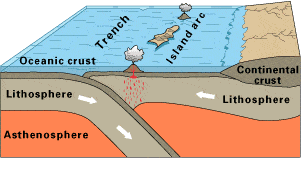
Observe this diagram of a plate boundary. One statement BEST describes what is happening:
the oceanic crust is melting.
the denser ceanic crust is subducting under the less dense oceanic crust
volcanic islands are forming.
the tectonic plates are moving away from each other.
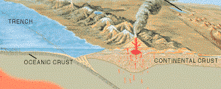
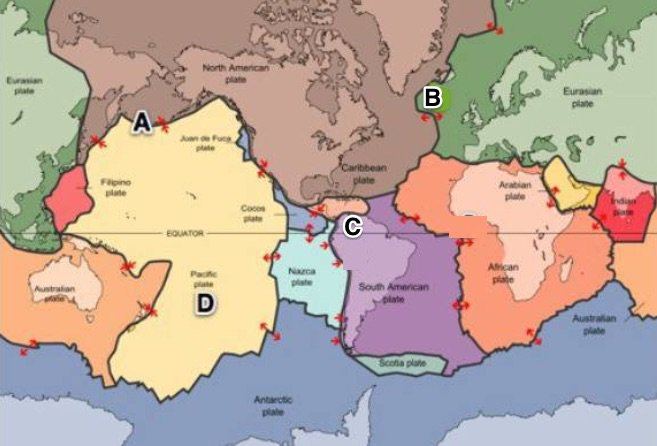
Where would sea floor spreading most likely occur?
At convergent boundaries (oceanic vs. oceanic)
At convergent boundaries (oceanic vs. continental)
At divergent plate boundaries (oceanic vs. oceanic)
At transform plate boundaries
Oceanic crust is.....
younger and less dense than continental crust.
thinner, younger, and more dense than continental crust.
older, thicker, and less dense than continental crust.
bigger and younger than continental crust.
Earth's plates are....
constantly moving and changing the face of the Earth.
never moving, but are fixed in place.
hardly ever moving, but move fast when they do.
moving, but it has little effect on Earth's surface.
At subduction zones, __________ are formed.
mountains
island arcs
rift valleys
volcanoes
What are mid-ocean ridges?
chains of underwater falls
chains of underwater volcanoes
chains of underwater mountains
Chains of underwater rocks
A subduction zone is formed....
when one tectonic plate sinks below another.
at all plate boundaries.
when plates diverge.
at transform boundaries.
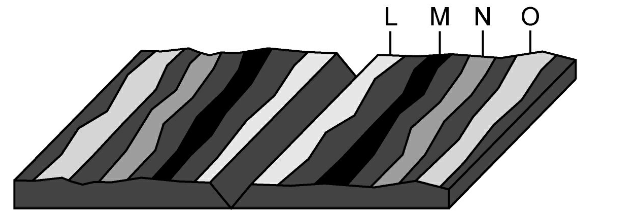
How is it possible for new crust to be formed without increasing the surface area of the Earth?
Crust is destroyed at the same time it is created.
New crust is underwater where it sinks.
New crust breaks more easily than old crust.

Volcanoes are found...
on land.
under water.
on islands.
all of the above.
Hotspots are volcanoes that form...
at convergent plate boundaries.
at divergent plate boundaries.
at transform plate boundaries.
in the middle of a tectonic plate.
Hotspots form because...
magma is pushed to the surface at a plate boundary.
a mantle plume weakens Earth's crust.
water is pushed up to Earth's surface
a mantle plume strengthens Earth's crust.
Magma under a hotspot melts Earth's crust because...
it is hotter than the surrounding magma.
it is cooler than the surrounding magma.
it does affect Earth's crust.
none of the above.

This image shows the hawaiian island change. Hawaii is currently the tallest island and is still an active volcano. Based on the map chose the answer that best explains the age of the islands.
The further the islands are from Hawaii the younger the island is.
Hawaii is the youngest island because it is currently on top of the hotspot.
Hawaii is the oldest island because it is closest to the hotspot.
Ohau is younger than the big island because it is further from the hot spot.
lithosphere?


What must be present to form a geyser?
intense heat
water
an underground 'plumbing' system
All of the above are necessary.
What geologic feature is categorized as either a 'black smoker' or a 'white smoker'?
Geysers
Hotspots
Ocean Vents
Hot Springs
Subduction, trenches, and volcanoes are associated with _____________ boundaries.
convergent
divergent
transform
intra-plate

