wayground logo

Free Printable Worksheets

Font size

S
M
L
XL
Worksheets

Cellular Division

Total questions: 127

Worksheet time: 2hrs 16mins

Name
Class
Date
1.

Which of the following comparisons of Mitosis to Meiosis I is NOT correct for animal cells?

a)

no chromosome pairing<---->homologous chromosomes pair

b)

homologous chromosomes at equator<---->sister chromosomes at equator

c)

sister chromatids separate<---->homologous chromosomes separate

d)

chromosomes have one chromatid at telophase<---->chromosomes have two sister chromatids at telophase

2.

In order for the human diploid number of 46 to be maintained through generations, which of the following must occur?

a)

Chromosomes replicate prior to the cell cycle.

b)

Replication occurs prior to mitosis to produce gametes and fertilization restores the diploid number.

c)

Sister chromatids form in the G1 phase of the mitotic cell cycle.

d)

Sister chromatids are formed prior to mitosis.

3.

During ______ , a spindle appears while the nuclear envelope fragments and the nucleolus disappears. Only one set of sister chromosomes from each pair of homologous chromosomes is present.

a)

prophase I

b)

prophase II

c)

telophase I

d)

telophase II

4.

Which of the following statements is NOT correct when cells undergo meiosis?

a)

Meiosis ensures that the chromosome number remains constant generation after generation

b)

Meiosis ensures that each generation has a different genetic makeup than the previous one

c)

Meiosis ensures that each newly formed daughter cell receives the same number and kinds of chromosomes

d)

Meiosis occurs in the production of egg and sperm cells in animals.

5.

Cytokinesis begins during this stage of mitosis.

a)

interphase

b)

prophase

c)

anaphase

d)

telophase

6.

Identify the stage of mitosis shown in the image

a)

telophase

b)

anaphase

c)

metaphase

d)

cytophase

7.

Identify the stage of mitosis shown in the image above.

a)

telophase

b)

anaphase

c)

prophase

d)

cytophase

8.

Which statement is correct about the cells produced by mitosis?

a)

Two daughter cells are produced, each has the same number of chromosomes as the parent cells

b)

Four daughter cells are produced, each has the same number of chromosomes as the parent cells

c)

Two daughter cells are produced, each has half the number of chromosomes as the parent cells

d)

Two daughter cells are produced, each containing the same number of chromosomes as what they had at the start of G2

9.

Which choice best describes the cell cycle?

a)

Cells grow and develop during interphase. Cells reproduce during the mitotic phase.

b)

Cells grow and develop during the mitotic phase. Cells reproduce during interphase.

c)

The nucleus of a cell divides during interphase. The cytoplasm of a cell divides during the mitotic phase.

d)

The nucleus of a cell divides during the mitotic phase. The cytoplasm of a cell divides interphase.

10.

Why is the synthesis stage called this?

a)

because protein synthesis is taking place

b)

because DNA synthesis is taking place

c)

because it combines several smaller stages into one

d)

because the chromosomes come together

11.

In the figure, which set of chromatids illustrates the result of a single crossover of the homologous

chromosomes?

a)

A

b)

B

c)

C

d)

D

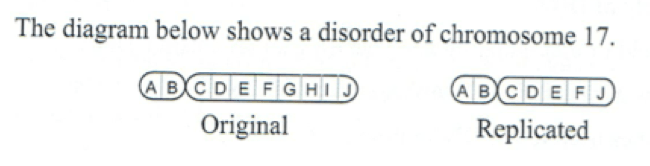
12.
Which of the following is NOT an example of mitosis?
a)
Growth
b)
Repai of damaged cells
c)
Replacement of dead cells
d)
Reproducing
13.
How many daughter cells are produced in mitosis?
a)
4 new cells
b)
2 new cells
c)
One new cell
d)
none of these
14.
How many daughter cells are produced in meiosis?
a)
4 daughter cells
b)
none of these
c)
3
d)
1
15.
When an area of a chromatid is exchanged with the matching area on a chromatid of its homologous chromosome, _________________ occurs
a)
crossing over
b)
mutagenesis
c)
hybridization
d)
fertilization
16.
The end of meiosis results in  ________ to each other.
a)
2 cells that are identical
b)
4 cells that are identical
c)
2 cells that are not identical
d)
4 cells that are not identical
17.
The first stage of the cell cycle during which the cell matures and prepares to divide and copies its DNA; The stage the cell stays in the most
a)
interphase
b)
prophase
c)
metaphase
d)
anaphase
18.
Which structure(s) are considered to be haploid cells?
a)
Sperm only
b)
Egg only
c)
Zygote only
d)
Both Sperm and Egg
19.
Attaches the two identical sister chromatids to form a chromosome.
a)
Chromatin
b)
Chromosomes
c)
Sister Chromatid
d)
Centromere
20.
Which events occur during anaphase I of meoisis?
a)
separation of sister chromatids
b)
separation of homologous pairs
c)
lining up of sister chromatids
d)
lining up of homologous pairs
21.
If an organism has a diploid number of 24, then the haploid number must be...
a)
24
b)
16
c)
12
d)
8
22.
Each chromosome contains two identical parts called
a)
Chromatin
b)
Chromosome
c)
Sister Chromatid
d)
centromere
23.
In which phase of mitosis is the cell?
a)
Prophase
b)
Metaphase
c)
Anaphase
d)
Telophase
24.
Which process and type of resulting cells are represented?
a)
mitosis, gametes
b)
mitosis, body cells
c)
meiosis, gametes
d)
meiosis, body cells
25.
Is the following cell diploid or haploid?
a)
Diploid
b)
Haploid
26.
What phase is represented?
a)
metaphase 1
b)
metaphase 2
c)
anaphase 1
d)
anaphase 2
27.
What is one of the advantages, why is it better to reproduce sexually versus asexually?
a)
survival of the fittest
b)
overproduction
c)
genetic variation
d)
cloning
28.
Body cells may produce additional body cells by means of _________. Organisms that reproduce sexually produce gametes by means of the process of _________.(DOK2). 
a)
mitosis; meiosis
b)
meiosis; mitosis
c)
mitosis; conjugation
d)
meiosis; gametogenesis
29.
The organism shown in the drawing below usually reproduces through the __________ process called binary fission.
a)
asexual
b)
heterosexual
c)
isosexual
d)
sexual
30.
Sea stars (starfish) can reproduce asexually by fragmentation if their arms are cut off, or sexually by releasing sperm and eggs into the water. Which of these is the major difference between asexual and sexual reproduction in sea stars? 
a)
The chromosome number is reduced in sea stars during sexual reproduction. 
b)
The number of chromosomes is increased in sea stars during sexual reproduction.
c)
 The appearance of the sea stars is changed as a result of asexual reproduction.
d)
There is no genetic variation in the sea stars as a result of asexual reproduction.
31.
Arrange the stages of mitosis shown in the diagram above in sequential order. Use the numbers on the image to indicate the order. Hint: Do not use 3,  because those cells are in interphase. (DOK2)
a)
1 2 3 4 5
b)
4 5 2 1 
c)
2  1 5 4
d)
1 2 5 4
32.
This picture shows which process?
a)
mitosis
b)
meiosis
c)
the cell cycle
d)
binary fission
33.

#1 is referring to

a)

sister chromatid

b)

chromatid

c)

centromere

d)

tetrad

34.

the entire structure is called a

a)

sister chromatid

b)

chromatid

c)

centromere

d)

tetrad

35.

#2

a)

sister chromatid

b)

chromatid

c)

centromere

d)

tetrad

36.

What process creates the above chromosome

a)

Synapsis

b)

Crossing Over

c)

DNA Replication

d)

Homologous Chromosomes

37.

phase of meiosis

a)

Metaphase 2

b)

Interphase

c)

Prophase 1

d)

Prophase 2

38.

what process had to happen to creates the pairing of homologous chromosomes

a)

DNA replication

b)

Crossing Over

c)

Synapsis

d)

Nucleus Disappears

39.

organelle duplication

a)

G1

b)

S phase

c)

G2

d)

Mitosis

40.

DNA replication

a)

G1

b)

S phase

c)

G2

d)

Mitosis

41.

what creates the spindle fibers

a)

centinals

b)

centrioles

c)

microtubules

d)

nothing

42.

uncontrolled cell growth is called

a)

repair

b)

growth spurt

c)

meisosi

d)

cancer

43.

oogenesis takes place in the

a)

ovaries

b)

prostate

c)

bladder

d)

cervix

44.

spermatogenesis takes place in the

a)

ovaries

b)

prostate

c)

testes

d)

cervix

45.

unequal division resulting in 3 small unviable cell and one large viable cell is called

a)

spermatogenesis

b)

oogenesis

46.
When does crossing over occur?
a)
Interphase
b)
Prophase 1
c)
Prophase 2
d)
Metaphase 1
47.
When homologous chromosomes match up, they form a structure call a ___________.
a)
tetrad
b)
triad
c)
diploid
d)
gamete
48.
What phase is  shown in the picture?
a)
anaphase 1
b)
anaphase 2
c)
metaphase 1
d)
telophase 1
49.

Two processes that increase genetic variation during meiosis are crossing over and _____

a)

Synapsis

b)

Tetrad

c)

Independent assortment

d)

Gameiosis

50.

What is one of the advantages of reproducing sexually versus asexually?

a)

underproduction of offspring

b)

overproduction of offspring

c)

genetic variation

d)

artificial selection

51.
Identify the phase.
a)
Telophase I
b)
Telophase II
c)
Metaphase I
d)
Metaphase II
52.

Haploid cells are represented by

a)

2n

b)

n

c)

1/2 n

d)

4n

53.

The organelle located within centrosome region of animal cells; aids in spindle fiber formation

a)

Chromatid

b)

Centriole

c)

Centromere

d)

Centrosome

54.
A male shark has 40 chromosomes in each of its sperm. How many would be present in its body cells?
a)
20
b)
40
c)
80
d)
160
55.
Fruit fly body cells have 8 chromosomes. After mitosis, you would expect a resulting fruit fly daughter cell to have ...
a)
16 chromosomes.
b)
46 chromosomes.
c)
8 chromosomes.
d)
4 chromosomes.
56.
Why would it be important to replicate DNA before a cell divides in mitosis or meiosis?
a)
In order for genetic information to be transferred into daughter cells.
b)
In order for the cell to be able to increase in size.
c)
In order for the DNA to be contained in the nucleus.
d)
In order for the cell to re-order the DNA sequencing in the new cells.
57.
Meiosis makes sperm and egg cells. In humans, sperm and egg cells each have _____ chromosomes. Therefore a fertilized human egg cell (sperm and egg cell combined) would create a cell with _____ chromosomes.
a)
23, 46
b)
46, 23
c)
2, 4
d)
50, 100
58.

What causes genetic variation? Choose ALL that apply.

a)

fertilization

b)

crossing over of chromosomes

c)

random assortment of chromosomes during metaphase

d)

asexual reproduction

59.

Chromosomes that are paired by size and content are called _______ chromosomes.

a)

homeostasis

b)

homologous

c)

matching

d)

sister

60.

In humans, the 22 pairs of chromosomes that don't include the sex chromosomes are called

a)

loci

b)

polysomes

c)

autosomes

d)

somatic chromosomes

61.
The diagram represents _____.
a)
a cell in metaphase of meiosis
b)
a cell in metaphase of mitosis
c)
a cell in anaphase of meiosis
d)
a cell in anaphase of mitosis
62.
Which of the following shows the correct sequence of the cell cycle?
a)
Mitosis-> G1->S->G2->cytokinesis
b)
S->G1-> G2-> mitosis-> cytokinesis
c)
cytokinesis->mitosis->G1->S->G2
d)
 G1->S->G2->mitosis->cytokinesis
63.
DNA is replicated during ______ of the cell cycle.
a)
G1
b)
S
c)
G2
d)
G0
64.
Which of the following is not a part of interphase?
a)
G2
b)
M
c)
G1
d)
S
65.
sequence
a)
C,D, B, A, F, E
b)
D,A,F,C,E,B
c)
B,E,C,F,A,D
d)
C,B,D,A E,F
66.
Which of these phases does not have a checkpoint?
a)
G1/S
b)
S/G2
c)
G2/M
d)
Mitosis right before sister chromatids separate
67.
How does mitosis in plant cells differ from mitosis in animal cells?
a)
animal cells form a cell plate
b)
plant cells form a cell plate
c)
plant cells go through the process in reverse
d)
plant cells go through two rounds of mitosis while animal cells just do one
68.
Which of the following phrases best describes cytokenesis
a)
division of the cytoplasm
b)
division of the nucleus
c)
division of DNA
d)
division of surface area
69.
Chromosome movement in mitosis and meiosis is regulated by
a)
microtubules
b)
microfilaments
c)
intermediate filaments
d)
All of thiese
70.
The cleavage furrow in cytokinesis is mediated by
a)
microtubules
b)
microfilaments
c)
intermediate filaments
d)
All of thiese
71.
The uncontrolled division of cells can lead to:
a)
cancer
b)
mitosis
c)
meiosis
d)
cellular recombination
72.
When a chromosome is NOT dividing, what form does it take?
a)
chromatid
b)
chromatin
c)
chromosome
d)
centromere
73.
Which best describes the role of p53 protein in the cell cycle
a)
it makes sure organelles are properly replicated
b)
it makes sure that the cytoplasm is equally divided
c)
it make sure DNA is free of errors
d)
It makes sure the DNA is copied
74.

Why do cells such as neurons divide very rarely?

a)

They no longer have active nuclei

b)

They have entered G0

c)

they can no longer break down cyclins

d)

They no longer produce MPF

75.

What two components make an active MPF

a)

a growth factor and a mitotic factor

b)

ATP synthetase and a protease

c)

cyclin and tubulin

d)

cyclin and a cyclin-dependent kinase

76.

Which molecule triggers the cell to pass the G2 checkpoint and enter mitosis?

a)

PDGF

b)

MPF

c)

cyclin

d)

cdk

77.

Cells from cancerous tumors usually have an unusual number of chromosomes, and unusual looking chromosomes. What could explain this?

a)

cancer cells are in G0

b)

cancer cells are arrested in the S phase

c)

cell cycle check points are not in place

d)

transformation introduces new chromosomes to cells

78.

G1 is associated with what event?

a)

doubling of cell content

b)

DNA replication

c)

The beginning of mitosis

d)

breakdown of the nuclear membrane

79.
A pair of identical chromosomes shown in a karyotype, one inherited from mom, and one inherited from dad are called
a)
sister chromotids
b)
centromeres
c)
homologous chromosomes
d)
autosomes
80.
What is the sex of this individual?
a)
female
b)
male
81.
Name the phase:
a)
Prophase
b)
Metaphase
c)
Anaphase
d)
Telophase
82.
A signal molecule that binds to a plasma-membrane protein is a
a)
ligand
b)
second messenger
c)
protein kinase
d)
receptor protein
83.
What is a G protein?
a)
specific type of membrane-receptor protein
b)
protein on the cytoplasmic side of a membrane
c)
membrane-bound enzyme
d)
relay protein
84.
Which of the following can activate a protein by transferring a phosphate group to it?
a)
cAMP
b)
G Protein
c)
protein kinase
d)
protein phosphatase
85.
What do second messengers do?
a)
transport a signal through the lipid bilayer
b)
relay a signal from the outside to the inside of the cell
c)
relay message from the inside of the mebrane throughout the cytoplasm
d)
dampen the message
86.
Signal amplification is most often achieved by
a)
an enzyme cascade
b)
binding of multiple signals
c)
branching pathways
d)
action of adenylyl cyclase
87.
What does a protein kinase do?
a)
removes phosphates
b)
transfers phosphates from ATP to proteins
c)
activates an enzyme
88.
What determines whether a cell is a target cell for a particular signal molecule?
a)
phosphorylation cascade
b)
cAMP
c)
signal receptors
d)
phosphatase
89.
Do plant cells communicate using hormones?
a)
yes
b)
no
90.
What determines whether a signal molecule binds on the surface or enters the cell?
a)
size
b)
polarity
c)
ability to cross the membrane
d)
all of these are correct
91.
Which of the following is a chemical message that usually travels through the bloodstream to target cells?
a)
hormone
b)
local regulator
c)
endocrine cell
92.
What do you call it when two neurons communicate through neurotransmitters?
a)
Hormones
b)
Synapse
c)
Cholesterol
d)
Monty
93.
The 3 steps of signal transduction in order are
a)
reception, transduction, response
b)
response, transduction, reception
c)
reception, response, transduction
d)
transduction, reception, response
94.
Protein kinases activate other relay proteins by adding a(n) ____ to them.
a)
phosphate
b)
ATP molecule
c)
cAMP
d)
GTP
95.
Each of the following numbered processes are involved in signal transduction pathways:  
 I.  Response
 
II.  Amplification
 
 III.  Reception
 
IV.  Transduction
Which of the following represents the sequence of events in a typical signal transduction pathway?
a)
I, II, III, IV
b)
III, I, IV, II
c)
II, IV, I, III
d)
III, IV, II, I
96.

An example of LOCAL cell communication is:

a)

White blood cells bumping into each other sharing antigen info

b)

Neurons communicating across a synapse

c)

Hormones traveling through the blood stream to target tissues

97.

An example of DIRECT cell communication is:

a)

White blood cells bumping into each other sharing antigen info

b)

Neurons communicating across a synapse

c)

Hormones traveling through the blood stream to target tissues

98.

What is 'C' labeling? (See image)

a)

G protein

b)

Adenylyl Cyclase

c)

Kinase

d)

ATP

99.

What is 'D' labeling? (See image)

a)

Alpha subunit

b)

Glycogen

c)

Kinase

d)

ATP

100.

What is 'F' labeling? (See image)

a)

cAMP

b)

ATP

c)

Alpha subunit

d)

G protein

101.

ATP each lose TWO phosphates to adenylyl cyclase. After losing two phosphate ATP becomes _______.

a)

ADP

b)

Adenylyl phosphate

c)

Protein kinase

d)

cyclic AMP (cAMP)

102.

cAMP is considered a "secondary messenger" which takes the original message (from the ligand) and _____________.

a)

amplifies it (spreads/grows it)

b)

shuts it off

c)

simply transfers the message to one kinase molecule

103.

An organism's reproductive cells, or sex cells, are called _____.

a)

bacteria

b)

prokaryotes

c)

gametes

d)

pathogens

104.

A _______ is a segment of DNA that codes for a specific protein or RNA molecule.

a)

gene

b)

gamete

c)

chromosome

d)

chromatid

105.

The 2 female sex chromosomes are ___.

a)

XY

b)

XX

106.

The 2 male sex chromsomes are _____.

a)

XY

b)

XX

107.

A photo of the chromosomes in a dividing cell that are arranged by size is called a _________.

a)

mutation

b)

gene

c)

picture

d)

karyotype

108.

Down Syndrome is also known as _________.

a)

Trisomy 18

b)

Trisomy 21

c)

Monosomy X

d)

Trisomy 13

109.

Turner Syndrome is also known as _______.

a)

Monosomy X

b)

Trisomy 13

c)

Trisomy 18

d)

Trisomy 21

110.
Cancer creates abnormal cells by disrupting
a)
the cell cycle
b)
red blood cell formation
c)
DNA replication
d)
ATP synthesis
111.
An abnormal mass of cancer cells is called a 
a)
tumor
b)
cyst
c)
lesion
d)
polyp
112.
Metastasis is
a)
the spread of cancer from one part of the body to another.
b)
the growth of tumors in the lungs
c)
cancer of the blood cells
d)
cancer that is found in connective tissues
113.
An example of a mutation where a piece of chromosome breaks off and attaches to another chromosome is called ___.
a)
trisomy
b)
translocation
c)
inversion
d)
deletion
114.
Notice the abnormal 23rd chromosome.  This individual suffers from which chromosomal genetic disorder?
a)
Klienfelter's Syndrome
b)
Down Syndrome
c)
Cris-du-Chat Syndrome
d)
Andrew's Syndrome
115.
A chromosome is found to be shorter than it's homologous match.  Which type of mutation would this most likely be?
a)
insertion
b)
deletion
c)
translocation
d)
inversion
116.
The following karyotype illustrates an example of which syndrome?
a)
Turner's Syndrome
b)
Klienfelter's Syndrome
c)
Edward's Syndrome
d)
Down Syndrome
117.
Cri-du-Chat Syndrome is caused by what kind of mutation?
a)
translocation
b)
inversion
c)
deletion
d)
addition
118.
What process occurs during meiosis that can result in chromosomal disorders?
a)
crossing over
b)
non-disjunction
c)
anaphase I
d)
prophase II
119.
Complete a karyotype analysis on the karyotype provided.
a)
47, XY, +18 
b)
46, XX
c)
47, XY, +21
120.
Complete a karyotype analysis on the karyotype provided.
a)
47, XX, +23
b)
46, X, +22
c)
45, X, +23
d)
46, XX, +21
121.
The karyotype shows an individual with Edward's Syndrome.  What is the name of the specific disorder?
a)
monomy
b)
trisomy
c)
deletion
d)
translocation
122.
Identify the mutation in the picture.
a)
Inversion
b)
Deletion
c)
Duplication
d)
Translocation
123.
Identify the mutation in the picture.
a)
Deletion
b)
Inversion
c)
Duplication
d)
Translocation
124.
When can a mutation be passed on to offspring?
a)
only when the mutation is present during or occurs during mitosis
b)
only when the mutation is present during or occurs during meiosis
c)
when the mutation occurs during mitosis or meiosis
d)
when the mutation occurs in somatic cells
125.
What type of chromosomal mutation has occurred?
a)
substitution
b)
insertion
c)
deletion
d)
nondisjunction
126.

Which Karyotype displays a female with Down syndrome?

a)
b)
c)
d)
127.

Non-disjunction involving the X chromosomes occurs during oogenesis and produces two kinds of eggs, XX and O (no X chromosomes). If normal sperms fertilize the two types of eggs, which are the possible genotypes produced?

a)

XX AND XY

b)

XYY AND XO

c)

XXY AND XO

d)

YY AND XO