wayground logo

Free Printable Worksheets

Font size

S
M
L
XL
Worksheets

Light Lessons 1-5

Total questions: 91

Worksheet time: 2hrs 52mins

Name
Class
Date
1.
Light is a form of 
a)
energy
b)
waves
c)
molecules
2.
Light travels in ____________ lines.
a)
obtuse
b)
crooked
c)
straight
3.
The highest point on a wave
a)
trough
b)
amplitude
c)
crest
d)
wavelength
4.
What is reflection in simple terms?
a)
Soaks up light
b)
Passes through
c)
light bounces off
5.
Carries energy from one place to another
a)
Waves
b)
Amplitude
c)
Frequency
d)
Crest
6.

The measurement of the length of a wave from one point of the wave to the next identical part of the wave (for example, top to top or bottom to bottom)

a)

Crest

b)

Amplitude

c)

Frequency

d)

Wavelength

7.
What kind of wave is pictured below?
a)
compressional wave
b)
transverse wave
c)
sound wave
d)
mechanical wave
8.
Which vocabulary term is used to identify the distance between points C & G?
a)
Amplitude
b)
Crest
c)
Frequency
d)
Wavelength
9.
Top of the wave
a)
Wavelength
b)
Amplitude
c)
Trough
d)
Crest
10.
Bottom of the wave
a)
Crest
b)
Trough
c)
Frequency
d)
Wavelength
11.

What are waves used for?

a)

Transferring Energy

b)

Storing Energy

c)

Moving Objects

d)

Removing Energy

12.

What is transferred in waves?

a)

Energy

b)

Objects

c)

Magic

d)

Light

13.

Which one is an example of a transverse wave

a)

Punching a bag

b)

Loud Music

c)

Sneezing

d)

Water Waves

14.

Which one shows the wavelength of a wave?

a)
b)
c)
15.

Light waves can travel through space, that means they do not need a medium to transmit.

a)

False

b)

True

16.

The states of matter that light interacts with are

a)

Liquid, Mass, Solid

b)

Solid, Liquid, Gas

c)

Solid, Wood, Mass

d)

Air, Water, The sun

17.

The crest of a wave is also called the

a)

Pike

b)

Peak

c)

Tip Top

d)

Tik Tok

18.

The distance from the resting point of the wave to the crest or trough is called the _________________.

a)

wavelength

b)

amplitude

c)

circular

19.

What is amplitude?

a)

the bottom part of a wave.

b)

the distance from the middle point of a wave to a crest or a trough.

c)

the distance from one crest to another crest or one trough to the next.

20.

What happens when a beam of light hits an object?

a)

The light passes through it

b)

All the light is absorbed

c)

A shadow forms

d)

All the light is reflected

21.

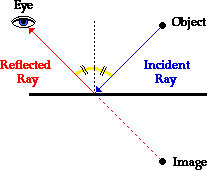
What is the angle of reflection equal to?

a)

The angle of refraction

b)

The angle of incidence

c)

The angle of absorption

d)

The angle of light

22.

What might explain why light travels in a straight line?

a)

If there is nothing to interfere with light waves, they should travel in a straight line.

b)

Light waves will always travel in a straight line, even if they come into contact with another object.

c)

Light waves don't travel in a straight line.

d)

Light waves travel in a straight line because sound waves travel in a straight line.

23.

What is the angle of incidence?

a)

The angle at which light bends in water.

b)

The angle at which light hits a surface.

c)

The angle at which light is absorbed by an object.

d)

The angle at which light bounces off a surface.

24.

When you look into a mirror, what is happening to the light?

a)

It is increasing in wavelengths.

b)

It is being refracted.

c)

It is being absorbed.

d)

It is being reflected.

25.

When light hits an area and bounces back it is called:

a)

echo

b)

refraction

c)

reflection

d)

absorbing

26.

Light travels through air, water, glass and many other materials. What path does it travel to get from one place to another?

a)

sideways

b)

back and forth

c)

straight

d)

up and down

27.

When light hits a barrier that is solid/opaque what is usually created?

a)

a hot object

b)

a shadow

c)

nothing

28.

What is the best explanation for Mickey seeing himself in the mirror?

a)

refraction

b)

absorbed

c)

reflection

d)

flipped

29.

What do we call a material that light can travel through?

a)

air

b)

water

c)

medium

d)

pathway

30.
Which of these describes how light travels through an empty space?
a)
It travels straight but may change direction to avoid objects.
b)
It changes direction often even if there are no objects. 
c)
It comes to a stop after it travels a certain distance. 
d)
It travels in a straight line without stopping. 
31.
What surface best reflects light?
a)
dull
b)
shiny
c)
clear
d)
black
32.
What kind of path does light take?
a)
It travels in a straight line until it hits something or goes through it.
b)
It bounces off all objects.
c)
It curves around all objects.
d)
It goes through all objects.
33.
The distance between one peak and the next in a wave
a)
Transpartent
b)
Scattering
c)
Wavelength
d)
Waste Pro
34.
The term for any wave that hits a surface and bounces off
a)
Transparent
b)
Translucent
c)
Refraction
d)
Reflection
35.
Light travels on straight lines.
a)
Light Bulb
b)
Sunshine
c)
Light Rays
d)
Frequency
36.
What is light?
a)
Is all around us, and we need it to see.
b)
Is a force that we need.
37.
Light is a KIND of ENERGY.
a)
True
b)
False
38.
All light has a SOURCE, or something it comes from. 
a)
True
b)
False
39.
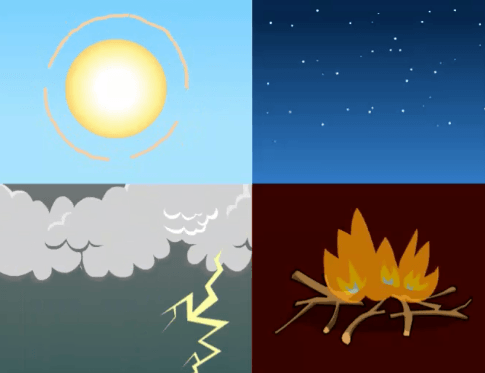
Which of these are examples of NATURAL sources of light?
a)
Sun 
b)
Stars
c)
Lightning
d)
ALL of them
40.
Which of these is our MAIN (most important) source of light?
a)
Lightbulbs
b)
The Sun
c)
Fire
d)
All of them
41.
What happens when light hits an object?
a)
Some of the light jumps in different directions
(bounces)
b)
Some of the light gets absorbed by the object.
c)
Some of the light bounces back to your eye
d)
ALL of them.
42.
_______ is when light hits and object and it BOUNCES off.
a)
Reflection
b)
Refraction
43.
Which objects REFLECT more light?
a)
Shiny objects
b)
Dull objects (not shiny)
44.
Light can pass through objects.
a)
TRUE
b)
FALSE
45.
Things make shadows because they ______ light.
a)
BLOCK
b)
PASS
46.
Light travels
a)
around corners
b)
in a straight line
47.
mirror
a)
absorbs
b)
reflects 
c)
refracts
48.
smooth, shiny surfaces
a)
reflect
b)
refract
c)
absorb
49.

Which travels faster?

a)

sound

b)

light

c)

water

50.
What is being blocked when a shadow is formed?
a)
Light Source
b)
Light Path
c)
Object
d)
Eye
51.

Why can we sometimes see only parts of the moon?

a)

The path of light can only reach half of the moon at a time.

b)

The path of light from Earth to the Sun is blocked.

c)

The moon is partially eaten by giant zombie rodents, but it can regrow.

d)

Our brain just wants to make things up to confuse us.

52.
A girl in her bedroom saw her sister break her mother's lamp in the living room.  Explain how this could be possible.
a)
The girl can see through the wall.
b)
The girl can see her sister, because light can bend.
c)
The girl can see her sister because of a reflective surface in the kitchen.
d)
Since there is light in the living room and bedroom, she is able to see.
53.
Which one is an example of light being reflected?
a)
Seeing yourself in a mirror
b)
Lighting a candle
54.

At what point is the laser being reflected?

a)

A

b)

B

c)

C

d)

D

55.

Light travels in straight lines until reflected by another object. Which illustration best shows the light being reflected?

a)
b)
c)
d)
56.

What makes it possible to see an object when looking through a periscope?

a)

It contains mirrors that reflect the object.

b)

It magnifies small objects so they can be seen.

c)

It absorbs the light rays passing through it.

d)

It separates the light into different colors.

57.

True or False, Light needs matter to travel?

a)

True

b)

False

58.

Light with longer wavelengths have more energy

a)

True

b)

False

59.

Transverse waves with shorter wavelengths have less energy than those with longer wavelengths.

a)

True

b)

False

60.

When light hits a solid (opaque) object, the light that creates the shadow does so because these light rays are ...

a)

Are slower than the other rays

b)

Are faster than the other rays

c)

Allergic to the object

d)

Are stopped by the solid object

61.

As light travels over distance, the light rays travel in a straight line but also

a)

Tik Tok

b)

Zig Zag

c)

Spread out

d)

Compress (get closer together)

62.

A student placed a pencil in a cup of water. The pencil appears broken because light

a)

always travels in a straight line.

b)

bends when it passes through water.

c)

makes the water in the glass evaporate.

d)

reflects the pencil on the water's surface.
63.

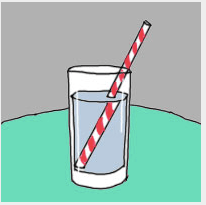
Why does the straw appear to be bent?

a)

light is reflected

b)

light is absorbed

c)

light is turned

d)

light is refracted

64.
When light bends it is ______
a)
Reflection
b)
Absorption
c)
refraction 
d)
optical density
65.
When light bounces back it is _____
a)
Reflected
b)
Refracted
c)
Absorbed
d)
Optical Density
66.
a)
Reflection
b)
Refraction
67.
a)
Reflection
b)
Refraction
68.
a)
Refraction
b)
Reflection
69.
a)
Reflection
b)
Refraction
70.
a)
Reflection
b)
Refraction
71.
a)
Reflection
b)
Refraction
72.
We see shadows because light travels in a __________________ line.
a)
curved
b)
straight
c)
rainbow
73.
a)
Reflection
b)
Refraction
74.
a)
Reflection
b)
Refraction
75.
a)

reflection

b)

refraction

76.
a)

reflection

b)

refraction

77.
a)

reflection

b)

refraction

78.

What is the name for the distance from peak to peak of a wave?

a)

Wavelength

b)

Amplitude

c)

Frequency

d)

Speed

79.

The letter b on the image above is represent for .........

a)

Wavelength

b)

Amplitude

c)

Frequency

d)

Speed

80.

Determine the wavelength of this wave.

a)

1m

b)

2m

c)

3m

d)

4m

81.

Based on the picture above, which has the longest wavelength?

a)

infrared

b)

x-ray

c)

microwave

d)

ultraviolet

82.

Based on the picture above, which has the shortest wavelength?

a)

visible

b)

radio

c)

microwave

d)

gamma rays

83.
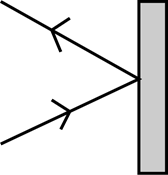
The illustration shows a light ray striking an object.
In the illustration, the light ray striking the object is-
a)
absorbed
b)
stopped
c)
reflected
d)
refracted
84.
A student placed a pencil in a cup of water.  The pencil appears broken because light-
a)
always travels in a straight line
b)
bends when it passes through water
c)
makes the water in the glass evaporate
d)
reflects the pencil on the water's surface
85.
The bouncing off of light rays from the surface of an object such as a mirror or other shiny surface is called:
a)
mirror
b)
laser
c)
reflection
d)
refraction
86.
The bending of a wave as it passes at an angle from one medium to another is called?
a)
Convex Lens
b)
Refraction
c)
Concave Lens
87.
Refraction is the bending of a wave disturbance as it passes from one _________ into another.
a)
glass
b)
medium
c)
area
d)
boundary
88.
According to the Law of reflection, a light ray striking a mirror
a)
continues moving through the mirror in the same direction
b)
moves into the mirror at a slightly different angle
c)
bounces off the mirror toward the direction it came from
d)
bounces off the mirror at the same angle it hits.
89.

How does light energy move?

a)

Longitudinal Waves

b)

Wavelengths

c)

Transverse Waves

d)

Ocean Waves

90.

What is the visible spectrum?

a)

a. The part of light waves we can see

b)

b. The part of light waves we cannot see

c)

c. the whole electromagnetic spectrum

d)

d. the energy spectrum

91.

What is a wavelength?

(Hint: there is one correct answer)

a)

a. The distance between a crest & a trough

b)

b.The highest part of a transverse wave

c)

c.The distance between two crests

d)

d. Light doesn't have a wavelength