
Font size
 Worksheets
Evolution and Classification Practice
Total questions: 140
Worksheet time: 2hrs 19mins


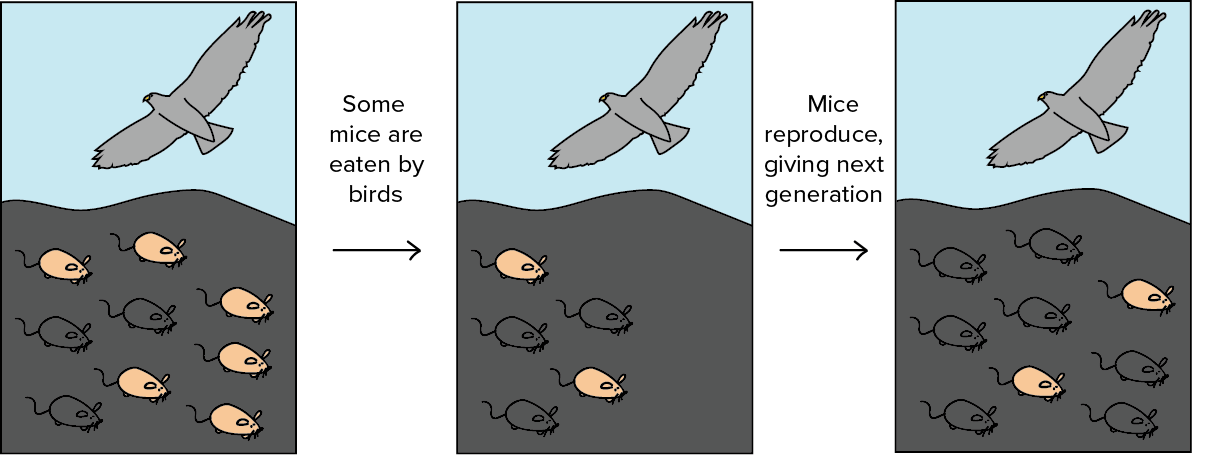
How would you best describe the effects of natural selection on the bird population?
Increase in beak size
Decrease in beak size
The small beak size has an advantage
Smallest & Largest beak have an advantage
A population of mountain plants suffered a wildfire, leaving only a few isolated plants to survive. What type of genetic drift or evolution will this population go through?
Macroevolution
Bottleneck Effect
Founder's Effect
Natural Selection
A population of finches that live on a large island becomes two separate islands with different environmental conditions. What would you expect to happen after several generations?
Nothing will change
Speciation will occur
Competition will not change
Natural Selection will stop
An organism that is more biologically fit...
Is bigger and healthier
Has more offspring
Can run faster
Is stronger

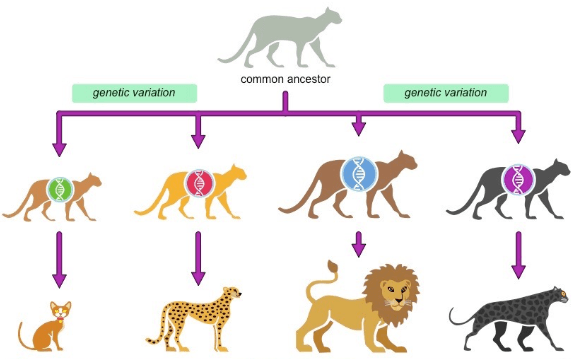
Which group of wild cats will most likely undergo speciation and why?
C - because of behavioral isolation
D - because of temporal isolation
A - because of geographic isolation
B - because of temporal isolation
When two organisms that once had a common ancestor are no longer able to reproduce and have fertile offspring together (become two new species)
Evolution
Speciation
Natural Selection
Competition
The slow changes that occur in a species over time because of survival of the fittest is known as...
Evolution
Competition
Bottleneck Effect
Natural Selection
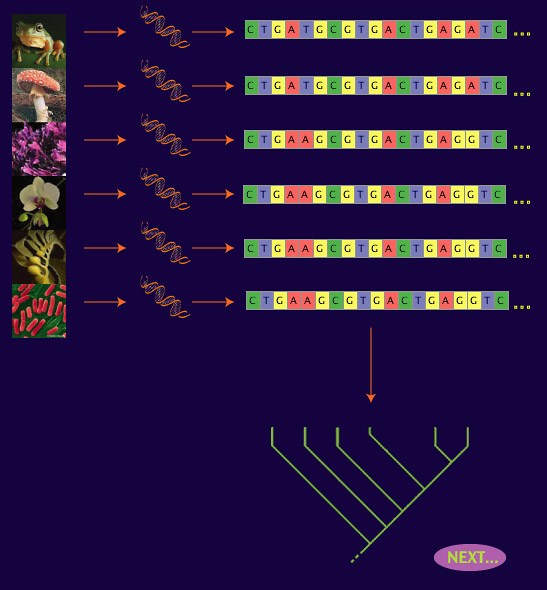


Genetic variation in a population can be increased with:
Mutations
Genetic drift
Founders effect
Genetic bottleneck.
Genetic drift, like bottlenecks, are different from natural selection in that they are:
Random
on Purpose
Controlled by humans

Bird wings and bat wings are similar, but bats and birds are not closely related. This means their wings are an example of :
Convergent evolution
Divergent evolution

Two species drastically effect the evolution of the other. This is an example of:
Coevolution
Natural Selection
Gene flow.
In a particular population of salmon, males compete to fertilize the eggs laid by females. Very small males are able to sneak in and fertilize the eggs pretty easily, and very large males are able to fight and out-compete others in order to fertilize eggs. Medium-sized males are not sneaky enough or strong enough in fights, therefore have difficulty fertilizing the eggs. This is an example of __________ selection.
directional
stabilizing
disruptive
artificial
The human tailbone is an example of a/an _________________: it no longer serves a purpose in our species but served a purpose in one of our ancestral species and hasn't been selected against, therefore still exists.
transitional form
homologous form
vestigial structure
adaptation
Homologous structures as a whole are
structures with the same function in a species, like the legs of tigers and the legs of dogs.
structures with the same anatomy but different function in species, like the forelimbs of humans and whales.
structures that no longer serve a purpose in a species, like goosebumps in humans.
structures that give an organism an advantage in its environment, like the webbed feet of a duck.
When one organism evolves and it affects the evolution of another organism, that is called ____________.
Convergent Evolution
Divergent Evolution
Coevolution

Alfred Russell Wallace contributed to Darwin's Theory of Evolution by studying the distribution of life forms over geographical areas. This is known as:
Biogeography
Natural Selection
Artificial Selection
What is the purpose of a cladogram?
To show a series of unrelated species of organisms
To show how evolutionary lineages branched off from common ancestors
To show how different species underwent natural selection

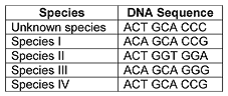
Look at the table. Which species is MOST closely related to the unknown species?
Species I
Species II
Species III
Species IV
TRUE OR FALSE: The first living organism on Earth was probably an anaerobic, unicellular prokaryote.
True
False
Which of the following is written in the correct order?
Domain, Kingdom, Class, Genus, Order, Phylum, Species Family
Domain, Kingdom, Phylum, Class, Order, Family, Genus, Species
Domain, Class, Genus, Phylum, Kingdom, Order, Family, Species
TRUE or FALSE: Mutations increase genetic variation?
True
False

There are approximately 300 different species of African Ciclid fish living in Lake Victoria. They all evolved from one common ancestor. This is an example of ______________.
Divergent Evolution
Coevolution
Gradualism
Using binomial nomenclature, choose the correct scientific name:
Strombas Gigas
strombas Gigas
Strombas gigas

This image shows the evolution of the hominid. Which description BEST describes the evolution of the hominid jaw structure?
The jaws of hominids evolved to be smaller and less protruding over time.
There appears to be no change in the jaws of hominids over time.
The jaws of hominids evolved to be larger and more protruding over time.


Having a standard taxonomic system benefits the scientific community by allowing scientists
from all over the world to do which of the following?
Have a common system for the classification of locations containing fossils
Use a similar system to classify the impact of removing species from ecosystems
Have a common understanding in the classification of organisms
Understand how other scientists classify predator–prey relationships
Some organisms have genes that improve their ability to survive and reproduce. If the genes
also help their offspring survive and reproduce, then which of the following will most likely
increase?
The frequency of the genes in one individual
The frequency of the genes in the population
The number of genes in one chromosome
The number of genes in the species

Zoogeographic regions are characterized by the presence of specific groups of animals. These
regions are determined by the taxonomic or phylogenetic relationships of animals. The map
shows the zoogeographic regions proposed by the naturalist Alfred Russel Wallace in 1876.The similarities of organisms in which two areas numbered above provide the best evidence
for common ancestry between the organisms in both locations?
1 and 2
3 and 4
5 and 6
7 and 8
Arthropods are joint-legged animals. Spiders, crabs, pill bugs, centipedes, and millipedes
are examples of the many types of arthropods. Which of these arthropods are most closely
related?
Arthropods of the same family
Arthropods of the same class
Arthropods of the same genus
Arthropods of the same species

A student used a microscope to study four members of the phylum Ciliophora. Members of
this phylum move when propelled by hundreds of tiny cilia.Although these organisms belong to the same phylum, they are classified as different —
families
species
kingdoms
orders
The gray squirrel, Eastern fox squirrel, and red squirrel are all different species of squirrels.
Why is having a scientific name for each species of an organism important?
To prevent existing named organisms from having their names changed as they become
extinct
To keep the classification system from being altered as new organisms are discovered
To allow organisms to be placed in many classification levels at the same time
To standardize the naming and organization of organisms to avoid confusion

The relationships among different orders of millipedes are shown in the cladogram.Based on this cladogram, which statement best describes relationships among millipede
orders?
Stemmiulida is more closely related to Merocheta than Penicillata is to Merocheta.
Spirostreptida is more closely related to Glomerida than Sphaerotheriida is to Glomerida.
Polyzoniida is more closely related to Glomeridesmida than Sphaerotheriida is to
Glomeridesmida.
Merocheta is more closely related to Glomeridesmida than Glomerida is to
Glomeridesmida.

The image shows part of the humerus bone in different genera of primates.
Which statement is best supported by the observable structures of the different humerus bones?
The primates lived in similar environments.
The primates shared a common ancestor.
The primates interbreed with similar organisms in a population.
The primates had diets that consisted of similar types of foods.
The white cattail is a hybrid species of plant that is a result of the cross between the broad-leaved cattail and the narrow-leaved cattail. Over time, the white cattail has established itself in the wetlands of Midwestern states. Which of these explains the success of the white cattail?
Favorable genes from parental generations provide advantageous characteristics to the hybrid species.
Hybridization produces offspring traits that allow different species to survive in extreme environments.
Inherited traits passed on from parental generations make hybrid species more susceptible to disease.
Hybrid species display more adaptations due to their reduced genetic diversity.
Common baboons live on the savanna in breeding groups called troops. While females tend to stay with the troop, younger or less dominant males may leave to join a neighboring troop. Which of these is a likely outcome of movement by young males?
Gene flow occurs between populations.
Allele frequencies suddenly change.
Relative genotypic frequencies reach a constant state.
Intermediate phenotypes increase in the species.

A
B
C
D

Scientists estimate that there are more than 20,000 species of ants. The species range in size from 1 mm long to 38 mm long and live in most environments. The diets of ants range from flowers and seeds to fluids from their own larvae. Ants have been able to successfully inhabit so many different environments because their populations have been able to --
hybridize with other species of insects
adapt to a variety of habitats and food sources
fill niches usually occupied by mammals
occupy habitats that have no other life-forms


A physical or behavioral trait that helps an organism survive and reproduce in its environment is called a what?
An adaptation
A response to a stimulus
A mutation
Evolution

The process by which two populations of the same species become so different that they can no longer interbreed.
natural selection
artificial selection
speciation
fossilization


Gray Wolf: Canis lupus
Aardwolf: Proteles cristatus
Coyote: Canis latrans
What scientific name is correct?
Quercus Alba
Quercus alba
quercus Alba
quercus alba
Which is the best prediction regarding the current classification system?
The system may change as new information and organisms are discovered.
Scientists will become bored with the current system and develop a new one.
Over time, organisms will become extinct, so classification will become simpler.
The system is set in stone and most likely will not change.

An organism identified with binomial nomenclature includes which two taxa?
class and order
family and genus
genus and species
kingdom and phylum
Name them:

The scientific name for a raccoon is written below in several different ways. Which one is written in the correct form?
Procyon lotor
Procyon lotor
Procyon Lotor
PROCYON LOTOR
Tool scientists use to classify organisms
classification chart
secret decoder
organism key
dichotomous key


Genetic drift, like bottlenecks, are different from natural selection in that they are:
Random
on Purpose
Controlled by humans

Evolutionary change on a small scale
macroevolution
microevolution
coevolution
parallel evolution
Evolutionary change on a large scale; Principle of common descent
macroevolution
microevolution
coevolution
parallel evolution

Process by which unrelated organisms develop similarities due to living in similar environments
family descent
survival of the fittest
convergent evolution
divergent evolution

Process by which closely related organisms develop differences due to living in different environments
family descent
survival of the fittest
convergent evolution
divergent evolution
When two or more species reciprocally affect each other's evolution. This occurs when organisms have close ecological interactions.
coevolution
parallel evolution
macroevolution
microevolution

