wayground logo

Free Printable Worksheets

Font size

S
M
L
XL
Worksheets

Astronomy Quiz

Total questions: 64

Worksheet time: 44mins

Name
Class
Date
1.
During a 365 day period, the Earth ________________ around the Sun.
a)
rotates
b)
tilts
c)
spins
d)
revolves (orbits)
2.
What causes day and night? 
a)
Sun's rotation
b)
Earth's rotation
c)
Moon's rotation
3.
True or False: The Sun revolves around the Earth
a)
True
b)
False
4.

What is an axis?

a)

The Earth’s rotation period with respect to the stars.

b)

An imaginary line that passes through the north and South Poles.

c)

Our clock is based on the Earth’s rotation with respect to the sun, from solar noon to solar noon, known as a solar day.

5.

Which theory stated that the sun was the center of the solar system?

a)

Big Bang Theory

b)

Heliocentric Theory

c)

Geocentric Theory

d)

Oscillating Theory

6.

Which astronomer was known for proposing the Geocentric Theory and creating maps of the earth using latitude and longitude?

a)

Isaac Newton

b)

Claudius Ptolomy

c)

Nicolaus Copernicus

d)

Galileo Galilei

7.

Which astronomer was known for proposing that planets revolve in an elliptical pattern instead of circular?

a)

Johannes Kepler

b)

Claudius Ptolomy

c)

Nicolaus Copernicus

d)

Galileo Galilei

8.

Which theory stated that Earth was the center of the solar system?

a)

Big Bang Theory

b)

Heliocentric Theory

c)

Geocentric Theory

d)

Oscillating Theory

9.

This is an model of which theory?

a)

Heliocentric Theory

b)

Geocentric Theory

c)

Big Bang Theory

10.

This is an model of which theory?

a)

Heliocentric Theory

b)

Geocentric Theory

c)

Big Bang Theory

11.
How long does the Earth take to make one revolution around the sun?
a)
360 days
b)
420 days
c)
365 days
d)
1 day
12.
True or false:It take the Earth 1 day to rotate.
a)
True
b)
False
13.
What is a constellation?
a)
A pattern of stars 
b)
A constant pattern
14.

What is the name of the theory that Ptolemy supported and which object was in the center?

a)

Geocentric, Sun

b)

Geocentric, Earth

c)

Heliocentric, Sun

d)

Heliocentric, Earth

15.

Which of Earth’s actions creates day and night ?

a)

Revolving on its axis

b)

Revolving around the Sun

c)

Rotating On its axis

d)

Rotating around the Sun

16.

A galaxy that is shaped like a flattened ball is a(an)__________.

a)

Spiral

b)

Irregular

c)

Elliptical

17.
What causes seasons?
a)
The spinning of an eclipse
b)
A revolution
c)
A rotation
d)
One day
18.
Vernal equinox is what season?
a)
Winter
b)
Spring
c)
Summer
d)
Fall
19.

Earth revolves

a)

1 degree per day

b)

24 degrees per day

c)

15 degrees per day

20.

Isaac Newton: Laws of Motion: What is the law that applies to astronomy?

a)

Law 1: An object in motion will remain in motion and an abject at rest will remain at rest unless an unbalanced force acts upon it, thus changing its motion

b)

Law 2: The force acting on an object is equal to the mass of that object times times its acceleration, F = ma

c)

Law 3: For every action, there is an equal and opposite reaction

21.

What is the impact of inertia on rotation?

a)

creates seasons

b)

creates day and night

c)

keeps earth spinning

d)

creates a year

22.

What is an example of revolution (in astronomy)?

a)

the introduction of the automobile into society.

b)

war fought between the colonial people and Great Britain.

c)

movement of earth around the sun

23.

What is evidence of revolution?

a)

seasons

b)

stars visible in night sky

c)

how fast earth moves

24.

What is the impact of revolution?

a)

creates day and night

b)

creates seasons

c)

calendar

d)

1 year

e)

365.25 days

25.
Which of the following was developed by Isaac Newton?
a)
the heliocentric theory
b)
the scientific method
c)
the theory of scientifc rationalism
d)
the theory of universal gravitation
26.
What did Kepler add to Copernicus’ heliocentric theory?  
a)
That Jupiter had four moons
b)
That the planets revolved around the earth 
c)
That the sun was the biggest star
d)
That the planets move in an ellipses around the sun
27.

What was the main difference between the theories of Johannes Kepler and Nicolaus Copernicus?

a)

the shape of the planetary orbits

b)

the importance of testing predictions

c)

the celestial body at the center of the universe

d)

the reason for the apparent rising and setting of the sun
28.
Planets orbit the Sun in a shape called a(n)
a)
circle
b)
ellipse
c)
focus
d)
perihelion
29.
An ellipse is drawn around two points called
a)
aphelion
b)
perihelion
c)
foci
d)
axis
30.
When a planet orbits the Sun, one of the foci of the elliptical orbit is 
a)
the axis
b)
the perihelion
c)
the center
d)
the Sun
31.
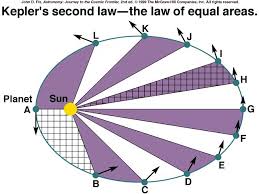
Where is the planet moving faster
a)
Position A to B
b)
Position B to C
c)
Position H to I
d)
Position I to J
32.
What is true about the area between points A, B and the Sun, and the area between points H, I and the Sun?
a)
The area between A, B and the Sun is the largest.
b)
The area between H, I and the Sun is the largest
c)
Both areas are equal in size
d)
There is not enough information to determine the areas
33.
Kepler's 2nd Law deals with 
a)
the shape of the planets' orbits
b)
the speed/area the planet travels 
c)
the length of time it takes the planet to orbit the sun
34.
The "Law of Harmonies" is which of Kepler's Laws?
a)
1st
b)
2nd
c)
3rd
d)
4th
35.
A planet moves __________ when it is farthest from the sun.
a)
faster
b)
slower
36.
Kepler's first law states that the orbits of the planets are oval in shape or 
a)
ellipses
b)
perfect circles
37.
The farther away a planet is from the sun, the _______ it takes it to orbit the sun once. 
a)
longer
b)
shorter
38.
This movement of earth over 11,000 years will change our north star to Vega
a)
nutation
b)
precession
c)
revolution
d)
rotation
39.
A wobble back and forth
a)
Rotation
b)
Nutation
c)
Revolution
40.
What did Kepler discover about planets and their orbital speed?
a)
Planets closest to the Sun will orbit with the fastest orbital speed.
b)
Planets with the greatest mass will orbit the Sun with the fastest orbital speed.
c)
Planets furthest from the Sun will orbit with the fastest orbital speed.
d)
Planets with the least mass will orbit the Sun with the fastest orbital speed.
41.

Law of Inertia: Impact on revolution?

a)

keeps earth spinning or an object revolving

b)

Law of motion: no force present to slow orbit down

c)

slows orbit down

42.

Universal Law of Gravitation: every mass exerts a force of attraction on every other mass, and the strength of that force is proportional to each of the masses and inversely proportional to the distance between them


What is the impact of this on revolution?

a)

makes earth speed up and slow down at certain points in its orbit

b)

The earth exerts equal force on the sun no matter where it is in its orbit.

c)

The earth exerts more force on the sun when it is the furthest away from the sun in its orbit.

d)

The earth exerts less force on the sun when it is the closest to the sun in its orbit.

43.
The occasional westward (left to right) motion of planets across the celestial sphere is called:
a)
retrograde rotation
b)
retrograde revolution
c)
retrograde motion
d)
reverse motion
44.
The Sun is at one focus of the Earth’s elliptical orbit.  What is at the other focus?
a)
our moon
b)
Jupiter
c)
Venus
d)
nothing
45.
True or False: All planets undergo retrograde motion as seen from Earth.
a)
True
b)
False
46.

During what time of the year do we experience the shortest day and the longest night?

a)

Autumnal equinox

b)

Summer solstice

c)

Vernal equinox

d)

Winter Solstice

47.

How many years does Earth require to complete a cycle of precession?

a)

10,000

b)

15,000

c)

21,000

d)

26,000

48.
At position A, in the Northern hemisphere it would be _____?
a)
Summer
b)
Winter
c)
Spring
d)
Fall
49.
At position D in the Northern hemisphere it would be _____?
a)
Summer
b)
Winter
c)
Spring
d)
Fall
50.
At position C, which hemisphere would have winter?
a)
Northern hemisphere
b)
Southern hemisphere
51.

At position 1 in the diagram it is winter in the Northern Hemisphere. What will the season be in the Northern Hemisphere in 6 months? (Think!!!!)

a)

Winter

b)

spring

c)

summer

d)

fall

52.

Why do we experience the changing of the season on the earth?

a)

distance from the sun

b)

rotation of the earth

c)

change in solar output

d)

tilt of the earth's axis

53.
What is the Earth's tilt in degrees?
a)
25.3 degrees
b)
32.5 degrees
c)
28.5 degrees
d)
23.5 degrees
54.

What is an Equinox

a)

Full tilt toward sun

b)

Full tilt away from sun

c)

Shortest day

d)

Equal day and night

55.

define a solstice

a)

Full tilt toward sun

b)

equal day and night

c)

10 degrees toward sun

d)

10 degrees away from sun

56.

When the Northern Hemisphere is pointing towards the Sun, what season is the Southern Hemisphere experiencing?

a)

Summer

b)

Spring

c)

Winter

d)

Fall

57.
In the summer many people enjoy going to the beach. There is a beautiful beach in Argentina, which is located in the Southern Hemisphere. Which diagram shows the position of Earth when it is summer in Argentina?
a)
A
b)
B
c)
C
d)
D
58.
What is the main difference between the heliocentric and geocentric models?
a)
In the Geocentric Model everything revolves around the Earth, and in the Heliocentric Model everything revolves around the Sun
b)
In the Heliocentric Model everything revolves around the Earth, and in the Geocentric Model everything revolves around the Sun
c)
In the Geocentric Model everything revolves around the Earth, and in the Heliocentric Model everything revolves around the Moon
d)
There is no difference between the two models
59.
Who proved that the Geocentric Model was incorrect, and later proposed that the Sun and the Moon orbit around the Earth, and the other planets orbit around the Sun?
a)
Aristotle
b)
Johannes Kepler
c)
Tycho Brahe
d)
Galileo Galilei
60.
Who used data from Tyco Brahe to develop the Planetary Laws of Motion?
a)
Tycho Brahe
b)
Johannes Kepler
c)
Galileo Galilei
d)
Aristotle
61.

Tycho Brahe: defined a coordinate system on the sky that identifies the relative positions of stars, planets, the sun and other celestial phenomena

a)

True

b)

False

62.

Impact of Kepler and Brahe on tilt?

a)

determined that the Earth has a tilt based on the stars

b)

determined that the Earth has a tilt based on the sun

c)

determined that the Earth has a tilt based on their reasoning

d)

determined that the Earth has a tilt based on the seasons

63.
When the moon revolves around the Earth, the Earth wobbles a little because the moon's gravity is tugging on it.
a)
Nutation
b)
Precession
c)
Barycenter
d)
Revolution
64.

What is the wobbling of Earth on its axis called?

a)

precession

b)

Nutation

c)

Rotation

d)

Revolution