Worksheets
Unit 6 Lesson 1-2
Total questions: 37
Worksheet time: 19mins
Who was the scientists that is credited for the idea of evolution?
Jean-Baptise Lamarck
Charles Lyell
Charles Darwin
Thomas Malthus
What was an important kind of animal in Darwin's observations for evolution?
Penguins
Turtles
Finches
Evolution is...
the process by which a population changes over a LONG period of time.
any change in the DNA code.
the smallest unit of life.
a change in an organism's environment which causes a response.
After observing the birds on the Galapagos Islands and researching later, Darwin concluded that...
the birds differed from island to island.
all the different birds evolved from the same species.
all the birds had the same diet.
the different birds came from different places.
all the islands had the same kind of birds.
Which is an example of Artificial Selection?
the Galapagos Finches
humans
Puggle (pug + beagle)
What is Artificial Selection?
The decision of which organisms become fossils.
A change in appearance of mind which does not influence DNA (therefore is not passed to offspring).
The process by which populations change over a LONG period of time.
The practice of breeding plants or animals to develop a desired trait, done by humans.
Variation for a trait means...
there are different options for that trait
there is only one option for that trait
breeding has occurred
Genetic variation leads to _____________.
diversity
hunting food
mutations
Natural Selection depends on...
which species are going extinct.
acquired traits.
whether or not humans are involved in the process.
which variation of a trait is more beneficial to the environment.

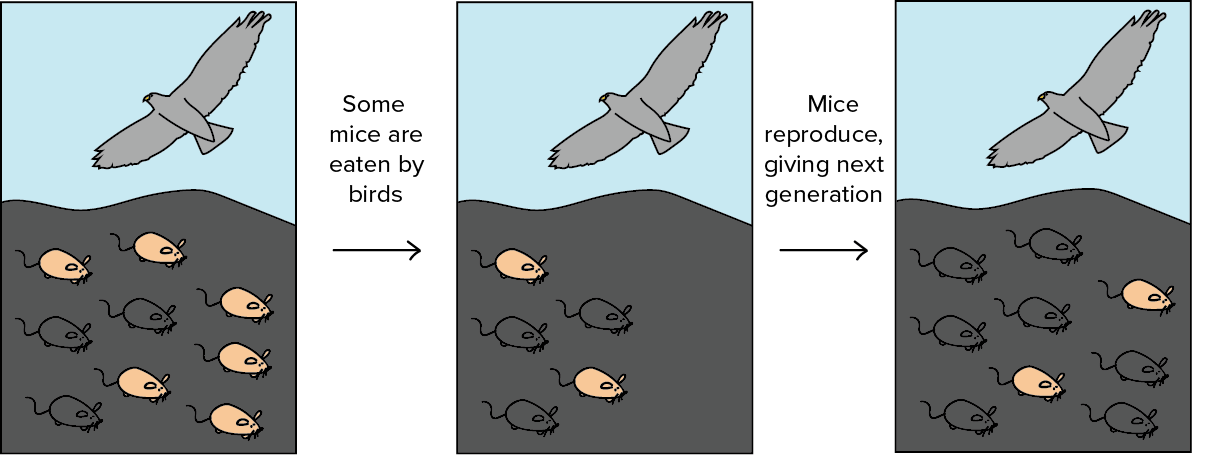
Which of the organisms in the picture is "favored" by Natural Selection?
light-colored Peppered Moth
dark-colored Peppered Moth
What does it mean to be "favored" by Natural Selection?
To be stronger and more fit.
To be the favorite child of nature.
To have a variation of a trait that is more beneficial to surviving in the environment.
To have a less beneficial variation of a trait for surviving.
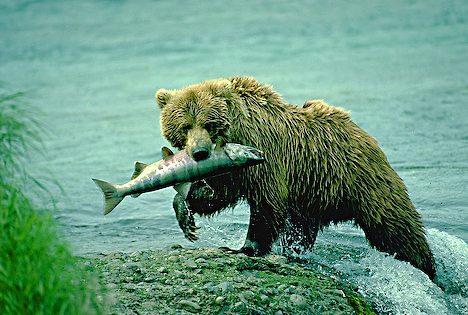
A grizzly bear survives because he is well-adapted to his environment. When he reproduces he passes on those traits to his offspring. This process is called...
Natural Selection.
Selective Breeding.
random mutations.
variations in a species.

If Easter eggs were living species of organisms, their different colors would be considered:
Adaptations
Variations
Different species
Extinct species
In sexual reproduction, ____ DNA is gained from each parent to be passed off to the offspring.
all
half
only some
Which allows for variation?
Asexual Reproduction
Sexual Reproduction
Having no offspring.
Which creates an offspring which is an identical copy of the parent?
Asexual Reproduction
Sexual Reproduction
Having no offspring.

What form of reproduction is this animal preform?
Asexual - Binary Fission
Asexual - Budding
Sexual Reproduction
Please select all of the following which are CHARACTERISTICS of LIFE.
Multicellular
uses and acquires energy
grows and matures
breathes oxygen
responds to the environment
A wave that moves the medium in a direction Perpendicular to the direction in which the wave travels
Longitudinal
Amplitude
Crest
Transverse
Which of these Galapagos wildlife is cutest?


What 4 things do all living things need?
food, oxygen, living space
water, air, food and living space
food, water and living space
food, water and oxygen
There are 4 parts to natural selection listed below. Which item below does not belong?
Overproduction
Stimulus
Genetic Variation
Selection
Adaptation
Which of the following scenarios is an example of natural selection?
Giraffes with longer necks survive a dry season by eating leaves from the top of trees. Those giraffes breed more successfully that year.
Dogs of the same breed and having a desirable coat color are bred to produce offspring with that coat color.
People kill rattlesnakes that rattle when a human approaches them. The snakes that stay quiet survive and breed.
There is a moist forest environment - but a change in weather causes it to become drier, more desert-like. Which adaptation would be help a rodent species survive this change?
dark hair and small ears
being able to eat only one type of berry
living above ground in damp areas
being able to eat plants that can survive in the drier climate
What is natural selection?
When reproduction occurs and mutations happen.
When a offspring has the traits from its parents.
When an organism is able to camoflauge in its environment.
the process whereby organisms that are better adapted to their environment tend to survive and reproduce more offspring.
In a cold environment what would be some adaptive traits? Sellect all that apply.
thick blubber
thick fur
thin fur
strong muscles
What is a mutation?
When animals have extra legs
When a frog has 3 eyes
When genes or DNA have been alterd or changed
When RNA is upside down
What is a trait?
a color
the quality or characteristic of an organism
the DNA of an organism
when mutatuons cause extra limbs.

Which of these are possible traits of a rattle snake?
Select all that apply
venom
rattle
hair
legs
scales
Why do offspring share traits from both parents?
offspring choose the traits they want
offspring get 75 percent of the traits from their father
offspring get 50 percent of each parents DNA
What must organisms do when an environment changes?
Adapt
Camoflauge
become common
fight