
 Worksheets
Chemical Reactions - Test Practice - round 2
Total questions: 55
Worksheet time: 3hrs 13mins
type of reaction in which a compound is broken down into its simple elements or compounds.
Double Displacement
Single Displacement
Synthesis
Decomposition

Some chemical reactions require a substance called a catalyst. The purpose of a catalyst is
to warm up the reaction
to speed up the reaction
to create more reactants
to stop the reaction

Is this chemical equation balanced? Why or why not? Choose the BEST answer.
Yes, the amount of atoms for each element are equal on both the reactant and product side.
No, the carbons are not the same number on both the reactant and product side.
No, neither the carbons or hydrogens are the same amount on both the reactant and product side.
No, none of the elements (carbon, hydrogen, or oxygen) are the same amount on both the reactant and product side.
Which of the following is NOT a sign of a chemical reaction?
Color changes
Cutting into pieces
Light is produced
Gas is formed
What type of reaction is illustrated below?
FeS + HCl --> H2S + FeCl
synthesis
decomposition
single replacement
double replacement
__K + __Br2 --> __KBr
__HNO2 + __O2 --> __HNO3
2HI --> H2 + I2
What type of reaction is illustrated below?
Zn + H2S --> ZnS + H2
synthesis
decomposition
single replacement
double replacement
You know that a chemical reaction has occurred if
there is a precipitate (new solid)
there is a color change.
there is a temperature change.
All of these answers are evidence.
heat or light is produced

In the equation, 2Mg + O2 ---> 2MgO, which are the reactants?
Mg and O2
MgO
Mg and MgO
O and MgO
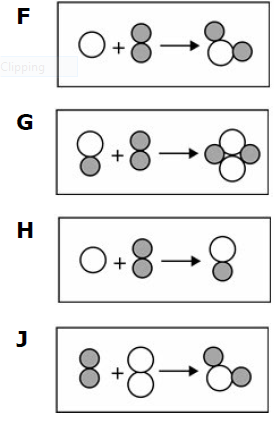
Which of the following models best demonstrates a balanced chemical equation?
F
G
H
J
Which of the following describes a precipitate?
a liquid forms when a block of metal is heated
a solid forms when one aqueous solution is poured into another
a gas forms when a solid is placed in a liquid
bubbles form when an acid is poured on a rock
Complete the balanced equation for this Double Replacement reaction.
3 NaOH + Fe(NO3)3 -->
NaFe + OH(NO3)3
2NaNO3
3 NaNO3 + Fe(OH)3
Predict the products for the this Single Replacement reaction:
K + HCl -->
KCl + H2
KHCl
KH + Cl2
Predict the products for the this Double Replacement reaction:
AgNO3 + KCl -->
AgCl + KNO3
AgK + ClNO3
KAg + NO3Cl
What is the correct way of representing hydrogen gas alone, in a reaction?
2H
H
H2
To predict if a single replacement reaction will take place you should use the____________ __________
Activity series
Solubility Chart
Periodic Table
When predicting a double replacement reaction we use the__________ ________ to help us determine if a solid is produced or not
Activity series
Solubility Chart
Periodic Table
What is the name for the solid formed during a reaction?
Precipitate
Rocks
Aqueous
The symbol for a soluble substance (dissolved in solution) is ______
(s)
(l)
(aq)
Is the following substance soluble or insoluble?
NaNO3
Soluble
Insoluble
Is the following substance Soluble or insoluble?
Aluminum phosphate
AlPO4
Soluble
insoluble
What kind of reaction is this:
2 H2O2 →2 H2O + O2
Synthesis
Decomposition
Single Replacement
Combustion
Zn + 2HCl --> ZnCl2 + H2
Predict the products for the following reactants.
(LIMITED OXYGEN)
C6H12 + O2 -->
CO + H2O + C
CO2 + O2
CO + H + C
CO2 + H2O
Predict the products for the following reactants.
(silver always has a charge of +1)
AgNO3 + Na2CO3 -->
Ag2CO3 + NaNO3
No Reaction
AgCO3 + NO3Na
AgCO3 + NaNO3
K2CO3 + BaCl2 -->
Ag2O -->
Write a complete balanced reaction for the following.
Solid Calcium metal reacts with oxygen gas to form a solid
2 Ca (s) + O2 (g) --> 2 CaO (s)
2 Ca (s) + 2 O (g) --> 2 CaO (s)
Ca (s) + O2 (g) --> 2 CaO (s)
Ca (s) + O2 (g) --> CaO2 (s)
Write a complete balanced reaction for the following.
Liquid butane, C4H8, is burned in the presence of EXCESS oxygen gas.
C4H8 (l) + 6 O2 (g) --> 4 CO2 (g) + 4 H2O (g)
C4H8 (l) + 12 O (g) --> 4 CO2 (g) + 4 H2O (g)
C4H8 (l) + 12 O2 (g) --> 4 CO2 (g) + 4 H2O (g)
C4H8 (l) + 5 O2 (g) --> 4 CO2 (g) + O2 (g) + 4 H2 (g)
What are the products of a Metal hydroxide decomposition such as:
Al(OH)3 -->
Al2O3 + H2
AlO + H2
Al2O3 + H2O
OH + Al
What are the products of a Metal hydroxide decomposition such as:
Na(OH) -->
Na (s) + OH (g)
Na2O (s) + H2O (g)
Na (s) + O(g) + H (g)
NaO (s) + H2O (g)
Predict the products for the synthesis of a nonmetal oxide reacting with water:
NO2 + H2O -->
HNO3
HNO
H2NO
H2NO4
Predict the products:
Mg + P -->
MgP
Mg2P3
Mg3P2
(MgP)23
Predict the products:
Li + N2 -->
LiN
NLi
Li3N
LiN3
Predict the products:
Na2O + H2O -->
Na2O + H2O
Na(OH)
Na2O+ H2
Na + H2 + O2
Calcium Chlorate decomposes into?
Calcium and chlorine and oxygen
calcium oxide and chlorine gas
calcium chloride and oxygen gas
Sodium Carbonate decomposes into?
sodium oxide and carbon monoxide
sodium oxide and carbon dioxide
sodium and oxygen and carbon
sodium carbide and oxygen
Copper (II) hydroxide decomposes into?
Copper (II) Oxide and water
copper (I) hydroxide
copper (II) oxide and hydrogen
Do you know the 7 diatomic elements??
yes - I have memorized them
No - i need to study more
Are you able to identify the type of reaction by looking at the reactants only??
Yes! I am proud of myself!
No =( i need to study the flow chart and examples more - i need to look at the past worksheets we have done for CW and HW
Do you know how to read and use the solubility rules??
Yes! I know the difference between soluble(aq) and insoluble (s)
No I need to perhaps watch a you tube video or ask a friend.
Mrs C will not go over this the DAY OF the exam!
Do you remember that you need to criss-cross the ion charges when you write the new product of an IONIC COMPOUNDS (METAL with a nonmetal OR POLY ATOMIC ION in the formula)
yes I can
Yes I can
Yes I can
Have you watched the test video Mrs C posted on showbie?
yes
No, but I will. I know I should ; )
Mrs C wishes you the best! She believes in you!
Keep up the hard work!
I want to earn a A
I want to earn a B or better
I am going to earn a C or better!!

