
 Worksheets
Bio PMA 3 Review
Total questions: 129
Worksheet time: 1hrs 28mins

Which of the brain regions marked on the diagram below is the frontal lobe?
A
B
C
D
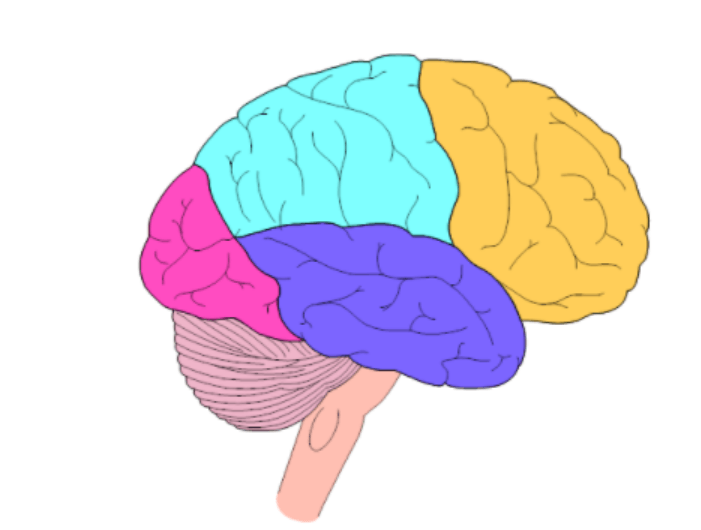
What lobe is bright pink in this picture?
Frontal
Parietal
Temporal
Occipital
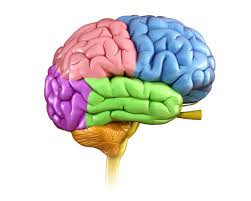
What lobe is green in this picture?
Frontal
Parietal
Temporal
Occipital
What lobe is pink in this picture?
Frontal
Parietal
Temporal
Occipital
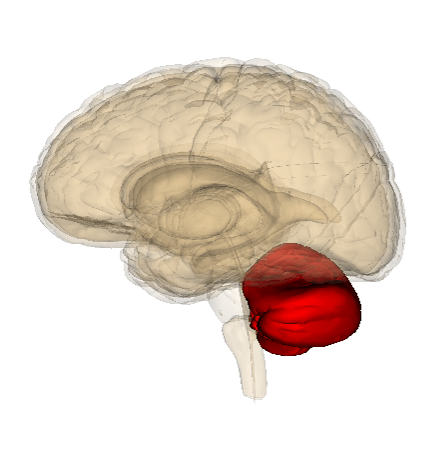
The red portion is the ________
Cerebrum
Cerebellum
Brain Stem
Diencephalon

The cerebellum is labeled
1
4
5
7
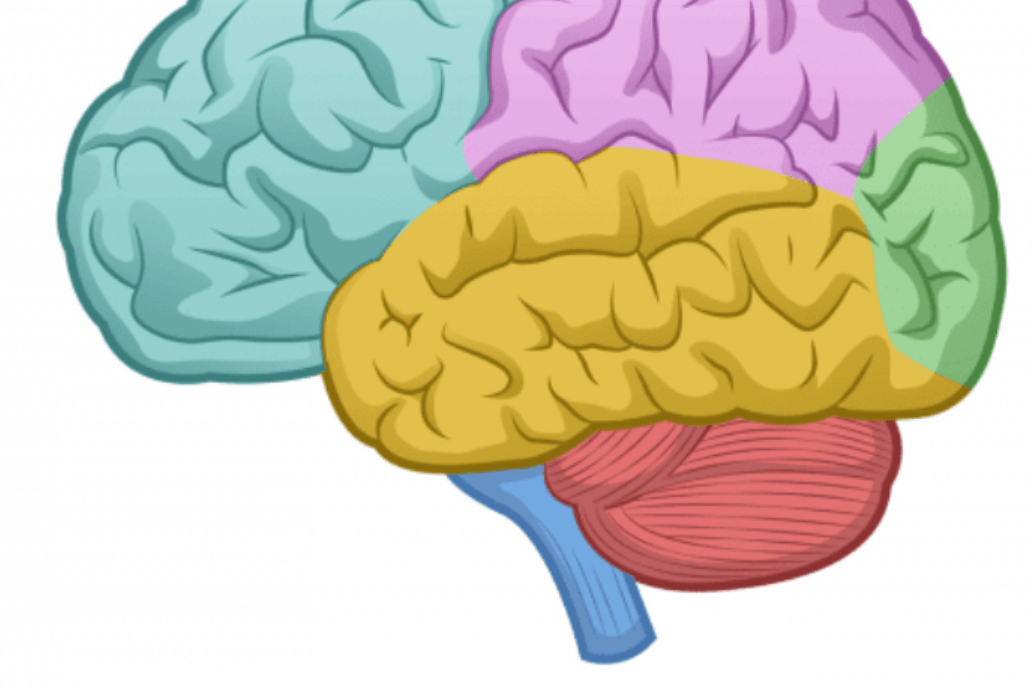
What structure is blue in this picture?
Cerebrum
Cerebellum
Brain Stem

Scientists studied the effect of water temperature on how fast a sugar cube dissolves. What was the independent variable?
Time to Dissolve
Amount of Water
Water Temperature
Beaker Size
Scientists tested the effect of water temperature on how fast a sugar cube dissolves. What was the dependent variable?
Amount of Water
Temperature of Water
Time for Sugar cube to Dissolve
Type of Beaker
What is a factor or condition in a scientific experiment that is purposefully kept the same?
Independent Variable
Dependent Variable
Controlled Variable
Hypothesis
What is a factor, usually being measured or observed, that responds to, or depends on, another factor.
Independent Variable
Dependent Variable
Controlled Variable
Hypothesis
What is the reproduction of a scientific investigation by another person to ensure accuracy.
Replication
Repetition
The invention of the microscope allowed scientists to see which of the following?
Cells
Bacteria
Microorganisms
All of the Above

This is an image of a Vespula vulgaris, wasp. What microscope would be used to look at this image?
Transmission Emission Microscope
Light Microscope
Scanning Emission Microscope
Dissecting Microscope

This is an image of the epidermis of an onion root. What microscope would be used to look at this image?
Dissecting Microscope
Light Microscope
Transmission Emission Microscope
Scanning Emission Microscope
I am a microscope that can only view organisms that are no longer living. I am best used to see surface objects in great detail and magnification that result in 3-D images of the specimens. What microscope am I?
Light Microscope
Scanning Emission Microscope
Transmission Emission Microscope
Dissecting Microscope
If blood volume decrease, then there's less blood available to pump causing blood pressure to
Increase
Stay the same
Decrease
Atherosclerosis is the buildup of cholesterol or other substances in blood vessels that causes
low blood pressure
high blood volume
low blood volume
high blood pressure
A student gets hit by a car and it causes extreme blood loss. What will happen to blood pressure?
Increase
Stay the same
Decrease
Which of the following factors affects your body's blood flow in negative ways?
Good Diet
Smoking
Alcohol
Medications


Our bodies work to fight off infections through non-specific and specific defense systems. Which of the following statements best reflects the role of the non- specific immune system?
It is designed as a first line of defense against pathogens.
It is designed to dispose of pathogens after they have been found.
It is designed to attack pathogens not found by the specific immune system.
It is designed to deal only with pathogens that are not a serious threat to the body.

Scientists developed a vaccine to protect humans from the H1N1 virus, which caused 17,000 deaths in 2009. Make a prediction which of the following patients in the table below would most likely contract the H1N1 virus?
Patient 1
Patient 2
Patient 3
Patient 4

Scientists have been studying the resistance of bacteria over the past 20 years. What conclusion is supported about the future of MRSA based on the data provided?
MRSA could become extinct by 2025.
MRSA could become isolated to one location of the world.
MRSA could become resistant to all antibiotics and spread rapidly
MRSA could evolve into a virus, where it could not be treated with antibiotics.

Which of the following image answer choices below corresponds to a non-specific defense response?
A
B
C
D
Which of the following are antibiotics used to fight against?
Viruses
Bacteria
Which of the following are vaccines used to fight against?
Viruses
Bacteria
A DNA molecule reads TCGACGATT. What is the sequence of the bases on the complementary strand?
ACCTGCTAA
AGCTGCTAA
AGCUGCUAA
ACCUGCUAA

The following steps describe which process?
Translation
Transcription
Replication
Prescription
If 10% of a DNA sample is made up of thymine, T, what percent of the DNA is cytosine, C?
10%
80%
90%
40%
Which of the following is not a difference between RNA and DNA?
RNA uses Uracil instead of Thymine
RNA contains ribose sugar & DNA contains deoxyribose
RNA is double stranded and DNA is single stranded
All of the answers are correct
Which conclusion can be made about the potential effect of genetic mutations on physical characteristics?
If a mutation changes a protein sequence, then a person’s traits will too
If a mutation changes a protein sequence, then a person’s traits will not
All genetic mutations will result in a change to a person’s physical traits
If mutation does not change a protein, then a person's traits will change
Which of the following describes the result of the semi-conservative DNA Replication process?
1 DNA with 2 old strands and 1 DNA with two new strands
Two DNA molecules, each with two new strands
2 DNA molecules, each with one original and one new strand
Two DNA molecules, each with two old strands
Mutations that change the amino acid sequence are called what?
Nonsense Mutations
Missense Mutations
Silent Mutations
Which mutation shifts the reading frame by inserting or deleting bases?
Frameshift Mutation
Nonsense Mutation
Missense Mutation
Silent Mutation
Mutations that change an mRNA sequence to stop before the protein is finished are called what?
Frameshift Mutation
Nonsense Mutation
Missense Mutation
Silent Mutation
If the codon in a dog UUU codes for phenylalanine, what does UUU code for in a cat?
Lysine
Phenylalanine
Arginine
Nothing

Which of the following processes are shown as Process A in the image?
Translation
Transcription
Replication
Prescription

Letter D represents what process?
Replication
Translation
Transcription
Prescription

According to the chart, which of the following are codons that signal for translation to stop?
UAA, GAU, AUG
UAG, UAA, UGG
UAG, UAA, UGA
AUG, UAA, UGA

Translate the RNA sequence AUG CUG CCC UAA into amino acids?
Met - Leu - Pro - Trp
Met - Leu - Ser - Stop
Met - Leu - Pro - Stop
Met - Pro - Leu - Trp

According to the chart, which of the following are codons that signal for Asn?
AAC & AAA
AAG & AAU
AAG & AAC
AAC & AAU
Which of the following is a consequence of cloning?
Increased genetic diversity
Decrease genetic diversity
Longer lifespans
New Species
Gene therapy uses genes to treat or prevent disease. What is an ethical concern over its use?
Decreased need for medicine
Increase in technology use
The long term effects on organisms because of it
Financial costs of the technology
Enzymes work best at a optimal ___ and ___
Temperature and Height
Temperature and Substrate
Substrate and Active Site
Temperature and pH
Enzymes speed up reactions by _______ the activation energy
Increasing
Decreasing
How do enzymes work?
1) Enzymes react w/ other proteins 2) Produce glucose
1) Substrates attach to enzyme's active site 2) Slows chemical reaction
1) Substrates attach to enzyme's active site 2) Produces carbon
1) Substrates attach to enzyme's active site 2) enzyme changes shape 3) Rxn
Amylase is used for breaking down starches in our food. Does it break other macromolecules?
Yes
No, because enzymes are specific and it can only break down starch

Which of the following identifies the optimal (best) pH for Enzymes A & B to react?
Enzyme A works best at a pH of 6, and Enzyme B works best at a pH of 14
Enzyme A works best at a pH of 6, and Enzyme B works best at a pH of 10
Enzyme A works best at a pH of 2, and Enzyme B works best at a pH of 6
Enzyme A works best at a pH of 10, and Enzyme B works best at a pH of 14

Which of the following macromolecules is incorrectly paired with its monomer?
Row 1
Row 2
Row 3
Row 4

The structure shown corresponds to which macromolecule?
Lipids
Proteins
Carbohydrates
Nucleic Acids

The structures shown correspond to which macromolecule?
Lipids
Proteins
Carbohydrates
Nucleic Acids

The structure shown stores genetic information. It corresponds to which macromolecule?
Lipids
Proteins
Carbohydrates
Nucleic Acids

The structures shown correspond to which macromolecule?
Lipids
Proteins
Carbohydrates
Nucleic Acids
Which of the following describes the difference between lipids and carbohydrates?
Both have carbon & hydrogen but carbs have oxygen & lipids have nitrogen
Both are made up of monosaccharides but lipids are hydrophobic
Both have carbon, oxygen, and hydrogen, but lipids can have a kink & are either saturated/unsaturated
Both have a carbon backbone but lipids have amins & carbs have carboxylics

Which of these correctly identifies the two cells described in the table?
Both Cell 1 and Cell 2 are eukaryotic
Both Cell 1 and Cell 2 are prokaryotic
Cell 1 is prokaryotic, and Cell 2 is eukaryotic
Cell 1 is eukaryotic, and Cell 2 is prokaryotic
Which structure is in both prokaryotes and eukaryotes?
Mitochondria
Ribosome
Nucleus
Cell Membrane
Spontaneous generation means that cells are formed from nothing. Which part of the cell theory allows us to reject this?
All organisms are made up of more than one cell
Cells are the basic unit of life
Cells come from pre-existing cells
Which of the following is not in the cell theory?
All organisms are made up of more than one cell
Cells are the driving force of organisms
Cells are the basic unit of life
Cells come from pre-existing cells
I have a coat of cellulose, DNA & a wall. I have mitochondria & chloroplasts. Which cell am I?
Plant Cell
Animal Cell
Bacterial Cell
Viral Cell
Which organelle captures light energy & converts energy stored in food during Photosynthesis?
Chlorophyll
Chloroplasts
Mitochondria
Lysosomes
Which of the following is the control center of the cell and contains DNA?
Nucleus
Cell Membrane
Rough ER
Ribsome
Which of the following describes the net movement of molecules during diffusion?
Particles move from low concentration to high concentration
Particles move from high concentration to low concentration
There is no net movement of particles
Which of the following is selectively permeable and made of both lipids and proteins?
Cell Wall
Nuclear Envelope
Cell Membrane
Nucleus
Which of the following best describes why the cell theory was developed over time?
Changes in cell models showed the theory was only an opinion
As new cells evolved, the cell theory became inaccurate
New discoveries and evidence caused changes in the cell theory
Changes in the theory due to new organelles appearing
Which of the following describes what happens when the concentration on both sides of a membrane is the same?
Particles move into the cell
Particles stop moving
Particles move out of the cell
Particles move faster
Large sac-like structures that store waters, salts, and proteins are called
Lysosomes
Chloroplasts
Vacuoles
Mitochondria
Which of the following is a small piece of RNA that is involved in protein synthesis?
Rough ER
Ribosome
Smooth ER
Lysosome
Which organelle modifies/sorts & packages proteins from the ER for cell storage/release?
Rough ER
Smooth ER
Ribosome
Golgi Apparatus
Which part of the cell theory supports the observation of cells multiplying?
Cells are the basic units of matter
Cells arise from pre-existing cells
All living things are made of one or more cells
The movement of molecules across the cell membrane without energy
Active Transport
Passive Transport
__________ involves cells using energy in the form of ATP to _________ and bring in molecules into the cell.
Passive Transport, move with the gradient
Passive Transport, move against the gradient
Active Transport, move against the gradient
Active Transport, move with the gradient
The flagella of bacteria allow them to move. They use which of the following to power them?
Oxygen
Carbon Dioxide
ATP
Proteins
Which of the following is considered the "Powerhouse" of the cell and produces ATP?
Cell Membrane
Nucleus
Mitochondria
Chloroplasts
The ____ lies outside the cell membrane and supports, shapes, and protects the plant cell
Cell Wall
Cytoplasm
Flagella
Cytoskeleton
Gas levels of a greenhouse are measured. If there is less amounts of carbon dioxide, then
Photosynthesis is occurring at a fast rate
Photosynthesis is occurring at a slow rate
There are low amounts of oxygen
None of the above
Our bodies and cells try to keep the conditions in our body the same by a process called
Homeostasis
Cellular Respiration
Photosynthesis
Oxidation
Which of the following are reactants of photosynthesis?
Oxygen and Glucose
Carbon Dioxide and glucose
Glucose and water
Sunlight, Carbon Dioxide, and Water
Which of the following are products of cellular respiration?
Oxygen and Glucose
Carbon Dioxide, Water, & ATP
Sunlight, Carbon Dioxide, and Water
Carbon Dioxide and glucose
Which of the following transports nutrients & sugars through the plant?
Phloem
Xylem
Which of the following describes the function of root hairs?
Decrease the need for oxygen
Increase the surface area of roots for nutrient absorption
convert minerals into glucose
Prevent water loss in the leaves
Which of the following is created from cellular respiration and stores energy?
ATP
Sunlight
Oxygen
Carbon Dioxide
How does water travel from the roots to the plan leaf? Name the structure that carries water.
Phloem
Xylem
Which of the following describes the difference between anaerobic and aerobic?
Anaerobic is in photosynthesis and aerobic is in cell respiration
Anaerobic means without oxygen and aerobic means with oxygen
Anaerobic means with oxygen and aerobic means without oxygen
Anaerobic is in cell respiration and aerobic is in photosynthesis
How do cells use the energy stored in ATP?
Break down the energy through aerobic respiration
Add water to it to release energy
Use glucose to combine with it
Break the bonds of the ATP molecule to release energy
How can we convert ADP to ATP?
Remove a phosphate group
Add a phosphate group to store energy
How do heterotrophs relate to autotrophs?
Autotrophs provide heterotrophs with food and oxygen
Heterotrophs provide autotrophs with food and energy
They don't relate because they're not the same organisms
How are the equations of photosynthesis and cellular respiration related?
The products of photosynthesis are the reactants of cell respiration
The products are both the same
They're entirely the same
The reactants are the same
What is the tiny openings that let in the carbon dioxide needed for photosynthesis?
Stomata
Xylem
Phloem
Chlorophyll
What is the chemical equation for cellular respiration?
Glucose + Oxygen -> Carbon dioxide + Water + Energy
Carbon dioxide + Glucose -> Oxygen + Water + Energy
Oxygen + Carbon dioxide + Energy -> Glucose + Water
Water + Carbon dioxide + Energy -> Oxygen + Glucose
What is the equation for photosynthesis?
Oxygen + Carbon dioxide + ATP -> Glucose + Water
Oxygen + Carbon dioxide + Sunlight -> Glucose + Water
Water + Carbon dioxide + Sunlight -> Oxygen + Glucose
Glucose + Oxygen -> Carbon dioxide + Water + Energy
Which of the following terms describes the evolution of humans and their most recent ancestors?
Endosymbiotic Theory
Hominid Evolution
Convergent Evolution
Arachnid Evolution

Which of the following sped up Hominid evolution by allowing us to stand up right and have better posture?
Cranial Capacity
Spinalism
Bipedalism
Homidism

Which of the following was the result of an increased cranial capacity (brain size)?
Communication
Lower Common Sense
Development of Computers
Ability to create hunting tools
According to hominid evolution, which of the following structures increased in size?
Brain Size
Jaw Size
Skull Size
Teeth Size

According to hominid evolution, which of the following decreased in size?
Jaw Size
Brain Size
Skull Size
Hip Size
How does size and function of structures provide evidence for evolution?
Increase in function shows that two species are related
Increase in size/function shows that organisms evolve
Reduced size & function show that organisms change over time
Decrease in function shows that two species are related
According to the endosymbiotic theory, which organisms came first?
Prokaryotic and Aerobic
Prokaryotic and Anaerobic
Eukaryotic and Anaerobic
Eukaryotic and Aerobic
When Earth first formed, which gas was missing?
Oxygen
Carbon Dioxide
Methane
Monoxide

According to the endosymbiotic theory where did early eukaryotes come from?
Meteorites
Prokaryotic Mutations
Bacteria eaten by prokaryotes that underwent symbiosis
Primitive forms of plants

Chimpanzees and rats are closely related. According to the cladogram, why?
They have few derived characters
They share no derived characters
They both derive from a recent common ancestor
Natural Selection

The idea that all species descended from common ancestors is called
Common Ancestry
Natural Selection
Gene Flow
Genetic Drift

Which are structures that are inherited from ancestors but have lost their function?
Homologous Structures
Analogous Structures
Vestigial Structures

Organisms that have identical DNA and share anatomical structures most likely what?
Are unrelated
Have a common ancestor
One evolved from the other
They are siblings
Which is the idea that life can come from nonliving components?
Nonspontaneous Generation
Spontaneous Generation
Evolution
Ecology

Miller-Urey experimented on compounds. What's the BEST resulting explanation of the experiment?
Methane and ammonia will always create organic molecules
Organic compounds came from inorganic compounds in the past
Life could not develop without natural processes
We do not know the true mechanism of life
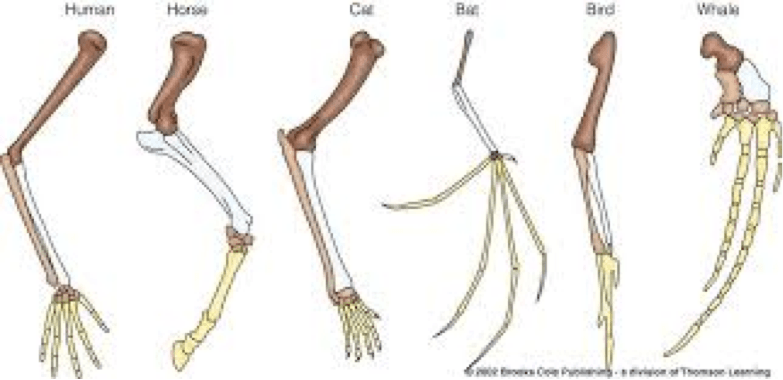
Which of the following are structures that are similar in different species of common ancestry?
Homologous
Vestigial
Analogous
Which of the following are structures that are different but have the same function?
Analogous
Homologous
Vestigial

Which of the following BEST explains the presence of vestigial structures in sperm whales?
Used for embryonic development
In the process of evolving
Same bones as other living mammals
Once were used for walking on land in past ancestors

Which is the concept that life can only arise from another living organism?
Biogenesis
Nonspontaneous Generation
Spontaneous Generation
Meiosis
Which describes how well an organism survives and reproduces?
Fitness
Finesse
Survival Rate
Genetic Drift
When an organism of a species has an adaptation, it will compete for resources better, survive longer and pass that adaptation on to it's offspring. This process is called
Natural selection
Artificial selection
Inbreeding
Outbreeding
What is the advantage of having different shaped beaks?
To look different from other species.
To be able to eat the food readily available in the environment.
To protect itself against predators.
To protect itself against prey.

The genetic code is essentially the same for all organisms. From this, one can logically assume which
of the following?
A gene from one organism can theoretically be expressed by another organism.
Each species has its own unique set of amino acids that is different from all other species.
The same codons in different organisms translate into different amino acids.
Proteins were the first genetic material.

Which of the following Macromolecules is shown in the image?
Carbohydrate
Protein
Lipid
Nucleic Acid

What is the name of the purple shaded part of the brain diagram?
Cerebrum
Cerebellum
Medulla Oblongata
Which plant structure creates the xylem?
Cambium
Stoma
Guard Cell
Dermal Tissue

Which of the following correctly identifies label A and B in the diagram?
A = O2 & C6H12O , B = CO2 & H2O
A = CO2 & H2O , B = O2 & C6H12O
A = CO2 & C6H12O , B = O2 & H2O
A = O2 & H2O, B = CO2 & C6H12O

Which of the following describes tissue in plants that are made of undifferentiated tissue allowing for plant growth?
Meristematic
Cambium
Xylem
Phloem

