
 Worksheets
EOC Review: On Par Edition!
Total questions: 130
Worksheet time: 1hrs 5mins
Name
Class
Date
1.
Which three of the following are fossil fuels?
a)
gasoline
b)
coal
c)
natural gas
d)
solar energy
2.
Enzymes and reactions are similar to:
a)
hamburger and French fries
b)
door and handle
c)
pen and paper
d)
lock and key
3.
__________ is found in all organic compounds.
a)
nitrogen
b)
carbon
c)
oxygen
d)
lithium
4.
enzymes are functional __________.
a)
lipids
b)
carbohydrates
c)
proteins
d)
none of the above
5.
define biology
a)
the study of things people buy.
b)
the study of binary code.
c)
the study of the popular 1960's board game, "The Game of Life."
d)
the study of life.
6.
What do enzymes do?
a)
slow down reactions.
b)
heat up reactions.
c)
speed up reactions.
d)
nothing.
7.
When you overheat an enzyme, it will __________.
a)
oxidize
b)
polymerize
c)
lyse
d)
denature
8.
Which of the following are carbohydrates?
a)
sugars
b)
proteins
c)
lipids
d)
all of the above
9.
True or False? Carbohydrates are a source of 'fast energy.'
a)
True
b)
False
10.

At which temperature is enzymatic activity at its peak?
a)
approximately 0°C
b)
approximately 20°C
c)
approximately 35°C
d)
approximately 60°C
11.

At which temperature will the enzymes be completely denatured?
a)
approximately 0°C
b)
approximately 20°C
c)
approximately 35°C
d)
approximately 60°C
12.
Consider the following: glucose, fructose, lactose
the suffix "-ose" likely means:
a)
sugar
b)
fat
c)
protein
d)
none of the above
13.
carbohydrates are made of:
a)
monosaccharides, also known as simple sugars
b)
monosaccharides, also known as simple proteins
c)
amino acids, also known as simple proteins
d)
lipids, also known as simple sugars
14.
Which of the following are true? (Select all that apply.)
a)
monomer : polymer :: amino acid : protein
b)
monomer : polymer :: lipid : omega-3 fatty acids
c)
monomer : polymer :: monosaccharide : carbohydrates
d)
monomer : polymer :: RNA : DNA
15.
True or false? Fats store long term energy and protect vital organs.
a)
True
b)
False
16.
what is the biological definition of a cell?
a)
primary element in all organic compounds
b)
basic unit of all living things
c)
a type of phone
d)
the opposite of "buy"
17.
What do heat, sunlight, and enzymes have in common?
a)
They all heat up reactions.
b)
They are all necessary for photosynthesis.
c)
They are all catalysts.
d)
They have nothing in common.
18.
Enzymes bind to:
a)
random substrates
b)
neurotransmitters
c)
catalysts
d)
specific substrates
19.
After a workout, you should consume __________ to help your muscles grow and repair.
a)
lipids
b)
sugars
c)
proteins
d)
carbohydrates
20.
Average the following numbers:
2, 4, 6
a)
2
b)
3
c)
4
d)
6
21.
A botanist wants to know how much sunlight is needed for orchid flowers. Which of the following best describes the variables in this experiment?
a)
The amount of growth is the independent variable, and the amount of water is the dependent variable.
b)
The amount of water is the independent variable, and the amount of growth is the dependent variable.
c)
The amount of sunlight is the independent variable, and the amount of growth is the dependent variable.
d)
The amount of growth is the independent variable, and the amount of sunlight is the dependent variable.
22.
Cells all have some protective outer membrane made up of:
a)
lipids
b)
sugars
c)
proteins
d)
carbs
23.
Cell membranes are:
a)
porous and allow all things to enter and exit the cell
b)
selectively permeable
c)
what helps the cell think
d)
None of the above
24.
Which organelle aids in structure and movement in the cell?
a)
nucleus
b)
cytoskeleton
c)
lysosome
d)
mitochondria
25.
Photosynthesis occurs in:
a)
mitochondria
b)
nucleus
c)
vacuoles
d)
chloroplasts
26.
True or False? All prokaryotes have a cell wall.
a)
True
b)
False
27.
What is stored in the nucleus of cells?
a)
genetic information
b)
food
c)
tax records
d)
energy
28.
What do viruses have in common with living cells?
a)
golgi apparatus
b)
rough endoplasmic reticulum
c)
nucleic acids
d)
smooth endoplasmic reticulum
29.
What separates viruses from living cells?
a)
viruses can't reproduce on their own
b)
viruses don't need to eat
c)
viruses don't grow or move themselves
d)
all of the above
30.
What do fungi and plants have in common?
a)
cell wall
b)
nucleus
c)
both A and B are correct
d)
none of the above
31.
Where do cells come from?
a)
other cells
b)
my mom
c)
probably magic
d)
all of the above
32.
What's the main difference between animal and fungal cells?
a)
animal cells have no nucleus
b)
fungal cells have no nucleus
c)
fungi have cell walls, but animals don't
d)
there are no differences between animals and fungi
33.
True or False? In prokaryotes, DNA is stored in the nucleus.
a)
True
b)
False
34.
How does a virus reproduce?
a)
By hijacking the host cell's organelles and using the materials found inside the cell.
b)
Photosynthesis
c)
By using its own mitochondria, the powerhouse of the cell
d)
Idk bro I didn't study.
35.
Which cells have true nuclei?
a)
prokaryotes
b)
eukaryotes
c)
protozoa
d)
archaea
36.
What organelle in plant cells helps with the structure of the plant and stores water? (hint: turgor pressure)
a)
mitochondria
b)
chloroplasts
c)
cell wall
d)
vacuole
37.
What do lysosomes do?
a)
Contain enzymes that break down things in the cell
b)
Make the cell "lyse," or split
c)
Spray Lysol in the cell
d)
None of the above
38.
Basic unit of life:
a)
cell
b)
sale
c)
sell
d)
sail
39.
Plant, fungal, and animal cells are:
a)
eukaryotes
b)
prokaryotes
40.
bacteria and protozoa are:
a)
eukaryotes
b)
prokaryotes
41.
Which of the following increases lipid packing density and maintains high membrane fluidity?
a)
carbohydrates
b)
sugars
c)
proteins
d)
cholesterol
42.
Which of the following is a mechanism by which cells move things in/out with the help of ATP?
a)
passive transport
b)
active transport
c)
diffusion
d)
public transport
43.
Which of the following is a mechanism by which cells move things in/out without the help of ATP?
a)
passive transport
b)
active transport
c)
diffusion
d)
public transport
44.
Which of the following is a mechanism by which things move from an area of high concentration to an area of low concentration?
a)
passive transport
b)
active transport
c)
diffusion
d)
public transport
45.
A student answers a question, gets it right, and the teacher gives them a dollar. Now the whole class wants to answer the next question. This is an example of:
a)
positive feedback
b)
negative feedback
c)
cellular respiration
d)
oxidation reaction
46.
A student answers a question, gets it wrong, and the teacher throws a rock at them. Now the class doesn't want to answer any questions. This is an example of:
a)
positive feedback
b)
negative feedback
c)
cellular respiration
d)
oxidation reaction
47.
What type of feedback loop is ATP likely on?
a)
promoting, positive feedback loop
b)
regulatory, negative feedback loop
c)
Fruit Loops™ (do NOT pick this.)
d)
There is no feedback loop involved.
48.
What type of feedback loop is blood glucose likely on?
a)
promoting, positive feedback loop
b)
regulatory, negative feedback loop
c)
Fruit Loops™ (do NOT pick this.)
d)
There is no feedback loop involved.
49.
Which of the following are false?
a)
hypertonic -- high solute concentration in the solution compared to the cell
b)
hypotonic -- low solute concentration in the solution compared to the cell
c)
isotonic -- same solute concentration in the solution compared to the cell
d)
None of the above.
50.

In the first solution, where will the water flow?
a)
into the cell
b)
out of the cell
c)
nowhere; the cell and solution are at equilibrium
d)
all of the above
51.

In the second solution, the tonicity of the solution is:
a)
hypertonic
b)
hypotonic
c)
isotonic
d)
all of the above
52.

In the third solution, the tonicity of the solution is:
a)
hypertonic
b)
hypotonic
c)
isotonic
d)
all of the above
53.

In the second solution, where will the water flow?
a)
into the cell
b)
out of the cell
c)
nowhere; the cell and solution are at equilibrium
d)
all of the above
54.

In the third solution, where will the water flow?
a)
into the cell
b)
out of the cell
c)
nowhere; the cell and solution are at equilibrium
d)
all of the above
55.
Because the lipid bilayer is hydrophobic, the cell membrane utilizes __________ to allow water to diffuse into the cell.
a)
aqueducts
b)
phagocytosis
c)
pinocytosis
d)
aquaporins
56.
Which of the following is an example of facilitated diffusion?
a)
aquaporins allowing water to cross the cell membrane
b)
endocytosis
c)
gas transfer in the lungs
d)
protein pumps moving ions against their concentration gradient
57.

Which of the following are integral proteins?
a)
b & c
b)
d & e
c)
f
d)
none of the above
58.

Which of the following are peripheral proteins?
a)
b & c
b)
d & e
c)
f
d)
none of the above
59.
When a cell eats, it's called phagocytosis, and when it drinks it's called pinocytosis. These are both examples of:
a)
endocytosis
b)
passive transport
c)
facilitated diffusion
d)
exocytosis
60.
When a cell secretes waste, large particles, or charged particles against their concentration gradient, it is performing:
a)
endocytosis
b)
passive transport
c)
facilitated diffusion
d)
exocytosis
61.
ATP is made of:
a)
a five carbon sugar (ribose)
b)
adenine
c)
three phosphate groups
d)
all of the above
62.
Most of a plants biomass is made of:
a)
oxygen from the atmosphere
b)
hydrogen from the water it absorbs
c)
carbon from carbon dioxide
d)
oxygen from the water it absorbs
63.
Which process of cellular respiration produces the most energy?
a)
glycolysis
b)
the Krebs cycle
c)
the electron transport chain
d)
none of the above
64.
How many net ATP are produced in that process from the above question?
a)
5
b)
2
c)
32
d)
none
65.
Where do the light reactions of photosynthesis occur?
a)
the thylakoid of the chloroplast
b)
the stroma of the chloroplast
c)
the matrix of the mitochondria
d)
the inner membrane of the mitochondria
66.
Where do the dark reactions of photosynthesis occur?
a)
the thylakoid of the chloroplast
b)
the stroma of the chloroplast
c)
the matrix of the mitochondria
d)
the inner membrane of the mitochondria
67.
Where do glycolysis and fermentation both occur?
a)
the cytoplasm of the cell
b)
the matrix of the mitochondria
c)
the inner membrane of the mitochondria
d)
all of the above
68.
Where does the Krebs cycle (aka citric acid cycle) occur?
a)
the cytoplasm of the cell
b)
the matrix of the mitochondria
c)
the inner membrane of the mitochondria
d)
all of the above
69.
Where do the electrons and protons needed for photosynthesis come from?
a)
photolysis
b)
glucose
c)
electron transport chain
d)
none of the above
70.
What is the catalyst for the dark reactions?
a)
sunlight
b)
heat
c)
rubisco
d)
none of the above
71.
Which of the following are true regarding photosynthesis and cellular respiration?
a)
they both store energy from sunlight into glucose molecules
b)
they both occur only via chloroplasts
c)
cellular respiration is photosynthesis in reverse
d)
all of the above
72.
Which kind of light is least likely to be used in photosynthesis?
a)
red light
b)
blue light
c)
green light
d)
yellow light
73.
What is the function of NADP+ in photosynthesis?
a)
to act as an electron carrier
b)
to shuttle high energy electrons to the electron transport chain
c)
to aid proton pumps in creating an electrochemical gradient
d)
all of the above
74.
What type of photosynthesis is the dark reaction we discussed in class?
a)
C3
b)
C4
c)
CAM
d)
none of the above
75.
Which of the following is an example of anaerobic respiration?
a)
glycolysis
b)
the Krebs cycle
c)
the electron transport chain
d)
both B and C
76.
Which of the following yields the highest net ATP?
a)
glycolysis
b)
the Krebs cycle
c)
the electron transport chain
d)
both B and C
77.
What are the products of photosynthesis?
a)
carbon dioxide and water
b)
glucose and oxygen
c)
rubisco
d)
none of the above
78.
What are the reactants of photosynthesis?
a)
carbon dioxide and water
b)
glucose and oxygen
c)
rubisco
d)
none of the above
79.
What are the limiting reagents of cellular respiration?
a)
oxygen
b)
carbon dioxide
c)
NAD+
d)
both A and C
80.
Which cells are best adapted for fermentation?
a)
fat cells
b)
nerve cells
c)
muscle cells
d)
none of the above
81.
Which of the following is the general equation for photosynthesis?
a)
pyruvic acid + NADH → lactic acid + NAD+
b)
pyruvic acid + NADH → ethyl alcohol + CO2 + NAD+
c)
6CO2 + 6H2O → C6H12O6 + 6O2
d)
ATP + NADPH + CO2 → ADP + NADP + glucose + H20
e)
C6H12O6 + 6O2 → 6CO2 + 6H2O
82.
Which of the following is the general equation for the dark reactions of photosynthesis?
a)
pyruvic acid + NADH → lactic acid + NAD+
b)
pyruvic acid + NADH → ethyl alcohol + CO2 + NAD+
c)
6CO2 + 6H2O → C6H12O6 + 6O2
d)
ATP + NADPH + CO2 → ADP + NADP + glucose + H20
e)
C6H12O6 + 6O2 → 6CO2 + 6H2O
83.
Which of the following is the general equation for the cellular respiration?
a)
pyruvic acid + NADH → lactic acid + NAD+
b)
pyruvic acid + NADH → ethyl alcohol + CO2 + NAD+
c)
6CO2 + 6H2O → C6H12O6 + 6O2
d)
ATP + NADPH + CO2 → ADP + NADP + glucose + H20
e)
C6H12O6 + 6O2 → 6CO2 + 6H2O
84.
Which of the following is the general equation for the alcoholic fermentation?
a)
pyruvic acid + NADH → lactic acid + NAD+
b)
pyruvic acid + NADH → ethyl alcohol + CO2 + NAD+
c)
6CO2 + 6H2O → C6H12O6 + 6O2
d)
ATP + NADPH + CO2 → ADP + NADP + glucose + H20
e)
C6H12O6 + 6O2 → 6CO2 + 6H2O
85.
Which of the following is the general equation for the lactic acid fermentation?
a)
pyruvic acid + NADH → lactic acid + NAD+
b)
pyruvic acid + NADH → ethyl alcohol + CO2 + NAD+
c)
6CO2 + 6H2O → C6H12O6 + 6O2
d)
ATP + NADPH + CO2 → ADP + NADP + glucose + H20
e)
C6H12O6 + 6O2 → 6CO2 + 6H2O
86.
True or False? Oncogenes are mutations that have the potential to cause cancer.
a)
True
b)
False
87.
What word refers to the invasive spread of cancer cells into new tissues?
a)
Metastasis
b)
Metamorphosis
c)
Metabolism
d)
Metacarpal
88.
The figure displays age based demographics (<1-85)
relating to cancer rates. Interpret the data to answer the following question: What is most likely the reason for the trend?
a)
Spindle fibers break down as we age, resulting in checkpoint errors during the M phase
b)
Elderly people are exposed to more carcinogens in their lifetime, like sunlight, than younger people.
c)
In the 1920’s, radium based drinks like RadiThor were marketed to help with medical ailments and as a performance enhancing drug; most of these patients consumed radioactive solutions like these.
d)
None of the above.
89.
Define cancer.
a)
The zodiac for people born in the fall
b)
A malignant growth caused by a genetic mutation that bypasses regulatory checkpoints
c)
A benign growth caused by a genetic mutation that ignores replication checkpoints
d)
None of the above.
90.
Indicate which of the following cancers have metastasized:
a)
A. Glioma found in the brain and spinal column
b)
Leukemia found in both the blood and bone marrow
c)
Carcinoma found in the lymph of the body
d)
None of the above.
91.
Which of the following is definitely a malignant growth?
a)
tumor
b)
cancer
c)
sunspots
d)
None of the above.
92.
__________ : oncoviruses :: stomping : roaches
a)
CAR-T Cell Therapy
b)
chemotherapy
c)
CRISPR
d)
None of the above.
93.
Which of the following are the stages of mitosis in order?
a)
interphase, prophase, metaphase, anaphase, telophase, cytokinesis
b)
prophase, anaphase, interphase, telophase, cytokinesis, metaphase
c)
anaphase, cytokinesis, interphase, metaphase, prophase, telophase
d)
all of the above
94.
What type of reproduction is mitosis?
a)
sexual
b)
asexual
c)
metrosexual
d)
none of the above
95.
Which of the following are reasons why cells divide?
a)
The larger a cell becomes, the more demand it places on its DNA.
b)
Larger cells are less efficient at consuming food and excreting waste.
c)
There is a limit on the ratio between cell surface area and volume.
d)
All of the above.
96.
Mitosis produces:
a)
fraternal twin cells
b)
haploid cells, or gametes
c)
genetically identical daughter cells
d)
none of the above
97.
During which phase is the cell at rest?
a)
prophase
b)
metaphase
c)
interphase
d)
anaphase
98.
cytokinesis is:
a)
the splitting of the cytoplasm
b)
cellular exercise
c)
how cells communicate
d)
none of the above
99.
telophase is:
a)
the phase in which the genetic material condenses into chromosomes
b)
the phase in which the cells line up at the center of the cell
c)
the phase in which spindle fibers pull the sister chromatids to opposite ends of the cell
d)
the phase in which the nuclear envelope reforms, the spindle breaks down, and chromosomes unravel
100.
metaphase is:
a)
the phase in which the genetic material condenses into chromosomes
b)
the phase in which the cells line up at the center of the cell
c)
the phase in which spindle fibers pull the sister chromatids to opposite ends of the cell
d)
the phase in which the nuclear envelope reforms, the spindle breaks down, and chromosomes unravel
101.
anaphase is:
a)
the phase in which the genetic material condenses into chromosomes
b)
the phase in which the cells line up at the center of the cell
c)
the phase in which spindle fibers pull the sister chromatids to opposite ends of the cell
d)
the phase in which the nuclear envelope reforms, the spindle breaks down, and chromosomes unravel
102.
prophase is:
a)
the phase in which the genetic material condenses into chromosomes
b)
the phase in which the cells line up at the center of the cell
c)
the phase in which spindle fibers pull the sister chromatids to opposite ends of the cell
d)
the phase in which the nuclear envelope reforms, the spindle breaks down, and chromosomes unravel
103.
This phase is also known as mitosis; in this phase, the metaphase checkpoint checks for chromosome spindle attachment.
a)
G1
b)
S
c)
G2
d)
M
104.
This phase is the period of cell growth; the checkpoint of this phase checks for growth factors, nutrients, and DNA damage.
a)
G1
b)
S
c)
G2
d)
M
105.
This phase is the period of DNA synthesis.
a)
G1
b)
S
c)
G2
d)
M
106.
This phase is when the organelles of the cell are replicated to prepare for mitosis. Its checkpoint checks for cell size and DNA replication.
a)
G1
b)
S
c)
G2
d)
M
107.
Which stem cells have the most potential?
a)
totipotent
b)
pluripotent
c)
multipotent
d)
none of the above
108.
This protein tells cells when to divide by binding to, and activating, CDK.
a)
Cas9
b)
cyclin
c)
rubisco
d)
none of the above
109.
This term means programmed cell death:
a)
senescence
b)
apoptosis
c)
lyse
d)
none of the above
110.
What prevents your chromatin from kinks or tangling?
a)
DNA helicase
b)
ligase
c)
Okazaki fragments
d)
histones
111.
DNA is made of:
a)
deoxyribose
b)
phosphate group
c)
nitrogenous base
d)
all of the above
112.
What is the difference in nucleotides between RNA and DNA?
a)
RNA has Uracil instead of Thymine
b)
DNA has Guanine instead of Cytosine
c)
RNA has ADP instead of ATP
d)
DNA has Adenine instead of Thymine
113.
Which type of bond holds together the "backbone" (alternating sugar & phosphate groups) of DNA?
a)
hydrogen bonds
b)
peptide bonds
c)
phosphodiester bonds
d)
Van der Waals forces
114.
Which type of bond holds together the nitrogenous bases of DNA?
a)
hydrogen bonds
b)
peptide bonds
c)
phosphodiester bonds
d)
Van der Waals forces
115.
Which type of bond holds the polypeptide chain together?
a)
hydrogen bonds
b)
peptide bonds
c)
phosphodiester bonds
d)
Van der Waals forces
116.
Why is DNA called the blueprint of life?
a)
because it typically appears blue in vitro
b)
because it's designed by engineers in the lab before you're born
c)
because it codes for the proteins that make an organism
d)
none of the above
117.
The bonds in DNA form when
a)
purines pair with pyrimidines
b)
purines pair with purines
c)
pyrimidines pair with pyrimidines
d)
none of the above
118.
What are Okazaki fragments?
a)
sections of DNA that code for a trait
b)
pieces of genetic code added to the lagging strand during DNA replication
c)
pieces of genetic code added to the leading strand during DNA replication
d)
none of the above
119.
What unzips your DNA
a)
ligase
b)
Okazaki fragments
c)
DNA polymerase
d)
DNA helicase
120.
Like your aglets protect your shoe strings, ____________ protects your DNA.
a)
telomeres
b)
telophone
c)
telegraph
d)
telophase
121.
In the Central Dogma of biology, the genetic information becoming RNA from a section of DNA is called
a)
transformation
b)
transcription
c)
translation
d)
transition
122.
In the Central Dogma of biology, the genetic information becoming a protein from RNA is called
a)
transformation
b)
transcription
c)
translation
d)
transition
123.
What is the complementary strand of RNA for the following section of DNA? GATTACA
a)
GATTACA
b)
CTAATGT
c)
UGUAAUC
d)
CUAAUGU
124.
What is the structural difference between DNA and RNA?
a)
RNA is a double helix, but DNA is a single helix
b)
RNA is a single helix, but DNA is a double helix
c)
RNA has Thymine while DNA has Uracil
d)
None of the above
125.
What is the difference between a point mutation and a frameshift mutation?
a)
Point mutations can only be deletions, changing the proteins the sequence codes for.
b)
Frameshift mutations shift the entire reading frame, changing the proteins the sequence codes for.
c)
Frameshift mutations swap out a single nitrogenous base, changing the protein a single codon codes for.
d)
None of the above.
126.
kChoose the complimentary mRNA strand:
CGTAGCTAGTAC
a)
CAUGACUGCAUG
b)
ATGCTGCATATC
c)
GCATCGATCATG
d)
GCAUCGAUCAUG
127.
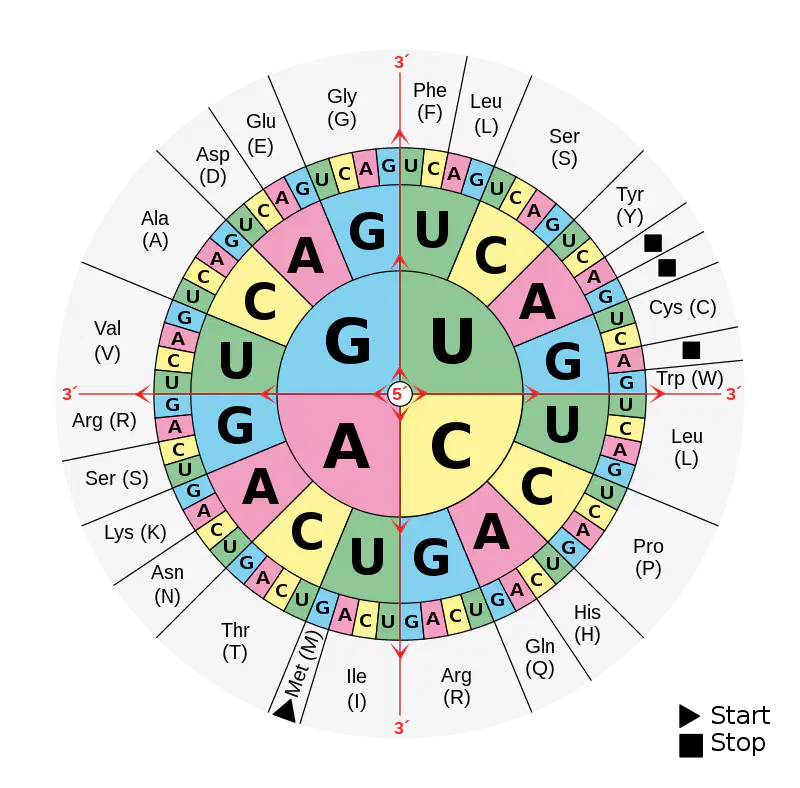
Which of the following proteins does the DNA sequence TAC code for?
*hint: transcribe it into mRNA first*
a)
Methionine
b)
Arganine
c)
Leucine
d)
Valine
128.
What does the tRNA molecule use to match peptides to the mRNA sequence?
a)
anticodon
b)
codon
c)
magic, probably Idk man
d)
all of the above
129.
What are reproductive germ cells?
a)
bacteria
b)
pathogens
c)
sex cells
d)
viruses
130.
Which of the following is most likely to affect gene expression?
a)
point mutation
b)
silent mutation
c)
insertion/deletion
d)
none of the above
100 %

