wayground logo

Free Printable Worksheets

Font size

S
M
L
XL
Worksheets

Quarter 3 Assessment Review

Total questions: 57

Worksheet time: 1hrs 17mins

Name
Class
Date
1.

Which type of heat transfer is shown?

a)

convection

b)

conduction

c)

radiation

d)

stir frying

2.

What type of heat transfer is shown?

a)

convection

b)

conduction

c)

radiation

d)

bonfire

3.

Law of Conservation of Mass says...

a)

Energy is always created and destroyed

b)

Energy is only in hot things

c)

Energy can be destroyed easily

d)

Energy cannot be created or destroyed

4.
Heat transfer in boiling water.
a)
Conduction
b)
Convection
c)
Radiation
5.
The heat transfer in the image is by
a)
convection
b)
conduction
c)
radiation
6.
When the 2nd story of a house is warmer than the 1st floor of a house is heat transfer through 
a)
conduction
b)
convection
c)
radiation
d)
thermal equilibrium
7.
The sun warming your skin is an example of heat transfer through 
a)
conduction
b)
convection
c)
radiation
d)
thermal electricity
8.
In the situation illustrated, how will heat energy move? Heat energy will be transferred from –
a)
the water to the hot plate by convection.
b)
the water to the hot plate by conduction.
c)
the hot plate to the water by convection.
d)
the hot plate to the water by conduction.
9.
An example of a situation in which an egg is receiving thermal energy through convection -
a)
The egg is kept warm by its mother in the nest.
b)
An egg cracked on a hot sidewalk starts to cook.
c)
The egg is hard boiled in a pot of water.
d)
A metal pan on the stove fries the egg.
10.

What kind of heat transfer is occurring when the sun warms the sand?

a)

Conduction

b)

Convection

c)

Radiation

d)

All of them

11.
A rock formed from fragments of other rocks is a(n)
a)
Metamorphic Rock
b)
Sedimentary Rock
c)
Extrusive Rock
d)
Igneous Rock
12.

Any rock that forms from another rock as a result of changes in heat or pressure (or both) is a:

a)

chemical rock

b)

igneous rock

c)

sedimentary rock

d)

metamorphic rock

13.
Cooling & crystalization produce
a)
igneous rocks
b)
metamorphic rocks
c)
sedimentary rocks
14.
The process by which igneous rocks are formed...
a)
heat and pressure
b)
melting and cooling
c)
weathering and erosion
15.
This rock was another type of rock that was heated and compressed over time. What type of rock is this?
a)
Sedimentary
b)
Igneous
c)
Metamorphic
16.
Rock that forms when sediment from older rocks get pressed and cemented together.
a)
Sedimentary Rock
b)
Metamorphic Rock
c)
Igneous Rock
17.
Rock that forms when pressure and temperature change existing rock.
a)
Igneous Rock
b)
Sedimentary Rock
c)
Metamorphic Rock
d)
Rock Cycle
18.
_______ rock forms from magma/lava
a)
Metamorphic
b)
Sedimentary
c)
Igneous
19.
This rock was formed by smaller pieces of rock that settled at the bottom of a lake millions of years ago. What type of rock is this?
a)
Sedimentary
b)
Igneous
c)
Metamorphic
20.
a rock that formed from layers of sediments
a)
metamorphic
b)
igneous
c)
sedimentary
d)
magma
21.

Which type of rock is made from magma cooling inside Earth?

a)

cool rock

b)

intrusive igneous

c)

non-foliated metamorphic

d)

sedimentary

22.
Which type of rock is made by small bits of rock, mud, or sand compacted and cemented together?
a)
Coal
b)
igneous
c)
metamorphic
d)
sedimentary
23.
Which type of rock is made from a rock being changed by heat and pressure?
a)
Smooshed Rock
b)
igneous
c)
metamorphic
d)
sedimentary
24.

Fossils are found in ____________ rocks.

a)

metamorphic

b)

magma

c)

igneous

d)

sedimentary

25.
Lava which cools on Earth's surface forms an
a)
metamorphic rock
b)
intrusive igneous rock
c)
extrusive igneous rock
d)
foliated metamorphic rock
26.
Rock that forms when sediment from older rocks get pressed and cemented together.
a)
Sedimentary Rock
b)
Metamorphic Rock
c)
Igneous Rock
27.
The process by which metamorphic rocks are formed...
a)
heat and pressure
b)
erosion and deposition
c)
melting and cooling
28.

What type of thermal energy transfer is warming the man from the fire?

a)

Convection

b)

Conduction

c)

Radiation

d)

Heat

29.

What type of thermal energy transfer is occurring at point A?

a)

Radiation

b)

Convection

c)

Conduction

d)

None of the above

30.

What type of thermal energy transfer is occurring at point B?

a)

Convection

b)

Conduction

c)

Radiation

d)

Kinetic

31.

What type of thermal energy transfer is occurring at point C?

a)

Convection

b)

Conduction

c)

Radiation

d)

Heat

32.

What type of thermal energy transfer is occurring when you are warmed by the sun?

a)

Convection

b)

Conduction

c)

Radiation

d)

Solar

33.

Uneven heating and cooling of the Earth's surface forces the air to circulate in an attempt to find equilibrium or balance. This type of heat transfer is an example of ______.

a)

Convection

b)

Conduction

c)

Radiation

d)

Solar energy

34.

An iron transfers heat to clothing through ___________.

a)

Conduction

b)

Convection

c)

Radiation

d)

Electricity

35.

What type of thermal energy transfer is occurring from the steam rising from the hot coffee?

a)

Conduction

b)

Convection

c)

Radiation

d)

Gas

36.

What are the types of Thermal Energy transfer?

a)

Conduction

b)

Convection

c)

Condensation

d)

Radiation

37.

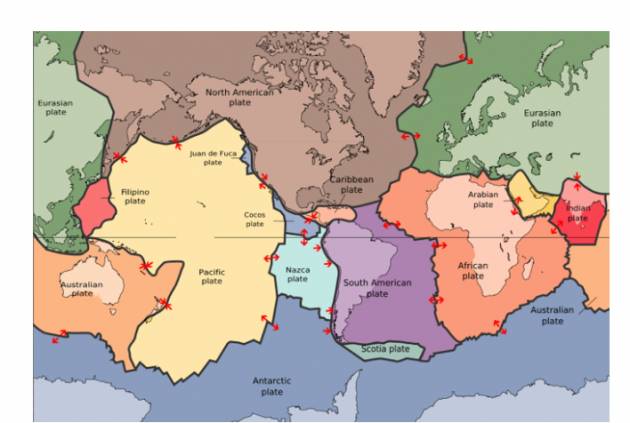
The movement of the tectonic plates is caused by

a)

the rotation of the Earth.

b)

convection currents in the Asthenosphere

c)

the gravity of the iron-nickel core.

d)

the Moho discontinuity.

38.
What geological forces might be responsible for this range of mountains?
a)
diverging tectonic plates
b)
erosion of the land by the ocean
c)
converging tectonic plates
d)
deposition of sediments by the ocean
39.

Where are earthquakes MOST LIKELY to occur?

a)

close to the equator

b)

close to the center of tectonic plates

c)

at divergent or convergent plate boundaries

d)

at transform plate boundaries

40.

The 2004 Indian Ocean tsunami was caused by a shift in two plates that pushed one section of the sea floor under another section of the sea floor by 5 meters. What type of boundary is this?

a)

divergent

b)

convergent

c)

transform

d)

metamorphic

41.

Where would sea floor spreading most likely occur?

a)

At convergent boundaries (oceanic vs. oceanic)

b)

At convergent boundaries (oceanic vs. continental)

c)

At divergent plate boundaries (oceanic vs. oceanic)

d)

At transform plate boundaries

42.
This boundary is described by two plates moving away from eachother along the edges and separating. The resulting gap allows magma to rise and create new crust, forming new lithosphere. 
a)
Convergent Boundary 
b)
Divergent Boundary  
c)
Transform Boundary
43.
This boundary is described as two plates moving past eachother ALONG THE EDGES horizontally.  These boundaries will get stuck or lock against eachother causing earthquakes when they slip and release. 
a)
Convergent Boundary
b)
Divergent Boundary
c)
Transform Boundary
44.
This boundary is described as moving toward one another  When the plates are both continental plates the will crumple up and form a mountains. When they are continental and oceanic plates, subduction occurs  and earthquakes and volcanoes form. 
a)
Convergent Boundary
b)
Divergent Boundary
c)
Transform Boundary
45.
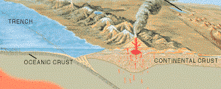
Trenches, deep underwater canyons on the sea floor are created at this type of boundary 
a)
Divergent
b)
Convergent, Subduction Zone
c)
Transform 
46.
New crust is created at this type of  boundary.
a)
Divergent
b)
Convergent, Subduction Zone
c)
Transform 
47.
Mountains are created at this type of  boundary.
a)
Divergent 
b)
Convergent
c)
Transform 
48.
Mid Ocean Ridge Formation  is created at this type of  boundary.
a)
Divergent 
b)
Convergent
c)
Transform 
49.

This famous fault in California has a lot of earthquakes!

a)

New Madrid

b)

Denali Fault

c)

Ramapo Seismic Zone

d)

San Andreas Fault

50.

What type of boundary is shown in the diagram?

a)

Divergent

b)

Convergent

c)

Transform

51.

What type of boundary is shown in the diagram?

a)

Divergent

b)

Convergent

c)

Slide/Transform

52.

What type of boundary is shown in the diagram?

a)

Divergent

b)

Convergent

c)

Slide/Transform

53.
What causes tectonic plates to move along the Earth's surface?
a)
wind
b)
ocean currents
c)
convection in the mantle
d)
expansion of the Earth
54.

___________ currents in the Earth's asthenosphere cause plate to shift at their boundaries. This movement also causes earthquakes and volcanic activity.

a)

conduction

b)

convection

c)

radiation

d)

ocean

55.

Can you draw and label a picture for all 3 thermal energy transfers?

a)

Yes

b)

No

56.

Can you justify and explain why we use rocks for certain products?

a)

Yes

b)

No

57.

Can you draw and label plate movement when given a geological event?

a)

No

b)

Yes