Wayground logo

Free Printable Worksheets

Font size

S
M
L
XL
Worksheets

skeletal and muscular systems

Total questions: 39

Worksheet time: 38mins

Name
Class
Date
1.
attaches bone to bone
a)
tendon
b)
ligament 
2.
The skeletal system does all of the following EXCEPT
a)
produces red blood cells
b)
stores calcium and minerals
c)
protects organs
d)
excretes waste
3.
attaches muscle to bone 
a)
tendon
b)
ligament 
4.
What are the main functions of the skeleton?
a)
A) protection
b)
b) Body shape 
c)
C) movement
d)
D) A,b and c
5.
No movement would occur without the skeletal system.
a)
True
b)
False
c)
Huh?
6.
What are the 3 types of muscle tissue?
a)
Thigh, Calf, & Shoulder
b)
Traps, Forearm, & Abs
c)
Hamstring, Biceps, & Triceps
d)
Smooth Muscle, Cardiac Muscle, & Skeletal Muscle
7.
Which muscles are involuntary?
a)
skeletal
b)
cardiac
c)
smooth
d)
smooth and cardiac
8.
When a muscle contracts, it _______
a)
gets longer
b)
gets shorter
c)
gets thinner
d)
grows hair
9.
Which types of muscle tissue are voluntary?
a)
Cardiac
b)
Skeletal
c)
Smooth
d)
Cardiac and Smooth
10.
Skeletal muscles are attached to the _________.
a)
Stomach
b)
Lungs
c)
Bones
d)
Involuntary Muscles
11.
Muscles always work in _____
a)
pairs
b)
groups of 3
c)
bones
d)
joints
12.
Voluntary muscle is
a)
muscle that has to be told when to move
b)
muscle that moves automatically
c)
muscle that needs to be stretched regularly
d)
muscle that makes up the heart and stomach
13.
What type of muscle would a sprinter have more of?
a)
Fast Twitch 
b)
Slow Twitch 
14.
A Triathlete would have more of these muscle fibers?
a)
Slow Twitch
b)
Fast Twitch
15.
Name a pair of muscles that work together. 
a)
Quads and Gastronomics  
b)
Glutes and Hamstrings
c)
Abs and Lats 
d)
Triceps and Biceps 
16.

fibers that contract/relax very quickly

a)

voluntary

b)

involuntary

c)

fast twitch

d)

slow twitch

17.

muscles that contract/relax more slowly

a)

fast twitch

b)

slow twitch

c)

involuntary

d)

voluntary

18.

substance produced in the anaerobic system

a)

strain

b)

synovial fluid

c)

lactic acid

d)

pepsin

19.

energy system that requires oxygen

a)

ATP

b)

aerobic

c)

anaerobic

d)

voluntary

20.

energy system without oxygen

a)

ATP

b)

aerobic

c)

anaerobic

d)

fast twitch

21.
Which type of muscle is striated?
a)
Skeletal 
b)
Muscles in your throat 
c)
Nervous tissue 
d)
Smooth
22.
 Dense connective tissue gets its strength from its matrix.  What is the composition of this matrix?
a)
 Plasma 
b)
Collagen, phosphorous, and calcium 
c)
Collagen, elastin, and fibrocartilage
d)
Parallel collagen fibers
23.
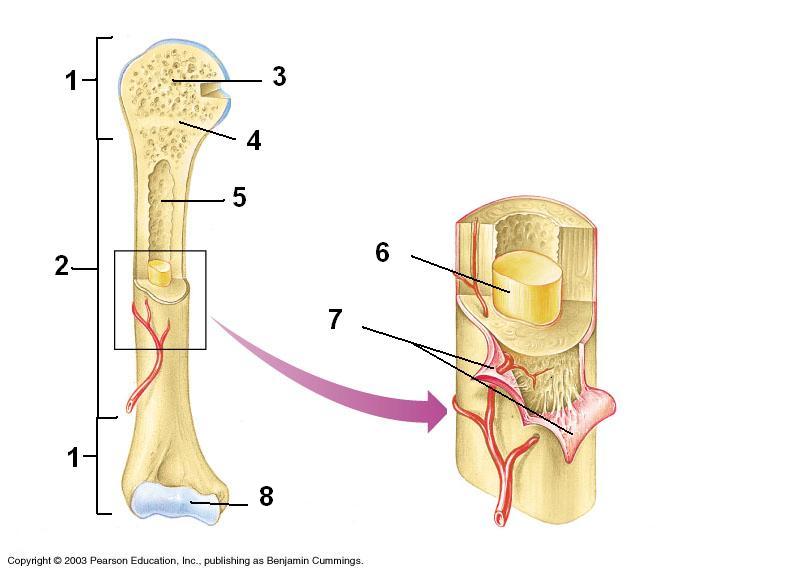
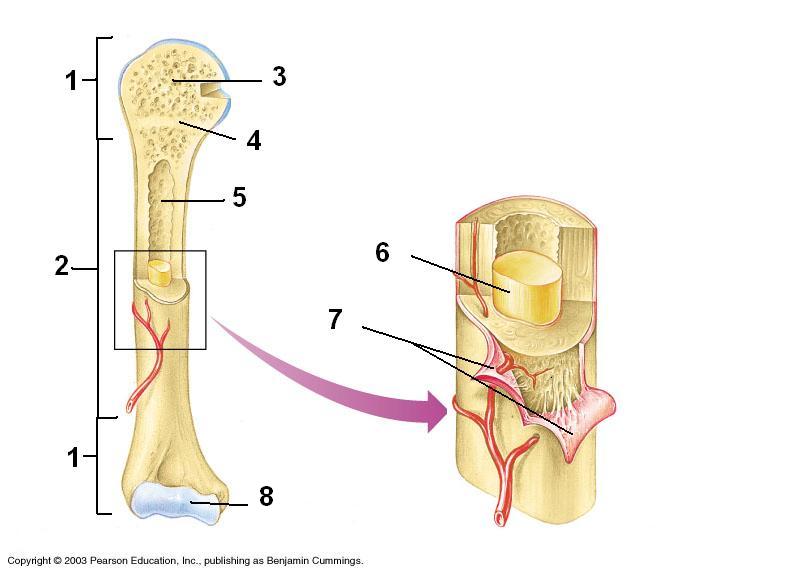
Structure #7 is the 
a)
medullary cavity
b)
periosteum
c)
epiphysis
d)
diaphysis
24.
In adults, the substance at #6 would be 
a)
red marrow
b)
yellow marrow
c)
spongy bone
d)
clotted blood
25.
Periosteum
a)
the membrane lining the bone cavity
b)
the tough membrane covering the shaft of the bone
c)
the shiny, articulating cartilage on the ends of a bone
d)
the blood vessels inside a bone
26.
Where are blood cells made? 
a)
Yellow marrow 
b)
Red marrow
c)
Spongy Bone 
d)
Periosteum
27.
Which connective tissue contains a gel-like matrix and is found in the nose, ear, and at the end of bones.
a)
Bone
b)
Cartilage
c)
Blood
d)
Adipose
28.

What are the four types of bones?

a)

Long, short, medium, thin

b)

Long, irregular, short, flat

c)

Flat, short, long, Irregular

d)

Regular, long, flat, short

29.

What are the 3 main types of joints?

a)

Ball and socket

b)

Fixed

c)

Hinge

d)

Synovial

e)

Slightly moveable

30.

What is an example of a fixed joint?

a)

Vertebrae

b)

Elbow

c)

Skull

31.

What are fixed joint connected together with?

a)

Cartilage

b)

Fibrous connective tissue

32.

What term is given to the point where 2 or more bones meet?

a)

Joint

b)

Ligament

c)

Cartilage

33.

Which is an example of a hinge joint

a)

knee and elbow

b)

shoulder and hip

c)

neck

d)

ankle and wrist

34.
Name this joint
a)
gliding
b)
saddle
c)
ball and socket
d)
condyloid
35.
Name this joint
a)
pivot
b)
saddle
c)
gliding
d)
hinge
36.
Which joint allows movement in only one direction?
a)
ball and socket
b)
fiibrous
c)
hinge
d)
pivot
37.
Allow bones to move in almost any direction
a)
Pivotal joint
b)
Ball and socket joint
c)
Hinge joint
d)
Gliding joint
38.
The knee joint is
a)
Hinge
b)
Gliding
c)
Ball and socket
d)
Pivot
39.

Which causes a muscle contraction?

a)

Actin Pulls on the myosin

b)

Myosin Pulls on the Titin

c)

Myosin Pulls on Actin

d)

Actin Pulls on Titin