wayground logo

Free Printable Worksheets

NEW

Font size

S
M
L
XL
Worksheets

Patterns in Nature Review

Total questions: 63

Worksheet time: 53mins

Name
Class
Date
1.
The correct order of the four stages of complete metamorphosis is:
a)
egg, larva, pupa, adult
b)
pupa, egg, larva, adult
c)
egg, pupa, larva, adult
d)
larva, adult, pupa, egg
2.
Insects that undergo incomplete metamorphosis go through how many stages?
a)
2
b)
10
c)
8
d)
3
3.
The stage during the life cycle of an insect between the larva and the adult is:
a)
baby
b)
pupa
c)
puppy
d)
wing
4.
Most insects go through _______________ which involves four stages.
a)
complete metamorphosis
b)
decomposing
c)
irregular metamorphosis
d)
offspring
5.

The living things that are made when an animal reproduces are...

a)

larva

b)

pupa

c)

offspring

d)

fruit

6.

The ___________ hatches from from the egg.

a)

larva

b)

pupa

c)

chrysalis

d)

egg

7.

The caterpillar becomes a __________.

a)

larva

b)

pupa

c)

chrysalis

d)

egg

8.

An adult butterfly comes out of the _____________.

a)

larva

b)

pupa

c)

chrysalis

d)

egg

9.

Which animal shown does not hatch from an egg, but is born alive?

a)
b)
c)
d)
10.

A growth process in which an animal goes through major changes in body form over their life cycle.

a)

direct development

b)

learned behavior

c)

metamorphosis

d)

gene

11.

What is the third stage in the life cycle of a butterfly?

a)

Adult (butterfly)

b)

Pupa (chrysalis)

c)

Egg

d)

Larva (caterpillar)

12.
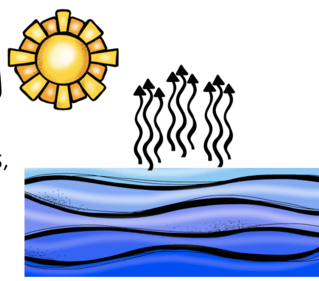
What part of the water cycle does this picture show?
a)
condensation
b)
precipitation
c)
evaporation
d)
transpiration
13.
Which of these is an example of precipitation?
a)
snow
b)
air
c)
clouds
d)
vapor
14.
Evaporation happens when the sun ___________ water and turns it into vapor.
a)
cools
b)
heats up
c)
freezes
d)
lights up
15.
When water condenses, the water vapor in the air gets ___________ and changes back into liquid.
a)
cold
b)
hot
c)
warm
d)
solid
16.
What is the water cycle?
a)
the 3 forms of water
b)
the movement of water on, above, or below the surface of the Earth
c)
when water melts
d)
when clouds form
17.
Precipitation happens when clouds of water droplets are too ______________.
a)
cold
b)
light
c)
heavy
d)
hot
18.
Where is most water found on Earth?
a)
glaciers
b)
lakes
c)
rivers
d)
oceans
19.
What source of energy evaporates the most water from Earth’s surface?
a)
volcanoes
b)
the sun
c)
lightning
d)
wind
20.
What is A?
a)
Evaporation
b)
Condensation
c)
Precipitation
d)
Runoff
21.
What is B?
a)
Evaporation
b)
Condensation
c)
Precipitation
d)
Runoff
22.
Name this tool. 
a)
Barometer
b)
Hygrometer
c)
Thermometer
d)
Ruler
23.
What tool is used to measure the amount of rain that has fallen? 
a)
Rain Gauge
b)
Barometer
c)
Wind Vane
d)
Precipitation
24.
What tool is used to measure wind speed? 
a)
Wind Vane
b)
Anemometer
c)
Thermometer
d)
Barometer
25.
What tool is used to determine wind direction? 
a)
Barometer
b)
Hygrometer
c)
Anemeometer
d)
Wind Vane
26.
What is the name the name of this weather tool? 
a)
Rain Gauge
b)
Telescope
c)
Wind Vane
d)
Anemometer
27.
What is the name of this weather tool and what does it measure? 
a)
Rain Gauge and the amount of water that is in the air
b)
Rain Gauge and the amount of rain that has fallen
c)
Hygrometer and the amount of rain that has fallen
d)
Hygrometer and the amount of water that is in the air
28.
What does a barometer measure? 
a)
measures high and low pressure in the air
b)
measures humidity in the air
c)
measures speed of the wind 
d)
measures the amount of rain that has fallen
29.
What tool measures humidity in the air? 
a)
anemometer
b)
water gauge
c)
hygrometer
d)
barometer
30.
Which term describes when the Earth spins on its axis.
a)
Rotation
b)
Revolution
c)
Kepler's Laws
d)
Precession
31.
Which type of motion causes night / day? 
a)
Rotation
b)
Revolution
c)
Kepler's 1st Law
d)
Nutation
32.
Which term describes the time it takes for Earth to complete one circle around the sun.
a)
Rotation
b)
Revolution
c)
Kepler's 1st Law
d)
Barycenter
33.
Lasts 365 days
a)
Rotation
b)
Revolution
c)
Nutation
d)
Precession
34.
Lasts 24 hours
a)
Rotation
b)
Revolution
c)
Precession 
d)
Barycenter
35.

The Earth going around the Sun one time is called a . . .?

a)

Revolution

b)

Rotation

c)

Shadow

d)

Seasons

36.

Why do we have seasons?

a)

The Earth spins on it's axis

b)

The sun appears to go across the sky

c)

The Earth orbits the Sun

d)

The Earth tilts toward the Sun

37.

When the Earth tilts toward the Sun we have?

a)

Winter

b)

Summer

c)

Spring

d)

Fall

38.

When the Earth tilts away from the Sun we have?

a)

Winter

b)

Spring

c)

Summer

d)

Fall

39.

What is an imaginary line on which the Earth spins?

a)

Rotation

b)

Revolution

c)

Tilted

d)

Axis

40.

How long does a rotation take:

a)

365 days

b)

One Year

c)

24 hours

d)

365.25 days

41.

How long does a revolution take?

a)

365.25 days

b)

24 hours

c)

30 Seconds

d)

One Week

42.

Why does a shadow appear to move?

a)

Earth revolves around the sun

b)

Earth rotates on it's axis

c)

The earth tilts away from the Sun

d)

None of the above

43.

What kind of objects cause shadows?

a)

transparent

b)

tranlucent

c)

opague

d)

big

44.

Earth spins on its _______________.

a)

Axis

b)

Equator

c)

Hemisphere

d)

Toes

45.

A term that is used to describe Earth’s path around the Sun is Earth’s ________________________.

a)

Axis

b)

Equator

c)

Orbit

d)

Lane

46.

______________________ makes the Sun appear to move across the sky.

a)

Earth's Tilt

b)

Earth's Revolution

c)

Earth's Rotation

d)

Earth's Gravity

47.

When it is daytime on the half of Earth facing the Sun, it is_________________on the other half of Earth

a)

Daytime

b)

Nighttime

c)

Summer

d)

Winter

48.
23.5 degrees
a)
axis
b)
day
c)
tilt
d)
rotation
49.
If its ____ in the Northern hemisphere, then its fall in the Southern hemisphere. 
a)
spring
b)
summer
c)
fall
d)
winter
50.
If its ____ in the Northern hemisphere, then its summer in the Southern hemisphere. 
a)
spring
b)
summer
c)
fall
d)
winter
51.
The hemisphere where you live
a)
northern
b)
southern
52.
The rotation of the ________ creates the daily cycle of tides.
a)
Moon
b)
Sun
c)
Earth
53.
What causes the moon's phases?
a)
the moon's position in orbit
b)
the Earth's position in orbit
c)
the sun's position
54.
How long does it take the Earth's moon to orbit Earth?
a)
1 year
b)
1 day
c)
30 days
d)
3 months
55.
Which lunar phase will complete the pattern?
a)
Last quarter
b)
New moon
c)
Full moon
d)
Waxing gibbous
56.
How much time passes between Position "a" and Position "g"
a)

One Day

b)

One Week

c)

Two Weeks

d)

One Month

57.
If there was a New Moon on December 30, approximately when would we have our next 1st quarter moon?
a)
January 14
b)
January 6
c)
January 30
d)
February 30
58.
If there was a New Moon on December 30, approximately when would we have our next Full moon?
a)
January 14
b)
January 6
c)
January 30
d)
February 30
59.
If the last full moon was on April 4th, when can you expect to see the next full moon? 
a)
April 29th
b)
July 4th
c)
May 4th
d)
September 12th
60.
Name the phase of the moon that comes AFTER this moon phase.
a)
full moon
b)
new moon
c)
1st quarter
d)
3rd/last quarter
61.

What Moon phase will come after this one?

a)

Waning Gibbous

b)

Last Quarter

c)

New Moon

d)

Full Moon

62.
Which moon phase is shown in this diagram?
a)
new moon
b)
first quarter
c)
full moon
d)
last quarter/3rd quarter
63.

What comes directly after this moon phase?

a)

First Quarter

b)

waning gibbious

c)

New Moon

d)

Full Moon