
Font size
 Worksheets
กายวิภาคศาสตร์ระบบกล้ามเนื้อ
Total questions: 65
Worksheet time: 49mins

จงบอกชื่อกล้ามเนื้อในส่วนสีชมพู
Pectorals
Tricep
Bicep
Quadriceps

จงบอกชื่อกล้ามเนื้อในส่วนสีชมพู
Quadriceps
Bicep
Pectorals
Gastrocnemius

จงบอกชื่อกล้ามเนื้อในส่วนสีชมพู
Hamstring
Pectorals
Abdominals
Quadriceps

Iจงบอกชื่อกล้ามเนื้อในส่วนสีชมพู
Hamstring
Gastrocnemius
Deltoid
Latissimus Dorsi

จงบอกชื่อกล้ามเนื้อในส่วนสีชมพู
Bicep
Tricep
Deltoid
Trapezius

จงบอกชื่อกล้ามเนื้อในส่วนสีชมพู
Obliques
Abdominis
Spinal Erector
Hamstrings

จงบอกชื่อกล้ามเนื้อในส่วนสีชมพู
Gluteus Maximus
Quadriceps
Hamstrings
Deltoids

จงบอกชื่อกล้ามเนื้อในส่วนสีชมพู
Obliques
Trapezius
Gluteus Maximus
Latissimus Dorsi

จงบอกชื่อกล้ามเนื้อในส่วนสีชมพู
Biceps
Triceps
Abdominals
Obliques

จงบอกชื่อกล้ามเนื้อในส่วนสีฟ้า
Latissimus Dorsi
Hamstrings
Spinal Erector
Trapezius

จงบอกชื่อกล้ามเนื้อในส่วนสีชมพู
Obliques
Internal
External
Tra
e


What muscle is highlighted in the picture?
Triceps
Biceps
Quads
Deltoids


These muscles that make up someone's "six pack" are really called what?
extermal obliques
gluteus maximus
rectus abdominus
gastrocnemius


Given the following structures muscle fasciculus:
1.whole muscle
2.muscle fiber (cell)
3.myofilament
4.myofibril
5.muscle fasciculus
Choose the arrangement that lists the structures in the correct order from the outside to the inside of a skeletal muscle.
1,2,5,3,4
1,2,5,4,3
1,5,2,3,4
1,5,2,4,3
1,5,4,2,3
given the following events:
1.acetycholine broken down
2.acetylcholine moves across the synaptic cleft
3.action potential reaches the terminal branch (presynaptic terminal)
4.acetylcholine combines with a receptor molecule on a skeletal muscle (postsynaptic membrane)
5.action potential produced in skeletal muscle cell
Choose the arrangement that lists the events in the order the occur at a neuromuscular injunction
2,3,4,1,5
3,2,4,5,1
3,4,2,1,3
4,5,2,1,3
Given the following events:
- sarcoplasmic reticulum releases calcium ions
- sarcoplasmic reticulum takes up calcium ions
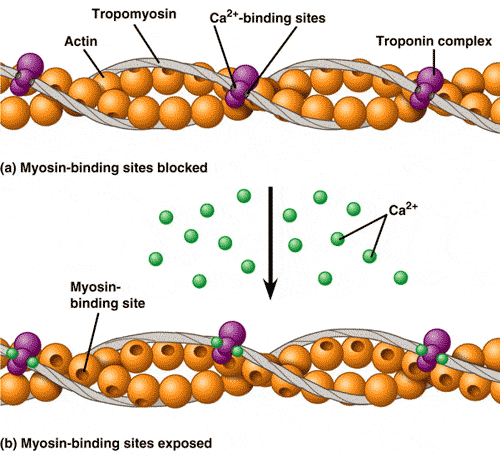
- calcium ions bind to troponin molecules within actin myofilaments
- action potentials move down the T tubule
- cross bridges form and muscle contraction occurs
Choose the arrangement that lists the events in the order they occur following a single stimulus of a skeletal muscle.
1,4,3,5
2,4,3,5
4,1,3,5
5,4,3,2
skeletal muscles
require energy in order to contract
require energy in order to relax
relax when calcium ions are transported into sarcoplasmic reticulum
all of the above
increasing the frequency of stimulation of a muscle
results in rigor mortis
increases the length of the relaxation phase
results in recruitment of motor units
results intetanus
A weight-lifter attempts to lift a weight from the floor, but the weight is so heavy he is unable to move it. The type of muscle contraction the weight lifter used was mostly
isometric
isotonic
notsometric
notsotonic
notsoeasy


The impulse that triggers a contraction travels deep into a muscle fiber by means of
Sarcoplasmic reticulum
Transverse Tubules
Mitochondria
Motor end Plates
Myofibrils are composed primarily of
Actin and Myosin
ATP and ADP
Troponin
Tropomyosin
A muscle cramp is likely due to a lack of
Actin
Myosin
ATP
ADP
Rigor mortis that occurs in skeletal muscles a few hours after death is due to
excessive ATP, which prevents muscle relaxation
lack of ATP, which prevents muscle relaxation
excessive ATP, which causes muscle contraction
None of these
Muscle fatigue is most likely due to an accumulation of
citric acid
lactic acid
creatine
myosin
Which of the following occur when ATP binds to the myosin head?
Myosin head change to low energy configuration
Myosin head undergoes power stroke
Myosin head detach from actin
Myosin head forms cross bridge
Which of the following are the regulatory protein in muscle contraction? (Multiple answer)
Sarcoplasmic reticulum
Actin
Troponin
Myosin
Tropomyosin
Which of the following decreases during muscle contraction? (Multiple answer)
I band
A band
Z line
H zone
M line
Ca2+ will be released from the sarcoplasmic reticulum when
impulse reaches neuromuscular junction
impulse transmitted along T tubule
ATP binds to sarcoplasmic reticulum
acetyl choline binds to ligand gated ion channels
Ca2+ released by sarcoplasmic reticulum will bind to
Actin
Troponin
Myosin
Tropomyosin
Rigor mortis occur because
Lack of calcium ions attach to tropomyosin
Lack of ATP attach to the myosin head
Muscle stiff due to lack of heat
Lactic acid accumulates in muscle
Power stroke will occur when
ATP binds to myosin head
Myosin head releases ADP and Pi
Myosin head hydrolyse ATP
Myosin binds to actin
Which of the following occur during muscle relaxation (multiple answer)?
Release of calcium from sarcoplasmic reticulum
Tropomyosin covers myosin binding site
Acetyl choline released into synapse
No cross bride formation
ATP binds to myosin head

The unit between A and A is called
a sarcomere
The I band
the Z disc
fascia
What is the contractile unit formed from Z line to Z line?
Sarcomere
T Tubule
Sarcoplasmic reticulum
Fascicle
____________ attaches to actin to form the cross bridge.
Troponin
Tropomyosin
Myosin
Calcium
What does calcium attach in a muscle contraction?
Myosin
Tropomyosin
Troponin
Actin
What is released from the sarcoplasmic reticulum?
Inorganic phosphate
ADP
Calcium
ATP
What is the name of the neurotransmitter released at a neuromuscular junction?
Calcium
Acetylcholine
Dopamine
Troponin
Which of the following steps occurs first:
Calcium ions are released from the sarcoplasmic reticulum.
Calcium binds to troponin which, in turn, moves tropomysin out of the way exposing the actin binding site.
Cross-bridging between actin and myosin shorten the H-zone causing a contraction.
A nerve impulse reaches the axon terminal leading to exocytosis of the neurotransmitter, acetylcholine.

