Wayground logo

Free Printable Worksheets

Font size

S
M
L
XL
Worksheets

Chemical Bonding

Total questions: 78

Worksheet time: 1hrs 4mins

Name
Class
Date
1.
Which type of bond has an equal sharing of electrons?
a)
Polar Covalent 
b)
Non Polar Covalent
c)
Ionic
d)
Metallic
2.
An ionic bond forms when atoms ___________ electrons.
a)
gain
b)
share
c)
increase
d)
transfer
3.
All chemical bonds involve two atoms sharing electrons.
a)
True
b)
False
4.
Chemical bonds form when atoms
a)
combined nuclei
b)
give up neutrons
c)
gain protons
d)
share or transfer electrons
5.
Bonds that form between two metals are called ______________ bonds.
a)
ionic 
b)
covalent
c)
metallic
d)
pervasive
6.
Covalent compounds
a)
Share electrons
b)
transfer electrons
c)
contain a sea of electrons
d)
conduct electricity
7.
A bond that forms when electrons are transferred is called a/an
a)
ionic bond
b)
covalent bond
c)
hydrogen bond
8.
When electrons are shared unequally a/an ___________ bond is formed 
a)
ionic 
b)
hydrogen
c)
polar covalent 
9.

Why do atoms bond?

a)

They typically don't bond

b)

To add or take away energy levels

c)

To have a full valance shell.

d)

To have a full inner shell

10.

Ionic bonding is between a

a)

nonmetal and nonmetal

b)

metal and nonmetal

c)

metal and metal

d)

Depends on the situation

11.

Covalent bonding is between a

a)

nonmetal and nonmetal

b)

metal and nonmetal

c)

metal and metal

d)

It depends on the situation

12.

What happens when magnesium loses 2 electrons?

a)

It stabilizes to a net charge of 0

b)

It turns into an atom

c)

It becomes negatively charged

d)

It becomes positively charged

13.

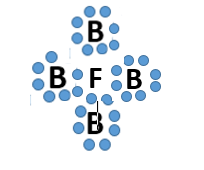
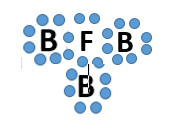
What is the correct Lewis structure for BF3?
a)
b)
c)
d)

BF3 (The formula is the Lewis Structure)

14.

What is the ionic formula for a bond between Calcium and Phosphorus?

a)

Ca2P3

b)

Ca3P2

c)

Ca2P5

d)

P5Ca2

15.

What category of element usually forms a positive ion?

a)

Metals

b)

Nonmetals

c)

metalloids

d)

Noble gases

16.

Which category of elements usually form negative ions?

a)

metals

b)

nonmetals

c)

metalloids

d)

noble gases

17.

CaCl2 is an example of what type of bond?

a)

Covalent

b)

Metallic

c)

Ionic

18.

9. What happens when an atom gains an electron?

a)

Neutral (no charge)

b)

Positive Charge

c)

Negative Charge

19.

12. What elements generally make an ionic bond?

a)

metal and nonmetal

b)

2 or more nonmetals

c)

metal

d)

none of the above

20.

13. What elements generally make a covalent bond?

a)

metal and nonmetal

b)

2 or more nonmetals

c)

metal

d)

none of the above

21.
If an atom of nitrogen gains 3 electrons, what is its overall charge?
a)
Neutral - No charge
b)
+3
c)
-3
d)
-1
22.
What is the correct name for this formula: AlPO4
a)
Aluminum phosphorus
b)
Aluminum phosphate
c)
Aluminum phosoxide
d)
Aluminum quatrophosphate
23.
KI contains a polyatomic ion
a)
TRUE
b)
FALSE
24.
Calcium carbonate contains a polyatomic ion
a)
TRUE
b)
FALSE
25.
What is the correct name for K2S?
a)
potassium sulfur
b)
potassium sulfide
c)
potassium sulfate
d)
potassium sulfite
26.
How many electrons are shared in a triple bond?
a)
6
b)
3
c)
6 pairs
d)
5
27.
How many are shared in a double bond?
a)
2
b)
4 pairs
c)
6
d)
4
28.
How many are shared in a single bond?
a)
2 pairs
b)
4
c)
2
d)
1
29.
What does the prefix tetra mean?
a)
1
b)
2
c)
3
d)
4
30.
The name of FeCl₂ is
a)
iron chloride
b)
iron (II) chloride
c)
iron (I) chloride
d)
iron dichloride
31.
The name of Cu₃N₂ is
a)
copper (III) nitride
b)
copper (II) nitride
c)
copper nitride
d)
tricopper dinitride
32.
The name of Ni₂O₃ is
a)
nickel (II) oxide
b)
nickel (III) oxide
c)
nickle oxide
d)
dinickel trioxide
33.
The chemical formula of potassium iodide is
a)
KI
b)
PI
c)
KI₂
d)
K₂I
34.
What is the formula for silicon dioxide?
a)
SO2
b)
NaO2
c)
SiO2
d)
SiO
35.
What ending is used for the names of negative ions formed when atoms gain (steal) electrons?
a)
ade
b)
ate
c)
ion
d)
ide
36.
What is a repeating three-dimensional pattern that forms when ions bond called?
a)
Crystal Lattice
b)
Crystal Lettuce 
c)
Crystal Configuration
d)
Quartz
37.
Which of the following properties of metal means it can be drawn into wires?
a)
malleability
b)
ductility
c)
electrical conductivity
d)
flexibility
38.
The ability of metal to be hammered into thin sheets is called _________________.
a)
ductility
b)
malleablility
c)
moving electrons
d)
construction work
39.

Which term represents the strength of the attraction an atom has for the electrons in a chemical bond?

a)

Electrical conductivity

b)

Electronegativity

c)

First ionization energy

d)

Specific heat capacity

40.

What is the name of the compound N2Br4 ?

a)

Nitrogen tetrabromide

b)

Dinitrogen tetrabromide

c)

Dinitride tetrabromide

d)

Dinitrogen tetrabromine

41.

What is the chemical formula of the compound boron trifluoride?

a)

BF3

b)

B3F

c)

BFl3

d)

BF4

42.

What is the name of the compound IF7 ?

a)

Iodine heptafluoride

b)

Iodine septafluoride

c)

Iodine hexafluoride

d)

Iodine pentafluoride

43.

Which is the correct Lewis Dot Structure for H2S?

a)
b)
c)
44.

Ions that end in -ate or -ite are...

a)

polyatomic

b)

monoatomic

c)

do not exist

d)

are always cations

45.
What is the name of Mg(OH)2?
a)
Magnesium Hydride
b)
Magnesium Dihydride
c)
Magnesium Dihydroxide
d)
Magnesium Hydroxide
46.
What is the name of K3PO4?
a)
Tripotassium Phosphate
b)
Tripotassium Phosphite
c)
Potassium phosphide
d)
Potassium phosphate
47.
Magnesium bromide is an ionic compound with the chemical formula MgBr₂.  What does the "2" tell you?
a)
There are 2 bromide ions for every magnesium ion
b)
Bromide has a 2- charge
c)
Bromide has a 2+ charge
d)
There are 2 magnesium ions to every bromide ion
48.
What determines how ionic bonds will form?
a)
Number of protons
b)
Mass of the atom
c)
Number of total electrons
d)
Number of valence electrons
49.

Which type of chemical bond accounts for the high electrical conductivity in a bar of pure silver (Ag)?

a)

metallic

b)

ionic

c)

covalent

d)

hydrogen

50.
Atoms gain or lose electrons to have a stable electron structure like a noble gas – generally 8 outermost electrons – follows the _____.
a)
Pauli Exclusion Principle
b)
HONC 1234 Rule
c)
Hund's Rule
d)
OCTET Rule
51.

The type of bond between metal cations and the shared electrons that surround it.

a)

ionic bond

b)

covalent bond

c)

metallic bond

d)

James Bond

52.
Which of these is NOT an alloy?
a)
bronze
b)
copper
c)
brass
d)
stainless steel
53.
Why do metals conduct
a)
They are shiny
b)
The electrons are held tightly within the lattice
c)
The electrons are delocalised and able to move
d)
The electrons are shared between two metal ions
54.

The element with the largest electronegativity is...

a)

O

b)

F

c)

Cl

d)

C

55.

Which of these is the least electronegative element?

a)

oxygen

b)

potassium

c)

chlorine

d)

nitrogen

56.

Define electron affinity.

a)

The energy it takes to add an electron to an atom.

b)

The energy it takes to remove an electron from an atom.

c)

The energy produced during Beta decay

d)

The energy it takes to hold on to exactly 8 valance electrons

57.

Why do elements form bonds?

a)

To become more stable

b)

To become more reactive

c)

To become neutrally charged

d)

To shed excess electrons

58.

Electronegativity is...

a)

how good an atom is at attracting electrons

b)

the ability of an atom to lose electrons

c)

the energy required to remove an electron from a specific atom

d)

measure of negative charge of an anion

59.
Which of the following will have a larger radius than Zinc?
a)
Gallium
b)
Aluminum
c)
Magnesium
d)
Strontium
60.
Which of the following will have a lower ionization energy than Scandium (Sc)?
a)
Helium (He)
b)
Titanium (Ti)
c)
Calcium (Ca)
d)
Magnesium (Mg)
61.
Which atom has the largest atomic radius?
a)
potassium
b)
rubidium 
c)
francium
d)
cesium
62.
As you move down the periodic table atoms get bigger.  This is because ____________.
a)
The atoms have more mass.
b)
The atoms have more protons.
c)
The atoms have more energy levels
d)
The atoms have more nuetrons
63.
As you move across the periodic table atoms tend to get smaller because, ______________.
a)
the atoms have more mass.
b)
the atoms have less mass
c)
the atoms have more protons.
d)
the atoms have less electrons.
64.
The minimum energy required to remove an electron from the ground state of an atom
a)
electron configuration
b)
energy levels
c)
ionization energy
d)
ionic bond
65.
The ionization potential of an element is the amount of energy required to remove an electron from an isolated atom or molecule. According to the periodic table, which of the following indicates the correct decreasing order of ionization energy?
a)
Li > Na > K > Cs
b)
Na > K > Li > Cs
c)
Li > K > Na > Cs 
d)
Cs > K > Na > Li 
66.

Mg2+ has the same number of electrons as F-. Which ion is larger?

a)

Mg2+

b)

F-

c)

Both are the same size

d)

Cannot be determined

67.
How many atoms of Oxygen are in this compound?
a)
4
b)
1
c)
12
d)
7
68.
In this Lewis structure, the symbol above F means...
a)
electrons are being transferred to Fluorine
b)
electrons are less attracted to F than H
c)
electrons are more attracted to F than H
d)
Fluorine has formed a cation
69.

Using your electronegativity handout and the types of atoms involved, predict what type of bond would form between F and Cl.

a)

nonpolar covalent

b)

polar covalent

c)

ionic

d)

metallic

70.

Water which is polar likes to dissolve:

a)

ionic compounds

b)

polar molecules

c)

nonpolar molecules

d)

metallic compounds

71.

What is the correct Lewis Structure for the bond between Mg and Cl?

a)

A

b)

B

c)

C

d)

D

72.

Which is the correct molecular structure for carbon dioxide?

a)
b)
c)
d)
73.

When you have H-Cl, what is the polarity?

a)

nonpolar

b)

polar

c)

ionic

74.

When you have Br-Br, what is the polarity?

a)

Polar

b)

nonpolar

c)

Ionic

75.

When you have Be-F, what is the polarity?

a)

nonpolar

b)

polar

c)

ionic

76.

When you have Si-O, what is the polarity?

a)

nonpolar

b)

polar

c)

ionic

77.

When you have C-H, what is the polarity?

a)

nonpolar

b)

polar

c)

ionic

78.

The Lewis structure of the CO32- ion is

a)
b)
c)
d)
e)