wayground logo

Free Printable Worksheets

NEW

Font size

S
M
L
XL
Worksheets

Waves Review

Total questions: 69

Worksheet time: 2hrs 34mins

Name
Class
Date
1.
Waves that require a medium are called 
a)
mechanical waves
b)
transverse waves
c)
light waves
d)
gamma rays
2.
What happens when you increase the amplitude of a sound?
a)
it makes the sound louder
b)
it makes the sound travel faster
c)
it increases the wavelength of the sound
d)
it increases the frequency of the sound
3.

What kind of wave is pictured below?

a)

compressional wave

b)

transverse wave

c)

sound wave

d)

mechanical wave

4.
What can electromagnetic waves travel through?
a)
mediums
b)
empty space
c)
solely solids
d)
both mediums and empty space
5.
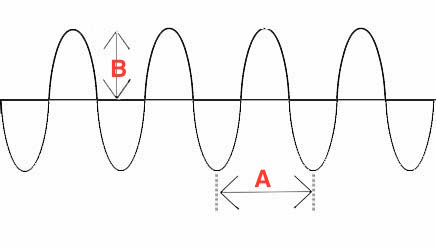
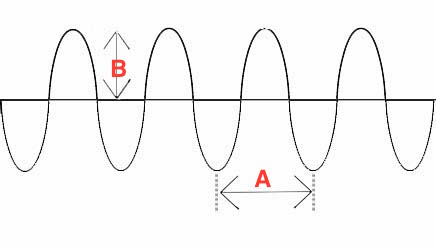
What property of this wave is represented by the letter "A"
a)
amplitude
b)
crest
c)
trough
d)
wavelength
6.
What property of the wave is represented by the letter "B"?
a)
amplitude
b)
crest
c)
trough
d)
wavelength
7.
What do waves carry from place to place?
a)
Energy, but not matter or particles
b)
Energy and matter or particles
c)
Matter or particles but not energy
d)
Neither energy nor matter or particles
8.
Which wave is pictured?
a)
Transverse
b)
Longitudinal
c)
Both
d)
Neither
9.
A wave carries...?
a)
energy only
b)
matter only
c)
energy and matter
d)
neither
10.
What type of wave move a slinky back and forth?
a)
longitudinal
b)
transverse
11.
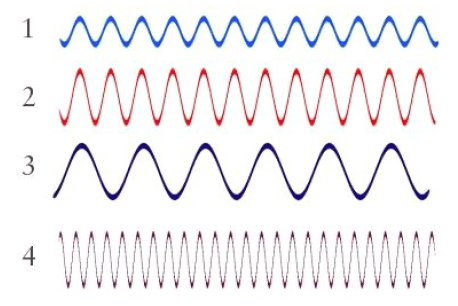
Which wave in the diagram has the greatest wavelength?
a)
1
b)
2
c)
3
d)
4
12.
Which of the following can sound travel through?
a)
solid
b)
liquid
c)
gas
d)
all of the above
13.
What happens to frequency when the energy increases?
a)
it increases
b)
it decreases
c)
it stays the same
14.
What is the frequency of this wave?
a)
3 Hertz
b)
4 Hertz
c)
5 Hertz
d)
6 Hertz
15.
If there is no wave, the particles would be at the _____________________.
a)
wavelength
b)
resting point
c)
trough
d)
beach
16.
When wavelength increases, what happens to the frequency?
a)
it increases
b)
it decreases
c)
it stays the same
17.
What is the speed of a wave that has a wavelength of 2 and a frequency of 2.5?
a)
2.5 m/s
b)
5 m/s
c)
4.5 m/s
d)
6 m/s
18.
Which wave has a longer wavelength?
a)
wave C
b)
wave D
19.
Which wave has a greater frequency?
a)
wave B
b)
wave C
20.
Which wave has the most energy?
a)
top wave
b)
bottom wave
21.
Which of the following is NOT a mechanical wave?
a)
sound
b)
light
c)
ocean
d)
seismic
22.
Which wave has a greater frequency?
a)
A
b)
B
23.
How would a person measure the wavelength on this sound wave?
a)
dense to less dense
b)
trough to crest
c)
compression to compression
d)
beginning of illustration to the end
24.

You can't hear sounds in outer space because there is no

a)

medium

b)

light

c)

energy

d)

heat

25.

How fast the wave is moving through a medium

a)

wave speed

b)

wavelength

c)

amplitude

d)

frequency

26.

Distance between points where the wave begins to repeat itself

a)

trough

b)

amplitude

c)

wavelength

d)

frequency

27.

When a wave bounces off of something and moves in a different direction

a)

reflection

b)

refraction

c)

absorption

d)

propagation

28.

Waves that propagate through the earth due to a geologic disturbance like an earthquake

a)

seismic waves

b)

transverse waves

c)

longitudinal waves

d)

light waves

29.

when a wave is bent by traveling from one medium to another

a)

reflection

b)

refraction

c)

absorption

d)

propagation

30.

a form of electromagnetic radiation that doesn't require a medium to pass through

a)

sound wave

b)

light wave

c)

transverse wave

d)

compressional wave

31.

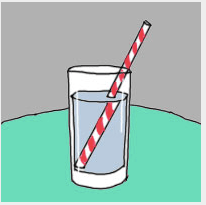
Why does the straw appear to be bent?

a)

light is reflected

b)

light is absorbed

c)

light is turned

d)

light is refracted

32.

What is the best explanation for Mickey seeing himself in the mirror?

a)

refraction

b)

absorbed

c)

reflection

d)

flipped

33.

What do we call a material that light can travel through?

a)

air

b)

water

c)

medium

d)

pathway

34.
When light bends it is ______
a)
Reflection
b)
Absorption
c)
refraction 
d)
optical density
35.
When light bounces back it is _____
a)
Reflected
b)
Refracted
c)
Absorbed
d)
Optical Density
36.
a)
Refraction
b)
Reflection
37.
a)
Reflection
b)
Refraction
38.
a)
Reflection
b)
Refraction
39.
A student placed a pencil in a cup of water.  The pencil appears broken because light-
a)
always travels in a straight line
b)
bends when it passes through water
c)
makes the water in the glass evaporate
d)
reflects the pencil on the water's surface
40.
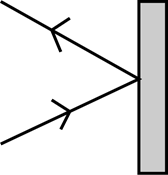
The illustration shows a light ray striking an object.
In the illustration, the light ray striking the object is-
a)
absorbed
b)
stopped
c)
reflected
d)
refracted
41.
What do we call this tool that separates white light into the colors of the Visible Spectrum?
a)
tuning fork
b)
prism
c)
microscope
d)
graduated cylinder
42.
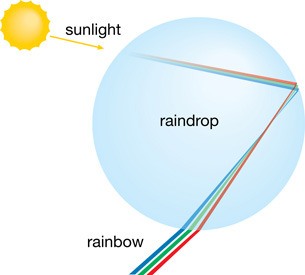
Light bending as it passes through a rain drop is an example of...
a)
Refraction
b)
Reflection
43.

What color has the longest wavelength?

a)

Black

b)

Green

c)

Purple

d)

Red

44.
Electromagnetic waves that help your body produce vitamin D are called?
a)
ultraviolet rays
b)
x-rays
c)
gamma rays
45.
Which type of waves are used in broadcasting?
a)
radio waves
b)
infrared rays
c)
x-rays
46.
For waves in any medium, as the wavelength decreases, what happens to the frequency?
a)
It also decrease
b)
It stays the same
c)
It increases
47.
How much of the electromagnetic spectrum is made up of visible light?
a)
only a small portion
b)
a very l;arge portion
c)
about half
48.
Which of the following has wavelengths longer than microwaves?
a)
Infrared waves
b)
Radio waves
c)
Visible light
49.
Which electromagnetic waves allow us to diagnose & treat cancer?
a)
Gamma rays
b)
X-rays
c)
Ultraviolet rays
50.
The electromagnetic spectrum includes the complete range of electromagnetic waves placed in order of:
a)
increasing amplitutde
b)
increasing wavelength
c)
increasing frequency
51.
Which of the following has frequencies higher than ultraviolet rays?
a)
visible light
b)
infrared rays
c)
x-rays
52.
Which electromagnetic waves help doctors detect broken bones inside your body?
a)
gamma rays
b)
x-rays
c)
ultraviolet rays
53.
Which of the following lists the electromagnetic waves in order of increasing wavelength?
a)
X-rays, visible light, radio waves
b)
gamma rays, microwaves, UV rays
c)
infrared rays, radio waves, x-rays
54.
Which electromagnetic waves are used in devices such as heat lamps & TV remote controls?
a)
ultraviolet rays
b)
microwaves
c)
infrared rays
55.
Which of the following lists the electromagnetic waves in order of decreasing frequency?
a)
X-rays, microwaves, infrared rays
b)
UV rays, visible light, x-rays
c)
infrared rays, microwaves, radio waves
56.
Radar uses which type of electromagnetic waves to detect objects & measure their distance and speed?
a)
microwaves
b)
infrared rays
c)
x-rays
57.
The ray of light that strikes a reflecting surface is called ________.
a)
incident ray
b)
reflected ray
c)
normal ray
d)
none of the above
58.
The imaginary line perpendicular to a reflecting surface is called _____.
a)
crooked line
b)
parallel line
c)
angular line
d)
normal line
59.
The angle produced as a source of light bounces off a reflecting surface is called ______.
a)
angle of crookedness
b)
angle of reflection
c)
angle of incidence
d)
angle of bounce
60.
What does incidence angle equal?
a)
reflection angle
b)
∠C
c)
∠D
d)
all of these
61.
What does incidence angle equal?
a)
reflection angle
b)
∠C
c)
∠D
d)
all of these
62.
What does incidence angle equal?
a)
reflection angle
b)
∠C
c)
∠D
d)
all of these
63.
What is A?
a)
Angle of incidence
b)
Angle of reflection
c)
Incident ray
d)
Reflected ray
64.
What is A?
a)
Angle of incidence
b)
Angle of reflection
c)
Incident ray
d)
Reflected ray
65.
Law of reflection state that - The angle of incidence is .................. to the angle of reflection.
a)
equal
b)
double
c)
half
66.
........... – the angle between the normal and the reflected ray.
a)
Angle of incidence
b)
Angle of reflection
c)
Angle of coincidence
d)
Angle of direction
67.
........... – the angle between the normal and the incident ray.
a)
Angle of incidence
b)
Angle of reflection
c)
Angle of coincidence
d)
Angle of direction
68.
Which of these statements is true?
a)
Light travels in straight lines.
b)
Light is stopped when it meets a solid object.
c)
Light does not travel in straight lines.
d)
Light will only travel for about 2000km before it stops.
69.
This diagram best represents 
a)
reflection
b)
refraction
c)
absorption
d)
diffusion