wayground logo

Free Printable Worksheets

Font size

S
M
L
XL
Worksheets

8.2 Unit Exam

Total questions: 130

Worksheet time: 2hrs 1mins

Name
Class
Date
1.

Kinetic energy is...

a)

energy carried in ultraviolet waves

b)

energy stored in food

c)

energy in motion

d)

energy from splitting an atom

2.

The mathematical formula to find the amount of kinetic energy is....

a)

(mass x speed2) ÷ 2\left(mass\ x\ speed^2\right)\ \div\ 2

b)

mass x speed ÷ 2mass\ x\ speed\ \div\ 2

c)

2 x mass x speed22\ x\ mass\ x\ speed^2

d)

2 x mass x speed2\ x\ mass\ x\ speed

3.

What two factors affect an object's kinetic energy?

a)

area and volume

b)

mass and weight

c)

weight and height

d)

mass and speed

4.

Increasing an object's speed will increase its kinetic energy.

a)

false

b)

true

5.

Increasing an object's mass will increase its kinetic energy.

a)

true

b)

false

6.

If all objects are moving as the exact same speed, which would have the greatest kinetic energy?

a)

tennis ball

b)

football

c)

notebook

d)

box of 20 textbooks

7.
The faster an object moves, the ________ kinetic energy it has. 
a)
more
b)
less
c)
none of the above
d)
all of the above 
8.

The statement that "the energy within a system remains constant and cannot be created or destroyed, only transformed" best sums up _________.

a)

Something Mr. Lance likes to say.

b)

Life

c)

Law of Conservation of Energy

d)

The scientific method

e)

Newton's Third Law

9.
Can energy be destroyed?
a)
no
b)
yes
10.
Can energy be changed?
a)
yes
b)
no
11.
Energy can not be created or destroyed, only converted from one form to another.
a)
true
b)
false
12.

Energy stored because of gravity is called:

a)

Gravitational Potential Energy

b)

Kinetic Energy

c)

Mechanical Advantage

d)

Chemical Energy

13.

Which would have the LEAST gravitational potential energy (GPE)?

a)

A ball sitting on the ground

b)

Moon viewed from the Earth

c)

An airplane flying 30,000 feet above the ground

d)

A rock sitting on top of Mt. Everest

14.

How could you increase the gravitational potential energy of an object without changing its mass and gravity?

a)

Make the object larger

b)

Lower the object towards the ground

c)

Raise the object farther off the ground

d)

Allow the object to roll on the ground

15.

How could you increase the object's gravitational potential energy (GPE) without changing its distance from the ground (height) and gravity?

a)

Decrease the object's mass

b)

Increase the object's height

c)

Increase the object's mass

d)

Decrease the object's height

16.

____________ is the ability to do work.

a)

Energy

b)

Force

c)

Friction

d)

Motion

17.

When you are holding a book, energy is stored between the book and Earth; this type of energy is called ________ potential energy.

a)

Kinetic Energy

b)

Chemical Energy

c)

Gravitational Potential Energy

d)

Electric Energy

18.

Gravitational potential energy depends on the strength of gravity, ________ and ________ of the object.

a)

height and mass

b)

friction and movement

c)

mass and movement

d)

height and friction

19.

What is the value of the Earth's acceleration due to gravity (g)?

a)

9.8 m/s2

b)

100 m/s2

c)

25 m/s2

d)

3.14 m/s2

20.
Which type of energy increases when you compress a spring?
a)
elastic potential energy
b)
kinetic energy
c)
radiant energy
d)
sound energy
21.

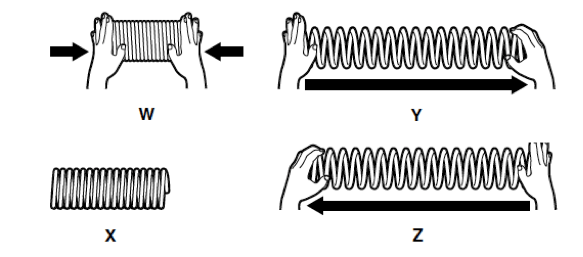
Elastic potential energy is energy stored in an object, such as a spring, due to the object being stretched or compressed. In which position is it most likely that the spring has lost its elastic potential energy?

a)

W

b)

Y

c)

X

d)

Z

22.
Waves that require a medium are called 
a)
mechanical waves
b)
transverse waves
c)
light waves
d)
gamma rays
23.
What happens when you increase the amplitude of a sound?
a)
it makes the sound louder
b)
it makes the sound travel faster
c)
it increases the wavelength of the sound
d)
it increases the frequency of the sound
24.

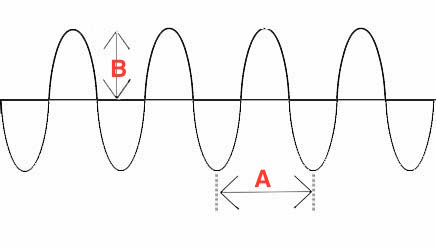
What kind of wave is pictured below?

a)

compressional wave

b)

transverse wave

c)

sound wave

d)

mechanical wave

25.
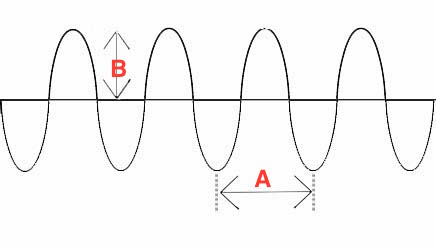
What property of this wave is represented by the letter "A"
a)
amplitude
b)
crest
c)
trough
d)
wavelength
26.
What property of the wave is represented by the letter "B"?
a)
amplitude
b)
crest
c)
trough
d)
wavelength
27.
What do waves carry from place to place?
a)
Energy, but not matter or particles
b)
Energy and matter or particles
c)
Matter or particles but not energy
d)
Neither energy nor matter or particles
28.
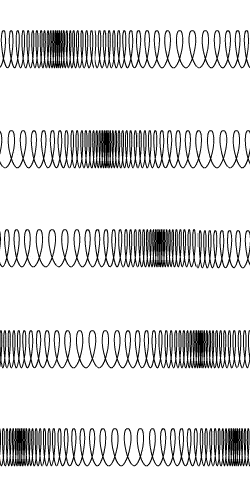
Which wave is pictured?
a)
Transverse
b)
Longitudinal
c)
Both
d)
Neither
29.
What type of wave move a slinky back and forth?
a)
longitudinal
b)
transverse
30.
Which vocabulary term is used to identify the distance between points C & G?
a)
Amplitude
b)
Crest
c)
Frequency
d)
Wavelength
31.
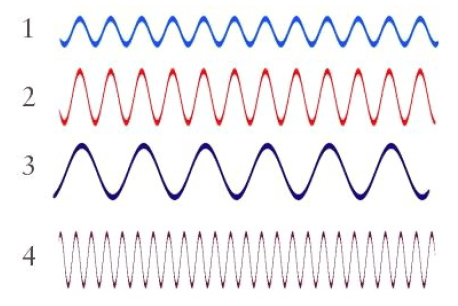
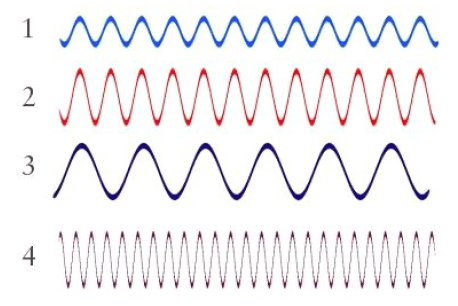
Which wave in the diagram has the greatest frequency?
a)
1
b)
2
c)
3
d)
4
32.
Which wave in the diagram has the greatest wavelength?
a)
1
b)
2
c)
3
d)
4
33.
Which of the following can sound travel through?
a)
solid
b)
liquid
c)
gas
d)
all of the above
34.
What type of wave is this?
a)
Longitudinal
b)
Transverse
35.
What happens to frequency when the energy increases?
a)
it increases
b)
it decreases
c)
it stays the same
36.
What part of the wave is shown at letter A?
a)
crest
b)
trough
c)
wavelength
d)
frequency
37.
Which part of the wave is shown at letter B?
a)
crest
b)
trough
c)
wavelength resting point
38.
Which part of the wave is shown at letter C?
a)
crest
b)
wavelength
c)
resting point
d)
amplitude
39.
Which part of the wave is shown at letter D?
a)
trough
b)
resting point
c)
wavelength
d)
frequency
40.
Which part of the wave is shown at letter E?
a)
trough
b)
crest
c)
resting point
d)
amplitude
41.
If there is no wave, the particles would be at the _____________________.
a)
wavelength
b)
resting point
c)
trough
d)
beach
42.
When wavelength increases, what happens to the frequency?
a)
it increases
b)
it decreases
c)
it stays the same
43.
The signal above is an example of a(n)
a)
Digital Signal
b)
Analog Signal
44.
Which is an example of an analog signal?
a)
Record Player
b)
CD Player
45.
Which is an example of an analog signal?
a)
Blu-Ray DVD
b)
VHS Tape
46.
Smooth and continuous data
a)
analog
b)
digital
c)
pulse
d)
binary
47.
Digital offers better clarity, but analog gives you richer quality.
a)
True
b)
False
48.
This is how analog signal looks like.
a)
True
b)
False
49.

A big disadvantage of digital technology is the recording does degrade over time.

a)

True

b)

False

50.

An analog signal is sent in discrete pulses in two states, on= 1 or off= 0.

a)

True

b)

False

51.
Is this digital or analog?
a)
Digital 
b)
Analog
52.
Is this digital or analog?
a)
Digital 
b)
Analog
53.
Is this digital or analog?
a)
Digital 
b)
Analog
54.
Is this digital or analog?
a)
Digital 
b)
Analog
55.

The picture shows an example of what kind of signal?

a)

Analog

b)

Digital

56.
What value (number) can an analog signal have?
a)
1 or 0
b)
Any whole number/value
c)
Any number/value
d)
It always depends on the type
57.
In a digital signal information is stored in:
a)
bits
b)
waves
58.

Which of the following is an example of an Digital signal storage?

a)
b)
c)
d)

All of these

59.
Morse code is a type of _____________ signal.
a)
digital
b)
analog
60.
Why are digital signals more reliable in transmitting information than analog signals? 
a)
They are more powerful
b)
They carry less information
c)
They have less interference over long distances
d)
They have more interference over long distances
61.
An analog signal is...
a)
continuous
b)
in pulses
62.

Identify a disadvantage of an analog signal:

a)

Requires low power

b)

Doesn't get interference

c)

When copied, quality goes down

d)

Hardware is usually small

63.
What is true about a digital signal?
a)
They are easily distorted or affected by interference
b)
They take up more space
c)
They require more information
d)
They are generally considered more reliable
64.
How can a signal be transmitted?
a)
Tone
b)
Light
c)
Electric Pulses
d)
All of the Above
65.
A signal is a way to transmit ________________ by means of gesture,action, sound, or other means.
a)
money
b)
information
c)
time
d)
light
66.
Which of the following is an example of a digital signal?
a)
Mercury Thermometer
b)
VHS Tape
c)
Blu-Ray
d)
Analog Clock
67.
Which of the following is an advantage of analog signals
a)
Less prone to interference
b)
Requires less power
c)
Travels Farther
d)
Carries more detailed information
68.
How do earthquake waves travel through the earth?
a)
Heat waves
b)
Light waves
c)
Sound waves
d)
Mechanical waves
69.
The light we can see. 
a)
visible
b)
gamma
c)
ultraviolet
70.
Can travel through matter (gas, liquid, solid) but not space. 
a)
light
b)
sound
71.
Can travel through matter (gas, liquid, solid) and empty space. 
a)
sound
b)
light
72.
Makes you get sunburn. 
a)
x-ray
b)
visible
c)
ultraviolet
73.
Visible light is 
a)
radiation
b)
light
c)
a way to transfer energy
d)
all of these
74.
When light shines through a prism it creates a ________________
a)
colors
b)
ROY G. BIV
c)
spectrum
d)
electromagnetic wave
75.
The highest point on a wave
a)
trough
b)
amplitude
c)
crest
d)
wavelength
76.
Light is a form of 
a)
energy
b)
radiation
c)
reflection
77.
What is reflection in simple terms?
a)
Soaks up light
b)
Passes through
c)
light bounces off
78.
Wax paper or a foggy window is an example of what type of material. 
a)
transparent
b)
translucent
c)
opaque
79.
What does refract mean?
a)
To shrink
b)
To bend
c)
To widen
d)
To enlarge
80.
Powerful energy, made in nuclear explosion and in stars. 
a)
gamma
b)
x-ray
c)
visible
81.
What kind of waves are being shown when you warm yourself by a fire?
a)
Electromagnetic waves
b)
Mechanical waves
c)
Friction
d)
Gasses in the atmosphere
82.
Shows all light from the sun and stars. 
a)
Electromagnetic Spectrum
b)
Camera
c)
Eyes
83.
Which wave has the greatest amplitude?
a)
The blue wave
b)
The red wave
84.
Which of the following is true about waves?
a)
When wavelength increases frequency increases
b)
When wavelength decreases, frequency increases
c)
When wavelength decreases, frequency decreases
85.
Which type of electromagnetic radiation is the reason we need sunglasses and sunscreen to avoid getting a sunburn?
a)
X-rays
b)
Gamma Rays
c)
Ultraviolet waves
d)
Infrared waves
86.
Which picture best shows the law of reflection?
a)
A
b)
B
c)
C
d)
D
87.
Which of the following is NOT true?
a)
Radio waves have lowest frequency
b)
Ultraviolet waves have highest energy
c)
Gamma waves have highest frequency
d)
Radio waves have longest wavelengths
88.
What property of light makes this pencil appear to be bent or broken?
a)
Reflection
b)
Refraction
c)
Diffraction
d)
Absorption
89.
A disturbance that travels through a medium as a longitudinal wave
a)
sound
b)
wavelength
c)
pitch
d)
frequency
90.
Material (matter) through which a wave travels
a)
medium
b)
Doppler Effect
c)
sound
d)
pitch
91.
A wave in which the vibration is in the same direction as that in which the wave is traveling; sound waves
a)
longitudinal wave
b)
ocean wave
c)
transverse wave
d)
mechanical wave
92.
A wave that requires a medium through which to travel
a)
mechanical wave
b)
chemical wave
c)
electromagnetic wave
d)
pitch
93.
Highest point of a wave
a)
crest
b)
trough
c)
wavelength
d)
frequency
94.

What is transported by a wave?

a)

air

b)

energy

c)

matter

d)

particles

95.

Lance and Kasi conduct an activity using a slinky. Lance fixes one end of the slinky against a fixed support. He then moves the slinky back and forth, as shown.


Kasi sees the wave moving towards the fixed support. What is true for this mechanical wave?

a)

It transmits energy only

b)

It transmits matter only

c)

It transmits both matter and energy

d)

It transmits both energy and a medium

96.

What kind of wave requires the particles of a medium to vibrate and transfer energy?

a)

infrared light wave

b)

Radio Wave

c)

Seismic Wave

d)

Visible light wave

97.

Which wave is classified as a mechanical wave?

a)

microwave

b)

infrared wave

c)

sound wave

d)

radio wave

98.

the measurement of the force of gravity on an object

a)

mass

b)

speed

c)

weight

d)

motion

99.

speed with a direction

a)

motion

b)

velocity

c)

acceleration

d)

distance

100.

energy cannot be created or destroyed, only transferred

a)

Law of conservation of matter

b)

Law of conservation of energy

c)

Law of energy transfer

d)

Law of the universe

101.

the quantity or strength of an object's motion; mass x velocity

a)

speed

b)

force

c)

energy

d)

momentum

102.

The amount of matter in a given space or volume; it is a relationship between mass and volume.

a)

joule

b)

volume

c)

weight

d)

density

103.

how far from one point to another

a)

speed

b)

distance

c)

movement

d)

length

104.

speed up, slow down, change direction

a)

speed

b)

motion

c)

movement

d)

acceleration

105.

A slingshot that has been pulled back, but has not been let go.

a)

potential

b)

kinetic

106.

A sled is moving quickly down the hill.

a)

potential

b)

kinetic

107.

A snake is coiled up ready to strike its prey.

a)

potential

b)

kinetic

108.

A girl is swinging at the park.

a)

potential

b)

kinetic

109.

Batteries laying on the table

a)

potential

b)

kinetic

110.

A diver is about to dive off of a platform.

a)

potential

b)

kinetic

111.

An arrow is released from a bow and it travels toward the target.

a)

potential

b)

kinetic

112.

A basketball sits on the shelf.

a)

potential

b)

kinetic

113.

An arrow is pulled back but hasn't been released from the bow yet.

a)

potential

b)

kinetic

114.
Which type of energy increases when you compress a spring?
a)
elastic potential energy
b)
kinetic energy
c)
radiant energy
d)
sound energy
115.

Elastic potential energy is energy stored in an object, such as a spring, due to the object being stretched or compressed. In which position is it most likely that the spring has lost its elastic potential energy?

a)

W

b)

Y

c)

X

d)

Z

116.

What is the energy due to Position?

a)

Kinetic Energy

b)

Potential Energy

117.

How can you increase Kinetic Energy?

a)

increase mass and speed

b)

increase to a higher position

118.

True or False: The equation for Kinetic energy is KE=1⁄2mv2

a)

True

b)

False

119.

An example of Potential Energy is:

a)

Stretching a rubber band

b)

Bike moving down a Hill

120.

An example of Potential Energy is:

a)

squishing a spring

b)

Bike moving down a Hill

c)

Roller Coaster moving

121.
The faster an object moves, the ________ kinetic energy it has. 
a)
more
b)
less
c)
none of the above
d)
all of the above 
122.
What kind of energy is in a rock at the edge of a cliff?
a)
Potential
b)
Kinetic
123.
Gravitational potential energy depends on the ________ and ________ of the object. 
a)
Height and mass
b)
Friction and movement
c)
Mass and Movement
d)
Height and Friction 
124.
Food has _________ energy. 
a)
Potential 
b)
Kinetic 
c)
None of the above 
d)
All of the above 
125.
Where would a person have to be located to have the minimum gravitational potential energy?
a)
up on the roof
b)
down in the basement
c)
in the middle
d)
outside
126.
A 0.40 kilogram bird is flying at a constant speed of 8.0 m/s. What is the bird's kinetic energy ?
a)
3.2 J
b)
4.2 J
c)
2.0 J
d)
12.8 J
127.
A baseball held by a pitcher has _____________energy.
a)
Kinetic
b)
Chemical 
c)
Potential
d)
Thermal
128.

What equation is used to calculate elastic potential energy?

a)

Ep = m g h

b)

Ep = 1/2 k x2

c)

Ep = F / E d

129.

What equation is used to calculate elastic potential energy?

a)

Ep = m g h

b)

Ep = 1/2 k x2

c)

Ep = F / E d

130.
When energy is transferred, the object upon which the work is done ______ energy.
a)
Gains 
b)
Loses