wayground logo

Free Printable Worksheets

NEW

Font size

S
M
L
XL
Worksheets

Cardiovascular System

Total questions: 70

Worksheet time: 58mins

Name
Class
Date
1.
Which part of the heart is this?
a)
Aorta
b)
Pumonary Vein
c)
Pulmonary Artery
d)
Left Atrium
2.
Which part of the heart is this?
a)
Aorta
b)
Right Ventricle
c)
Left Atrium
d)
Left Ventricle
3.
Which part of the heart is this?
a)
Pulmonary Vein
b)
Pulmonary Artery
c)
Right Atrium
d)
Tricuspid Valve
4.
During the Cardiac Cycle, Ventricular systole is when what happens?
a)
The Left Ventricle contracts
b)
When the Right Ventricle contracts
c)
When the Atria contract
d)
When both Ventricles contract
5.
During the Cardiac Cycle the diastole phase is when?
a)
The heart is fully contracted
b)
The heart is fully relaxed
c)
When the atria are relaxed and Ventricles contracted
d)
All of the above
6.

Which of the following best describes the connection between cardiovascular disease and age?

a)

As people age, their blood vessels become more elastic leading to less cardiovascular disease.

b)

As people age, the heart becomes more efficient with each pump, increasing cardiac output.

c)

As people age, blood pressure decreases leading to more cardiovascular disease.

d)

As people age, plaque builds up in the arteries increasing vessel resistance, which leads to disease.

7.

What causes atherosclerosis?

a)

high blood pressure

b)

an increase in blood viscosity

c)

accumulation of fatty materials

d)

an increase in blood volume

8.

Which of the following characteristics describe the veins?

a)

move away from the heart

b)

have low blood pressure

c)

distribute blood to body organs

d)

have high blood pressure

9.

What is the direction of blood flow in the circulatory system?

a)

lungs, body, heart, body

b)

body, lungs, heart, body

c)

heart, lungs, heart, body

d)

heart, body, lungs, body

10.

What part of the heart divides the heart into two?

a)

Biscuspid valve

b)

Septum

c)

Pulmonary artery

d)

bicep

11.

What is the role of veins in the cardiovascular system?

a)

Carry blood away from the heart

b)

Carry blood back to the heart

c)

Carry blood to the lungs

d)

Allows the exchanges of gases, nutrients and wastes between blood and the tissues

12.

What are the 3 main types of blood vessels?

a)

Capillaries, veins, aortas

b)

Capillaries, arteries, platelets

c)

Capillaries, veins, platelets

d)

Capillaries, veins, arteries

13.

Vasodilation can be defined as:

a)

A process in which blood vessels constrict causing a decrease in blood flow

b)

A process in which blood vessels increase their diameter causing an increase in blood flow

c)

A process in which blood vessels constrict causing an increase in blood flow

d)

A process in which blood vessels increase their diameter causing a decrease in blood flow

14.
Blood enters the heart through which vessels
a)
Superior and Inferior Vena Cava
b)
Pulmonary Artery
c)
Pulmonary Vein
d)
Tricuspid Valve
15.
The right side of the heart carries oxygenated blood
a)
True
b)
False
16.
Pulmonary Artery
a)
carries oxygenated blood to atrium
b)
carries deoxygenated blood to lungs
c)
carries oxygenated blood to lungs
d)
none of the above
17.
Pulmonary vein
a)
carries oxygenated blood to left atrium
b)
carries deoxygenated blood to left ventricle
c)
carries oxygenated blood to left ventricle
d)
carries deoxygenated blood to left atrium
18.
Blood flows from left atrium to left ventricle through which valve?
a)
Bicuspid
b)
Tricuspid
c)
Semilunar Valve
d)
Pulmonary valve
19.
Blood flows from right atrium to right ventricle through which valve?
a)
semilunar valve
b)
tricuspid valve
c)
bicuspid valve
d)
pulmonary valve 
20.
What are the pumping chambers
a)
Atria
b)
Ventricles
c)
Bicuspid
d)
Tricuspid
21.
This is the thickest layer of the heart
a)
Pericardium
b)
Endocardium
c)
Myocardium
d)
Epicardium
22.
The smooth layer that lines the inside of the heart
a)
Endocardium
b)
Pericardium
c)
Myocardium
d)
None of the Above
23.
Double membrane sac that covers the outside of the heart
a)
Pericardium
b)
Myocardium
c)
Endocardium
d)
All of the above
24.
The flow of blood between the heart and cells of body
a)
Systemic circulation
b)
Pulmonary circulation
c)
Oxygenated blood
d)
Deoxygenated blood
25.
The flow of blood between the heart and the lungs
a)
systemic circulation
b)
oxygenated circulation
c)
Pulmonary circulation
d)
none of the above
26.
The left side of the heart pumps deoxygenated blood
a)
True
b)
False
27.
_______starts in the heart and causes the heart muscle to contract and the heart to beat
a)
Enzymes
b)
Electrical impulses
c)
Hormones
d)
Neurons
28.
____________carry blood away from the heart
a)
bronchioles
b)
arteries
c)
veins
d)
capillaries
29.
________carry blood back to the heart
a)
arteries
b)
capillaries
c)
veins
d)
arterioles
30.
The pointed, inferior portion of the heart, known as the ________ rests on the diaphragm and is oriented towards the left hip.
a)
base
b)
mediastinum
c)
apex
d)
pericardium
31.
The two superior receiving chambers of the heart are known as the _________
a)
atria
b)
ventricles
32.
Blood leaves the right ventricle through the ___________.
a)
pulmonary trunk
b)
aorta
c)
superior vena cava
d)
coronary sinus
33.
Tunica _______, the middle layer of a typical blood vessel, contains smooth muscle and elastic fibers.
a)
intima
b)
externa
c)
media
d)
adventitia
34.
Arteries are normally depicted as red while veins are colored blue.  The exceptions to this rule are the _______ arteries and veins.
a)
systemic
b)
hepatic
c)
coronary
d)
pulmonary
35.
When the ventricles contract, the bicuspid (mitral) valve prevents blood from flowing from the ________.
a)
right ventricle to right atrium
b)
left ventricle to left atrium
c)
left atrium to the right atrium
d)
right atrium to the left atrium
36.
The sinoatrial node is located in the ________.
a)
aorta
b)
right atrium
c)
left atrium
d)
right ventricle
37.

Which one of the following represents the correct path for the transmission of an impulse in the intrinsic conduction system of the heart?

a)

AV node, SA node, Purkinje fibers, bundle branches

b)

SA node, AV node, bundle branches, Purkinje fibers

c)

SA node, AV node, Purkinje fibers, bundle branches

d)

SA node, bundle branches, Purkinje fibers, AV node
38.
The heart sounds "lub" and "dup" result from ________. 
a)
opening of the heart valves
b)
firing of the nodes of the intrinsic conduction system
c)
blood rushing through the chambers
d)
closure of heart valves
39.
Exchanges between blood and tissue cells occur in capillary beds.
a)
True
b)
False
40.
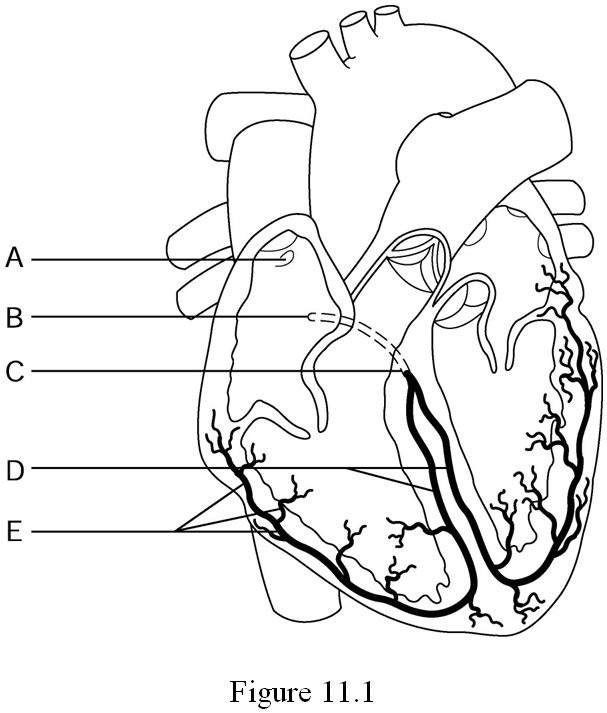
Which label is representing the Purkinje fibers?
a)
A
b)
C
c)
D
d)
E
41.
Which has valves, arteries or veins?
a)
Arteries
b)
Veins
42.

Which is the correct flow of blood?

a)

R. atrium --> R. Ventricle --> pulmonary artery

b)

R. atrium --> L. atrium --> aorta

c)

L. ventricle --> pulmonary artery --> aorta

d)

L. ventricle --> L. atrium --> aorta

43.

Which of the following are the smallest blood vessels?

a)

artery

b)

vein

c)

venule

d)

capillary

44.

The function of valves in the human circulatory system is to

a)

stimulate the heart beat.

b)

accelerate the flow of blood.

c)

prevent the backward flow of blood.

d)

serve as a cushion to prevent friction

45.

Coronary artery

a)

H

b)

J

c)

F

d)

E

46.

Aorta

a)

1

b)

2

c)

4

d)

5

47.

Left ventricle

a)

1

b)

2

c)

3

d)

4

48.

Pulmonary Veins

a)

A

b)

C

c)

F

d)

I

49.

Arteries contain valves that prevent backward flow of blood.

a)

true

b)

false

50.
What is the strongest (thickest) part of the heart?
a)
right atrium
b)
right ventricle
c)
left ventricle
d)
left atrium
51.

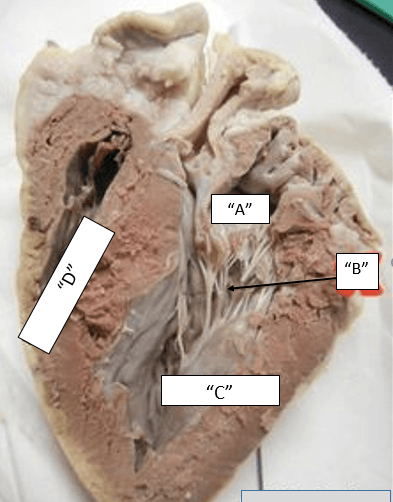
Which chamber is labeled D?

a)

right ventricle

b)

left ventricle

c)

right atrium

d)

left atrium

52.

What side of the heart is the silver probe pointing to?

a)

right

b)

left

53.

What are the string-like structures seen in this heart?

a)

semilunar valves

b)

atrioventricular valves

c)

interventricular septa

d)

chordae tendinae

54.

Identify "A" in this diagram.

a)

right atria

b)

left atria

c)

right ventricle

d)

left ventricle

55.

Identify "B" in this diagram.

a)

chordae tendinae

b)

interventricular septum

c)

right ventricle

d)

right atria

56.

Identify "D" in this diagram.

a)

left atria

b)

left ventricle

c)

right ventricle

d)

right atria

57.

Name the 4 valves in the correct order that the blood will flow through from the vena cava to the aorta.

a)

aortic semilunar valve, bicuspid (mitral) valve, pulmonary semilunar valve, tricuspid valve

b)

tricuspid valve, bicuspid (mitral) valve, aortic semilunar valve, pulmonary semilunar valve

c)

tricuspid valve, pulmonary semilunar valve, bicuspid (mitral) valve, aortic semilunar valve

d)

bicuspid valve, tricuspid (mitral) valve, aortic semilunar valve, pulmonary semilunar valve

58.

Which artery is the largest and why?

a)

The vena cava is the largest artery because it carries all the body's blood back to the heart

b)

The Pulmonary artery is the largest because it carries all the blood to the lungs

c)

The Aorta is the largest because it carries all the blood out into the body and has to withstand the most force

59.

A points to this vessel

a)

artery

b)

vein

c)

capillary

d)

Purkinje fiber

60.

B points to this vessel

a)

artery

b)

vein

c)

capillary

d)

Purkinje fiber

61.
An electrocardiogram measures what?
a)
The amount of pressure exerted on blood vessels.
b)
The electrical activity of the heart.
c)
How many times the heart contracts over time.
d)
The body's temperature caused by friction of blood in vessel.
62.
Which of the following is not a direct indicator of a person's cardiac health?
a)
Heart Rate
b)
Blood Pressure
c)
EKG
d)
Temperature 
63.
The p-wave correlates with which event?
a)
atrium contraction /signals moving from SA node to AV node
b)
ventricle contraction
c)
ventricle repolarization
d)
both atrial and ventricle contraction
64.
The place where the electrical current starts and is considered the heart's pacemaker:
a)
Sino-atrial node 
b)
right atrium
c)
atria-ventricular node 
d)
left ventricle
65.
The AV node is located at...
a)
A
b)
B
c)
C
d)
D
66.
The QRS-wave correlates with which event?
a)
atrium contraction /signals moving from SA node to AV node
b)
ventricle contraction
c)
ventricle repolarization
d)
both atrial and ventricle contraction
67.
 This triggers contraction in the ventricle
a)
SA node
b)
AV node
c)
QT node
d)
AV Bundles
68.
What is going on in the heart during the R-wave or QRS complex
a)
SA node triggers depolarization in atria
b)
AV node triggers depolarization in ventricle, the main pumpung action
c)
Delay caused by the SA node
d)
Repolarization of the ventricle 
69.
These aid in spreading contraction signal to ventricles 
a)
SA Bundles 
b)
AV Bundles
c)
Nodal groups
d)
Heart Murphs 
70.

Which valves have chordae tendinae and WHY?

a)

The AV (tricuspid/bicuspid) valves because they need to withstand high pressure from ventricles

b)

the semilunar valves because they need to withstand high pressure from the ventricles

c)

the AV valves because they close under low pressure

d)

the semilunar valves because they close under low pressure