
 Worksheets
Module 1 Biology Revision
Total questions: 107
Worksheet time: 4hrs 21mins

A scientist observes a single-celled organism with several long, whip-like tails. Which function do the whip-like tails most likely perform for the organism?
defense against predators
movement through an environment
detection of the location of a light source
measurement of atmospheric temperature changes
Which process best describes the assembly of proteins from amino acids?
Atoms are linked to form a compound.
Monomers are linked to form a polymer.
Atoms are added to a monomer until it becomes a polymer.
Molecules are added to a compound until it becomes a monomer.
Trees are typically able to transport water from their roots to their stems and leaves. Which statement describes the property of water that most supports the transportation of water to all parts of a tree?
Water forms a crystalline structure when it freezes.
Water dissolves fewer substances than any other liquid.
Water has strong attractions to itself and many other molecules.
Water can absorb large amounts of energy with minimal temperature changes.

Which biological molecules are most likely represented by molecules 1 and 2?
molecule 1: lipid
molecule 2: nucleic acid
molecule 1: lipid
molecule 2: protein
molecule 1: carbohydrate
molecule 2: nucleic acid
molecule 1: carbohydrate
molecule 2: protein
Which statement best describes a relationship between enzymes and a simple biological reaction?
Enzymes will increase the amount of substrate formed during a biological reaction.
Enzymes will decrease the amount of substrate formed during a biological reaction.
A reaction rate can be increased when the specific enzyme for a biological reaction is present.
A reaction rate can be decreased when multiple enzymes for a biological reaction are present.

Four students classified the main energy conversions that occur during photosynthesis and cellular respiration. Which student best classified the energy conversions that occur in the two processes.
Student 1
Student 2
Student 3
Student 4
A scientist observed that during the course of a chemical reaction the number of ATP molecules was reduced. What did the scientist most likely learn from the observation?
The reaction produced water.
The reaction consumed water.
The reaction caused an output of energy.
The reaction required an input of energy.
Which of the following is most involved in providing structure for a plasma membrane?
the number of protein channels embedded in the membrane
the types of carbohydrates attached to proteins on the surface
the types of proteins that are attached to the surface of the membrane
the arrangement of the hydrophobic and hydrophilic ends of the phospholipids

What cell process is best modeled by the diagram?
osmosis
exocytosis
passive transport
facilitated diffusion
A cell in the leaf of a green plant performs both photosynthesis and cellular respiration, often at the same time. Which statement best describes how these processes are related to each other?
Both processes produce carbon dioxide.
Both processes require energy directly from the sun.
Products of one process are used as some of the reactants for the other process.
Thermal energy from one process is used as the energy source for the other process.
The golgi apparatus is broken down during mitosis and then reformed. Which function would a cell be unable to perform during the time that its Golgi apparatus is broken down?
copying genetic material to include in the new cell
forming vesicles to import molecules into the cell
processing and packaging proteins for the cellular export
correcting errors in the process of building a new cell
Which of the following statements about cells is incorrect?
Both prokaryotic and eukaryotic cells contain a cell membrane, cytoplasm and ribosomes.
Prokaryotic cells do not contain a membrane-bound nucleus.
Prokaryotic cells contain a membrane-bound nucleus.
There are many more prokaryotic cells on Earth than there are eukaryotic cells.
An organism was described as being made up of a single cell containing a membrane-bound nucleus and membrane-bound organelles.
Which of the following correctly identifies the organism being described?
A unicellular eukaryote
A unicellular prokaryote
A multicellular eukaryote
A multicellular prokaryote
A light microscope has an ocular lens magnification of 10× and a total magnification of 400×. Which of the following options correctly indicates the magnification of the objective lens?
10×
4000×
4×
40×
The width of a human hair is approximately 100um.
Which of the following options correctly indicates this measurement in mm?
0.1mm
1000mm
10mm
1mm
Which of the following options correctly lists the organelles in a plant cell that can be seen with a light microscope that is typically used in schools?
Cell wall, nucleus, mitochondria, vacuole
Cell wall, nucleus, chloroplast, vacuole
Cell wall, nucleus, mitochondria, chloroplast, vacuole
Cell wall, nucleus, Golgi body, mitochondria, chloroplast, vacuole
Of the following, which option correctly lists the organelles/structures that a plant cell contains that an animal cell does not?
Cell membrane, large vacuole, chloroplasts
Cell wall, chloroplasts, lysosomes
Cell wall, large vacuole, chloroplasts, lysosomes
Cell wall, large vacuole, chloroplasts
Which of the following options identifies in the correct order the function of mitochondria, chloroplasts and ribosomes?
Photosynthesis; cellular respiration; produce polypeptides
Produce polypeptides; photosynthesis; cellular respiration
Cellular respiration; photosynthesis; produce polypeptides
Cellular respiration; produce polypeptides; photosynthesis
Which of the following statements about the nucleus is incorrect?
The nucleus is surrounded by a double nuclear membrane that contains many pores.
The nucleus stores the information needed to control all cell activities.
The nucleus is responsible for the processing, sorting and packaging of cell products.
The nucleus contains the nucleolus which is responsible for producing ribosomes.
Organelles such as the endoplasmic reticulum, mitochondria, Golgi body, chloroplasts are similar in that their structure is made up of flat membranes containing many folds.
The main reason that they all contain these flat, folded structures is that:
this provides the organelles with a distinctive pattern for identification.
this increases the surface area available for the organelle to carry out its function.
all of these organelles carry out the same function.
it allows the substances within the organelle to move more freely.
The structure of the cell membrane:
can be seen using an electron microscope.
is based on the fluid mosaic model.
allows any substance to move into and out of the cell.
allows the concentration of substances inside the cell to vary.

The phospholipid bilayer shown in the diagram below is made up of:
a head made up of fatty acids that are ‘water hating’ and a tail that is containing phosphate that is ‘water loving’.
a head containing phosphate that is ‘water hating’ and a tail that is made up of fatty acids that are ‘water loving’.
a head containing phosphate that is ‘water loving’ and a tail that is made up of fatty acids that are ‘water hating’.
a head made up of fatty acids that are ‘water loving’ and a tail that is containing phosphate that is ‘water hating’.
Which of the following types of substances would move the most freely through the cell membrane?
Large molecules
Non-lipid-soluble molecules
Lipid-soluble molecules
Electrically charged molecules
Which of the following statements most accurately defines the process of diffusion?
The net movement of the molecules of a substance from a region of low concentration to a region of high concentration until equilibrium is reached
The net movement of water from a region of high solute concentration to a region of low solute concentration through a differentially permeable membrane
The net movement of water from a region of high water concentration to a region of low water concentration through a differentially permeable membrane
The net movement of the molecules of a substance from a region of high concentration to a region of low concentration until equilibrium is reached
Which one of the following processes facilitates the movement of large molecules and charged particles either into or out of the cell through the phospholipid bilayer? This movement would occur with the concentration gradient.
Diffusion
Osmosis
Active transport
Facilitated diffusion
Which of the following best describes the process of osmosis?
The movement of water through a semipermeable membrane from a region of high water concentration (low solute concentration) to a region of low water concentration (high solute concentration)
The movement of water through a semipermeable membrane from a region of low water concentration (low solute concentration) to a region of high water concentration (high solute concentration)
The movement of water through a semipermeable membrane from a region of low water concentration (high solute concentration) to a region of high water concentration (low solute concentration)
The movement of water through a semipermeable membrane from a region of high water concentration (high solute concentration) to a region of low water concentration (low solute concentration)
An animal cell is placed into a solution that has a higher solute concentration than its cytoplasm. The solution surrounding this cell is known as:
hypertonic to the cells
hypotonic to the cells
osmotic to the cells
isotonic to the cells
In the kidney, cells have to reabsorb glucose into their cells against the concentration gradient. Which of the following processes facilitates this movement?
Diffusion
Active transport
Facilitated diffusion
Osmosis
An animal cell is placed into a solution that has a higher solute concentration than its cytoplasm. In which direction would the net water movement occur?
There would be no water movement
The water would move in both directions equally
Out of the animal cell
Into the animal cell
When an amoeba surrounds its prey (Tetrahymena) the membrane transport process used is:
pinocytosis
phagocytosis
exocytosis
active transport
As the size of a cell increases
the volume and surface area decrease at the same rate.
the volume and surface area decrease at the same rate.
the surface-area-to-volume ratio decreases.
the surface-area-to-volume ratio increases.

The SA:V ratio of the shape below is:
12:1
7:1
8:1
6:1
The main advantage of a small cell size is that:
it has a large volume relative to its surface area, increasing its efficiency in obtaining nutrients and removing wastes.
it weighs very little and is more able to conserve energy than a large cell.
it takes up much less space in the organism.
it has a small volume relative to its surface area, increasing its efficiency in obtaining nutrients and removing wastes.
Glucose is classed as which type of biomacromolecule?
Carbohydrate
Protein
Lipid
Nucleic acid
The primary function of an enzyme in a reaction is to:
decrease the activation energy.
increase the activation energy.
act as substrate molecules.
keep the products from interacting.
In an enzyme-catalysed reaction, as the temperature increases, the rate of the reaction:
will not change at all.
will increase to a certain point and then level off.
will decrease to a certain point and then level off.
will increase to a certain point and then decrease rapidly.
In an enzyme-catalysed reaction, as the temperature increases, the rate of the reaction:
will not change at all.
will increase to a certain point and then level off.
will decrease to a certain point and then level off.
will increase to a certain point and then decrease rapidly.
Which of the following are the products of photosynthesis?
Water, sugar and carbon dioxide
Glucose and oxygen
Water and carbon dioxide
Water, oxygen and glucose
Which of the following options contains the correct answers to fill in the gaps in the sentence below regarding the process of photosynthesis?
In photosynthesis, the light-dependent reactions occur in the (i)_______________, while the light-independent stage occurs in the (ii)__________________.
(i) Stroma, (ii) thylakoid membranes
(i) Thylakoid membranes, (ii) stroma
(i) Cytoplasm, (ii) stroma
(i) Stroma, (ii) cytoplasm
Which of the following is a correct statement about the process of aerobic cellular respiration?
Aerobic cellular respiration is a process in plants that produces energy.
Aerobic cellular respiration is a process in animals that involves breathing.
Aerobic cellular respiration is a process in both plants and animals that produces energy.
Aerobic cellular respiration is a process in animals that produces energy.
In animals, which of the following substances is produced anaerobically during strenuous exercise?
Lactic acid
Glucose
Ethanol
Carbon dioxide
Which of the following statements about unicellular organisms is NOT correct?
They have a complex structure.
They include Archaea and Bacteria.
They have a high SA:V ratio and rely on diffusion to obtain nutrients and remove wastes.
They are thought to be the earliest organisms to inhabit Earth.

The shape of the root hair cell shown below is an advantage to the role it plays as it:
provides a much greater surface area to anchor the plant in the soil.
increases the surface area for the oxygen to diffuse out of the root.
increases the surface area to absorb the glucose required by the plant.
provides a much greater surface area for the absorption of water.
Which of the following lists the levels of organisation in a multicellular organism, from the simplest level to the most complex level?
Organism, organ system, organ, tissue, cell, organelle
Organelle, cell, organ, tissue, organ system, organism
Organism, organ system, tissue, organ, cell, organelle
Organelle, cell, tissue, organ, organ system, organism
The lowest level of organisation that is able to perform all of the activities required for life is:
the cell; for example, a muscle cell.
the organelle; for example, a mitochondrion.
the organ; for example, the heart.
the tissue; for example, heart muscle tissue.

A student performed a first hand investigation to test the effect of temperature on the activity of an enzyme found in liver. The experimental set up and the height of the bubbles produced are indicated in the table below.
Identify a control in this experiment.
The temperature
Test tubes: 2, 4, 6, 8
The detergent
Test tubes: 1, 3, 5, 7

The diagram below shows the structure of a cell membrane. The molecule indicated by X is a:
carbohydrate
phospholipid
nucleic acid
protein
Which characteristic of prokaryotic cells can be used to distinguish them from eukaryotic cells?
Prokaryotic cells contain large vacuoles
Prokaryotic cells do not contain ribosomes
Prokaryotic cells have a large surface area to volume ratio
Prokaryotic cells do not contain membrane bound organelles

Select the row below which correctly compares prokaryotic and eukaryotic cells.
A
B
C
D

If enzyme Y is functioning at 25 °C and a pH of 7, under which conditions would the rate of enzyme action probably increase?
When the temperature is kept the same and the pH is decreased to 6.
When the temperature is decreased to 22 °C and the pH is kept the same.
When the temperature is increased to 44 °C and the pH is kept the same.
When the temperature is increased to 30 °C and the pH is increased to 8.

Osmosis and diffusion are processes that are vital for cellular function.
What process does the diagram show?
Diffusion only
Osmosis only
Diffusion and osmosis
Active transport

Is the following organism prokaryotic or eukaryotic?
Prokaryotic
Eukaryotic
Neither
Both

Is the following organism prokaryotic or eukaryotic?
Prokaryotic
Eukaryotic
Neither
Both
The phospholipid bilayer consists of...
hydrophobic heads and hydrophilic, fatty-acid tails.
hydrating heads and hydraulic, fatty-acid tails.
hydrophilic heads and hydrophobic, fatty-acid tails.
heads, shoulders, tails and toes.
Which organelle is responsible for cellular respiration in eukaryotic cells?
Nucleus
Ribosomes
Mitochondria
Golgi apparatus
What is the most correct equation for aerobic respiration?
Carbon dioxide + water --> glucose + oxygen
Carbon dioxide + glucose --> oxygen + energy (ATP)
Glucose + oxygen --> carbon dioxide + water + energy (ATP)
Glucose + ethanol --> carbon dioxide + energy (ATP)

Which cell shape would have the highest surface area to volume ratio?
A
B
C
D

Identify part A.
Nuclear membrane
Nuclear pore
Nucleolus
None of the above

Name part labelled B
Endoplasmic reticulum
Rough endoplasmic reticulum
ER
Smooth endoplasmic reticulum

Identify C.
Ribosomes
Mitochondria
Mitochondrion
Chloroplasts
What is the magnification of a fish whose drawing length is 8 cm and actual length 16 cm?
X2
X0.2
X0.5
X1/2

Calculate the size of a cell in micrometer shown if the diameter of the field of view is 2.25 mm.
3.75
375
3750
37.5
Identify Mitochondrion.


Identify the golgi apparatus.
Identify rough endoplasmic reticulum.
Identify smooth endoplasmic reticulum.

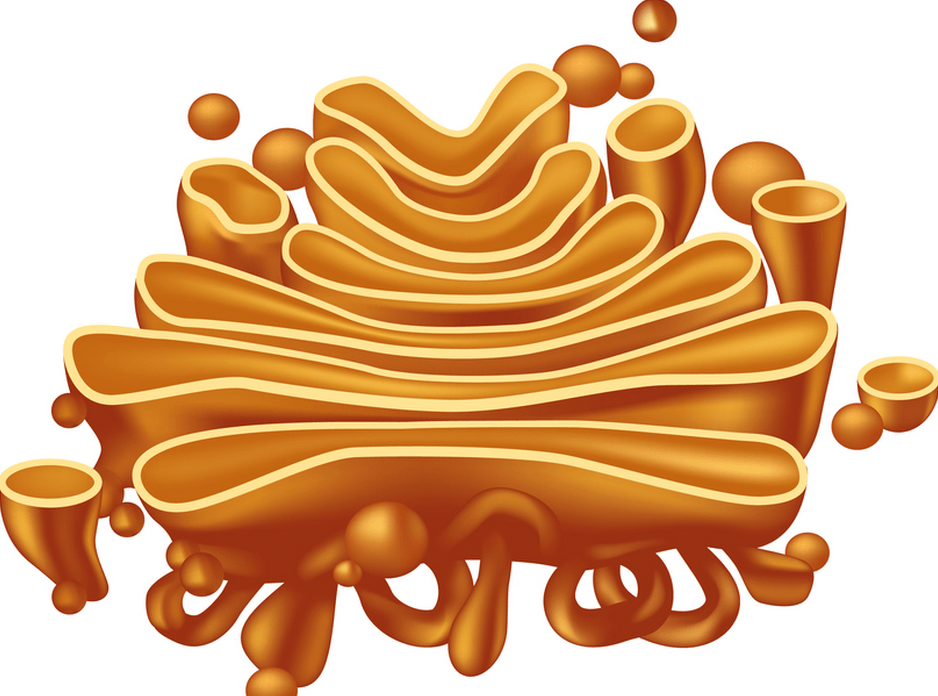
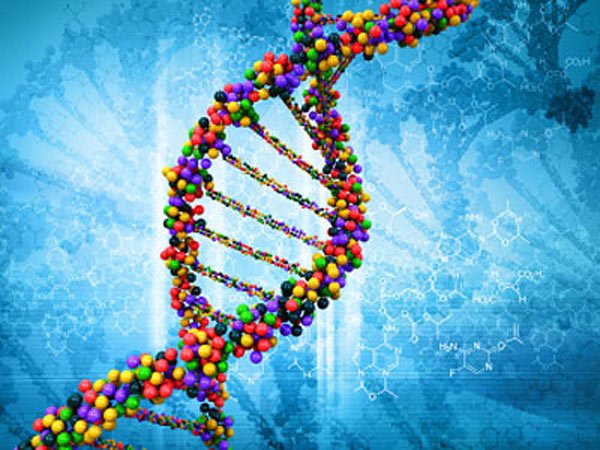
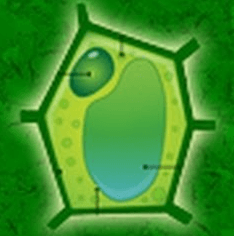
Which of the following describes the function of the nucleolus?
Command Center for the Cell
Produce initial parts of ribosomes
To hold chromosomes
To make DNA
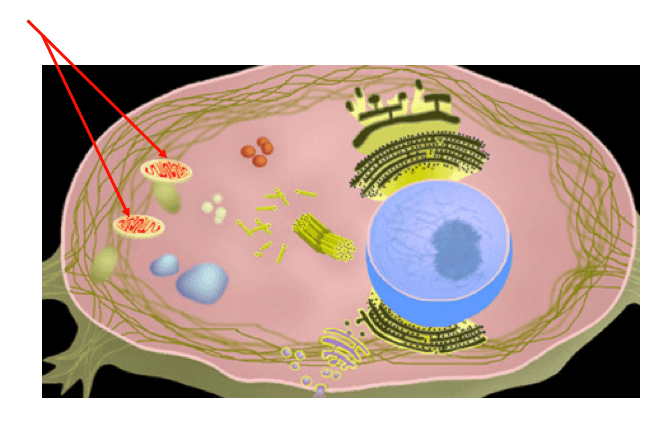
Identify the structures at the bottom of the arrows.
Ribosomes
Golgi Bodies
Mitochondria
Chloroplasts
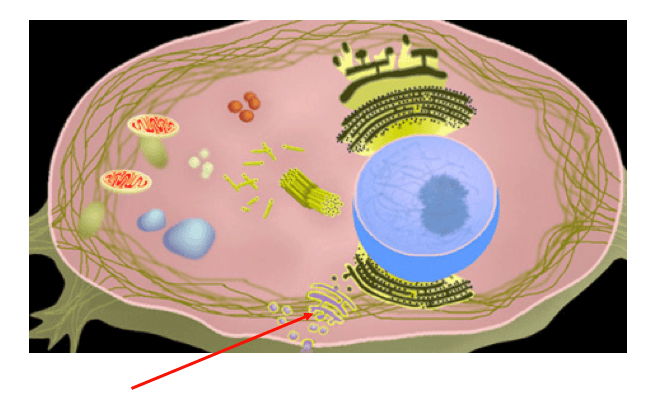
Identify the structure that the arrow is pointing to.
Endoplasmic Reticulum
Golgi Body
Ribosome
Mitochondria

In what organelle is the genetic material found inside?
Endoplasmic Reticulum
Golgi Complex
Nucleolus
Nucleus
What is the function of the mitochondria?
Structure that manufactures ribosomes
Structures that converts nutrients to energy
Stack of membranes that packages chemicals
Structure that contains DNA and directs the cell

I make proteins for the cell. What am I?
ribosome
mitochondria
chloroplast
lysosome


Cell membranes are found in
Only animal cells
Only Prokaryotic cells
Only Eukaryotic cells
All Eukaryotic and Prokaryotic cells

How does a cell membrane keep harmful stuff out of the cell?
Regulates what enters and leaves the cell
Flexibility
Protective barrier
Structure and support
Produces ATP (cellular energy) by breaking down glucose
Mitochondria
Lysosome
Peroxisome
Centrioles
Ribosome
Digests non-usable cell structures and foreign substances
Mitochondria
Lysosome
Peroxisome
Centrioles
Ribosome
Generate microtubules; forms a mitotic spindle to aid in movement of chromosomes
Mitochondria
Lysosome
Peroxisome
Centrioles
Ribosome
Synthesize proteins
Mitochondria
Lysosome
Peroxisome
Centrioles
Ribosome
How do floating ribosomes differ in function from the ribosomes attached to the ER?
Floating = produce proteins for INSIDE cell; Attached = produce proteins for OUTSIDE cell
Floating = produce proteins for OUTSIDE cell; Attached = produce proteins for INSIDE cell
Floating = produce lipids for INSIDE cell; Attached = produce lipids for OUTSIDE cell
Floating = produce lipids for OUTSIDE cell; Attached = produce lipids for INSIDE cell
Floating = INSIDE cytoplasm; Attached = Attached to ER
Processes and transports proteins made at attached ribosomes
Rough ER
Smooth ER
Golgi Apparatus
Cytoplasm
Plasma Membrane
Makes phospholipids
Rough ER
Smooth ER
Golgi Apparatus
Cytoplasm
Plasma Membrane
Makes, breaks down, and carries lipids (fats)---lipid metabolism
Rough ER
Smooth ER
Golgi Apparatus
Cytoplasm
Plasma Membrane
Modifies, packages, and ships proteins
Rough ER
Smooth ER
Golgi Apparatus
Cytoplasm
Plasma Membrane
Proteins continue to develop inside of its canals into their 3D shape
Rough ER
Smooth ER
Golgi Apparatus
Cytoplasm
Plasma Membrane
Controls what enters and exits the cell and maintains separates it from the outside environment
Rough ER
Smooth ER
Golgi Apparatus
Cytoplasm
Plasma Membrane
Increase surface area; Active in absorption
Cytoskeleton
Cilia
Flagella
Microvilli
Plasma Membrane

