wayground logo

Free Printable Worksheets

Font size

S
M
L
XL
Worksheets

Unit 6 PS

Total questions: 116

Worksheet time: 7hrs 45mins

Name
Class
Date
1.
Balance this reaction: ____ Na3PO4 + ____ KOH ---> ____ NaOH + ____ K3PO4
a)
1,3,3,1
b)
1,3,2,1
c)
2,3,3,1
d)
1,1,3,1
2.
Balancing this reaction: ____ CH4 + ____ O2 ---> ____ CO2 + ____ H2O
a)
2,1,3,1
b)
1,2,1,2
c)
1,2,2,1
d)
2,1,1,2
3.
Balance this reaction: ____ NaF + ____ Br2 ---> ____ NaBr + ____ F2
a)
3,1,2,1
b)
1,2,3,4
c)
2,1,2,1
d)
1,2,1,2
4.
Balance this reaction: ____ AlBr3 + ____ K2SO4 ---> ____ KBr + ____ Al2(SO4)3
a)
1,1,1,1
b)
2,3,6,1
c)
2,6,1,1
d)
3,1,2,2
5.
Balance this reaction: ____ NH3 + ____ H2SO4 ---> ____ (NH4)2SO4
a)
2,1,1
b)
2,1,2
c)
1,2,2
d)
2,2,1
6.
Balance this reaction: ____ GaF3 + ____ Cs ---> ____ CsF + ____ Ga
a)
1,1,3,1
b)
1,2,3,1
c)
2,3,3,1
d)
1,3,3,1
7.
Balance this reaction: ____ BaS + ____ PtF2 ---> ____ BaF2 + ____ PtS
a)
1,1,1,1
b)
1,2,1,1
c)
1,1,1,2
d)
2,1,1,1
8.
Balance this reaction: ____ HCN + ____ CuSO4 ---->____ H2SO4 + ____ Cu(CN)2
a)
2,1,1,2
b)
2,1,1,1
c)
1,2,2,1
d)
1,2,1,1
9.
Balance this reaction: ____ RbNO3 + ____ BeF2 ----> ____ Be(NO3)2 + ____ RbF
a)
1,1,1,1
b)
1,2,1,1
c)
2,1,1,2
d)
2,1,2,1
10.
Balance this reaction: ____ C5H14 + ____ O2 ----> ____ CO2 + ____ H2O
a)
1,8,5,7
b)
2,12,5,14
c)
3,27,15,24
d)
2,17,10,14
11.
Some elements combine chemically and no longer have the same ________________ they did before forming a compound.
a)
valence electons
b)
energy
c)
properties
d)
group number
12.
A _________________ is composed of symbols and subscripts indicating the number of atoms of an element in a compound.
a)
Chemical Equation
b)
Chemical Reaction
c)
Synthesis Reaction
d)
Chemical Notation
13.
Atoms form compounds when the compound is more ______________ than the separate atoms.  Noble gases are more _________than other elements because they have a complete outer energy level.
a)
reactive
b)
stable
c)
explosive
d)
toxic
14.
Elements that do not have full outer energy levels are more stable in __________________.
a)
bonds
b)
formulas
c)
reactions
d)
compounds
15.
Atoms gain lose, gain, or ______electrons to get a stable outer energy level.
a)
share
b)
split
c)
create
d)
destroy
16.
A ____________is the force that holds atoms together in a compound.
a)
Chemical Formula
b)
Chemical Reaction
c)
Chemical Bond
d)
Synthesis Reaction
17.
A _______ is a charged particle because it has more or fewer electrons than protons.  When an atom _____ an electron, it becomes a positively charged ion.  When an atom ____an electron, it becomes a negatively charged ion.
a)
isotope, gains, loses
b)
isotope, loses, gains
c)
ion, loses, gains
d)
ion, gains, loses
18.
An ionic compound is held together by the _______--the force of attraction between opposite charges of the atoms.
a)
Covalent Bond
b)
Ionic Bond
c)
Synthetic Bond
d)
Molecular Bond
19.
The result of this bond is a _________compound.
a)
neutral
b)
polar
c)
positively charged
d)
negatively charged
20.
The sum of the charges on the ions in a unit of the compound is ___________. 
a)
positive
b)
negative
c)
zero
d)
±1
21.
__________are neutral particles formed as  result of sharing electrons.
a)
Protons
b)
Electrons
c)
Molecules
d)
Ions
22.
A ________is the force of attraction between atoms sharing electrons.
a)
Synthetic Bond
b)
Ionic Bond
c)
Molecular Bond
d)
Covalent Bond
23.
Atoms can form double or triple ______depending on whether they share two or three pairs of electrons.
a)
Molecules
b)
Bonds
c)
Compounds
d)
Elements
24.
Electrons shared in a molecule are held ________to the atoms with the larger nucleus.
a)
more closely
b)
relative
c)
adjacent
d)
next
25.
Ionic bonds are between...
a)
nonmetals and nonmetals
b)
carbon and oxygen
c)
metals and nonmentals
d)
hydrogen and chlorine
26.
Covalent bonds are between...
a)
two or more nonmetals
b)
sodium and chlorine
c)
metals and metals
d)
metals and nonmetals
27.
What kind of chemical bond forms between a metal and a nonmetal?
a)
ionic
b)
covalent
c)
fake
d)
metallic
28.
What kind of bond forms between two nonmetals?
a)
ionic 
b)
covalent
c)
metallic
d)
fake
29.
What is the name for an ion with a positive charge?
a)
cation
b)
anion
c)
onion
d)
union
30.
What is the name for an ion with a negative charge?
a)
cation
b)
anion
c)
onion
d)
union
31.
What kind of bond forms when atoms share electrons?
a)
ionic
b)
covalent
c)
artificial
d)
univalent
32.
What kind of bond forms when atoms exchange electrons?
a)
ionic
b)
covalent
c)
artificial
d)
univalent
33.
What are valence electrons?
a)
sum of the protons and neutrons
b)
protons minus electrons
c)
electrons in the inner shells
d)
electrons in the outer shell
34.
If an atom loses two electrons what charge will it have?
a)
-2
b)
-1
c)
+1
d)
+2
35.
If an atom gains two electrons what charge will it have?
a)
-2
b)
-1
c)
+1
d)
+2
36.
If an atom has 7 protons and 7 electrons what charge will it have?
a)
-2
b)
-1
c)
0
d)
+2
37.
What happens when a sodium atom loses an electron?
a)
0
b)
-1
c)
+1
d)
-2
38.
How many valence electrons does oxygen have?
a)
2
b)
4
c)
5
d)
6
39.
An electron has what kind of charge?
a)
positive
b)
negative
c)
neutral
d)
none of these
40.
How are covalent bonds formed?
a)
Sharing of electrons
b)
Transfer of electrons
41.
Why do elements bond?
a)
To be friends
b)
To create a new element
c)
To become stable
42.
What is a valence electron?
a)
The sum of neutrons and protons.
b)
The # of electrons in the last shell.
c)
A type of bond.
d)
A popular compound.
43.
Group numbers on the periodic table help us determine 
a)
The number of valence electrons
b)
Color of the elements
44.
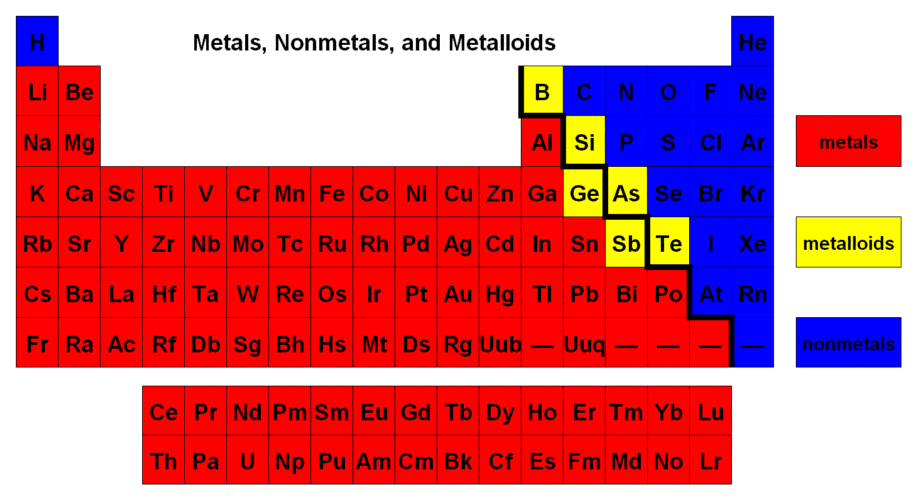
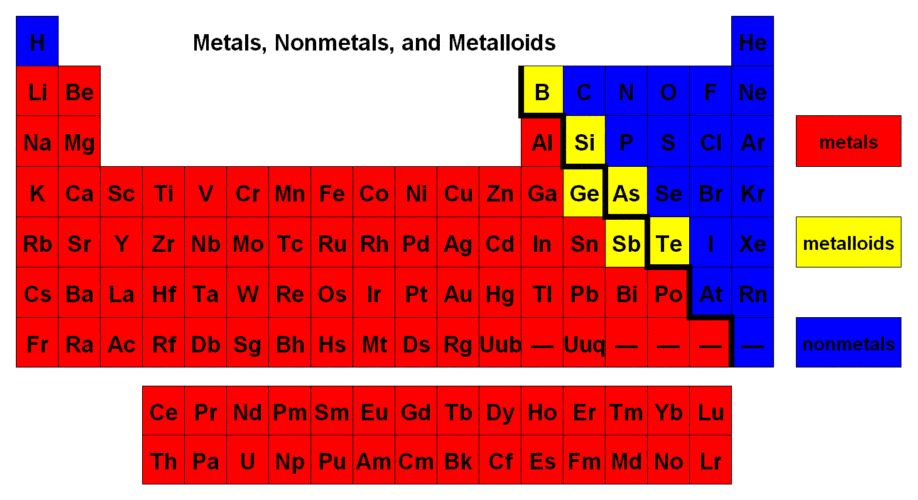
Where are metals located on the periodic table?
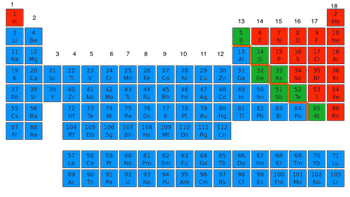
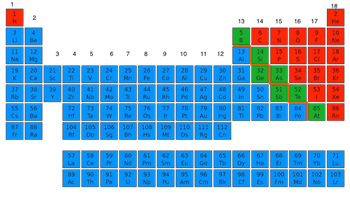
a)
Blue
b)
Green
c)
Red
45.
Where are the nonmetals located on the periodic table? 
a)
Blue
b)
Red
c)
Green
46.
Where are the metalloids located on the periodic table?
a)
Blue
b)
Red
c)
Green
47.
Which of these is not a real bond in chemistry?
a)
James
b)
Ionic
c)
Covalent
48.

All but Hydrogen and Helium want how many valence electrons?

a)

1

b)

2

c)

8

d)

0

49.

Why do atoms bond?

a)

to find a date

b)

to become bigger

c)

to go to dog jam

d)

to become stable

50.

When atoms bond it is called a ___________________ because they make a new substance.

a)

chemical reaction

b)

physical reaction

51.

Covalent Bonds ______________ valence electrons.

a)

give

b)

take

c)

keep

d)

share

52.
What elements generally make an ionic bond?
a)
metal and nonmetal
b)
2 or more nonmetals
c)
metal
d)
none of the above
53.
What elements generally make a covalent bond?
a)
metal and nonmetal
b)
2 or more nonmetals
c)
metal
d)
none of the above
54.
In chemical compounds, covalent bonds form when
a)
the electronegativity difference between two atoms is very large.
b)
electrons are completely transferred between two metals.
c)
pairs of electrons are shared between two nonmetal atoms.
d)
two nonmetal atoms are attracted to each other by opposite charges.
55.
An ionic bond forms when 
a)
Valence electrons are shared
b)
a sea of mobile electrons surround the cations
c)
valence electrons are transferred between atoms
d)
none of the above
56.
An ionic bond forms when 
a)
Valence electrons are shared
b)
a sea of mobile electrons surround the cations
c)
valence electrons are transferred between atoms
d)
none of the above
57.
Predict the bond that will form between Be and F.
a)
Ionic
b)
Covalent
58.
Predict the bond that will form between Se and Cl.
a)
Ionic
b)
Covalent
59.
Predict the bond that will form between Sr and S.
a)
Ionic
b)
Covalent
60.
What is a valence electron?
a)
an electron that is found in the outermost shell of an atom. 
b)
an electron found in the innermost shell of an atom.
c)
an electron found in the middle shell.
61.
What is the number of valence electrons for Oxygen?
a)
8
b)
6
c)
2
d)
1
62.
What is the number of valence electrons for Beryillum?
a)
1
b)
4
c)
2
d)
7
63.
What type of diagram is this?
a)
Electron Dot Diagram
b)
Bohr Model
c)
Alkali Diagram
d)
Chemical Diagram
64.
How many valence electrons in this structure?
a)
6
b)
5
c)
4
d)
7
65.

When is an atom stable?

a)

Full outer energy level

b)

With 2 or 8 valence electrons

c)

When protons equals electrons

d)

When it has more electrons than protons

66.

Which type of atom will always lose valence electrons to become stable?

a)

Metals

b)

Nonmetals

c)

Metalloids

67.

Which type of bond shares electrons equally?

a)

Polar covalent

b)

Nonpolar covalent

c)

Ionic

68.
In a ___________change, a substance changes into a different substance.
a)
Physical
b)
Chemical
69.
Which of these is NOT a sign that a chemical change has occurred? 
a)
A loss of transparency 
b)
An unexpected color change
c)
A temperature change
d)
The formation of a precipitate
70.
In a chemical reaction, bonds are broken and new bonds are formed that create new substances. The bonds that are broken are called what?
a)
Reactants
b)
Products
c)
Atoms
d)
Catalysts
71.
The Law of Conservation of Mass states
a)
that matter exists in all states and reacts the same
b)
that matter can only be changed into new substances by introducing a catalyst
c)
that matter exists in the same state throughout any chemical change
d)
that matter cannot be created or destroyed and that the mass of the products must equal the mass of the reactants
72.
How many Al atoms are in this compound?         4Al2O3
a)
2
b)
8
c)
6
d)
4
73.
How many F atoms are in this compound?
6MgF2 
a)
2
b)
6
c)
8
d)
12
74.
a copper penny turning greenish after a few years.
a)
Chemical Change
b)
Physical Change
75.
An gel ice pack getting cold after you put it in the freezer for an hour.
a)
Chemical Change
b)
Physical Change
76.
Which of the following IS a physical change?
a)
Getting a haircut
b)
Rusty metal
c)
sour milk
d)
A compound
77.
___________________ are the elements are compounds that leave (are formed in) a chemical
reaction.
a)
Polymers
b)
Bonds
c)
Reactants
d)
Products
78.
When a scientist mixed two chemicals, an exothermic reaction takes place. Which of the following would be proof that the reaction was exothermic?
a)
a change of color
b)
a change of state
c)
a temperature decrease
d)
a temperature increase
79.
What types of reactions absorb and release heat?
a)
acidic and basic
b)
endothermic and exothermic
c)
endothermic and heat transfusion
d)
covalent and ionic
80.
A scientist combines chemicals and produces an exothermic reaction. What byproduct of this reaction would show that it is exothermic?
a)
heat
b)
coolness
c)
a precipitate
d)
gas bubbles
81.
Which of the following is a chemical change?
a)
water freezes to form ice
b)
sugar dissolves in water
c)
gasoline burns in a car engine
d)
a piece of metal expands when it is heated
82.
In the reaction methane + oxygen turns into carbon dioxide + water, the methane and oxygen are called _______________.
a)
reactants
b)
products
c)
neutrals
d)
energizers
83.
A change in the shape of an object is an example of _________________.
a)
a chemical change
b)
energy
c)
an endothermic change
d)
a physical change
84.
What type of change occurs when a new substance is formed that has different properties from the original substances?
a)
chemical change
b)
nuclear change
c)
physical change
d)
mutation
85.
Increasing the concentration of a reactant in a chemical reaction will _____________.
a)
decrease the rate of the reaction
b)
stop the reaction from happening
c)
increase the rate of the reaction
d)
have no effect on the rate of the reacion
86.
Which of the following represents a chemical change?
a)
cutting a piece of paper with scissors
b)
cooling a mixture of air and kerosene vapor to obtain liquid kerosene
c)
burning a piece of notebook paper in the presence of oxygen
d)
heating water over a flame to its boiling point
87.
Which of the following is an example of a physical change?
a)
souring milk
b)
mixing baking soda and vinegar
c)
rusting metal
d)
mixing oil and vinegar
88.
Which of the following is a chemical change?
a)
the rusting of iron
b)
dissolving salt in water
c)
melting an ice cube
d)
bending a copper wire
89.
Which of the following is an example of a chemical change?
a)
rusting of a bicycle
b)
painting a house
c)
washing a dog
d)
tearing up a newspaper
90.
Which is an example of an endothermic reaction?
a)
burning wood
b)
airplane using fuel
c)
plant leaves using photosynthesis
d)
digesting food
91.
Which is an example of a physical change?
a)
sodium and chlorine form salt
b)
a copper ring turns white and green
c)
a log burns in a fire
d)
using sand and water to build a sand castle on a beach
92.
If you combine two substances in a beaker at room temperature and the beaker feels cold to the touch, it means that the substances:
a)
have not reacted with each other
b)
have undergone an endothermic reaction
c)
have undergone a physical change
d)
have undergone an exothermic reaction
93.
Which of the following is an example of a physical change?
a)
wood burning
b)
ice melting
c)
food digesting
d)
iron rusting
94.
In any chemical reaction, the mass of the products is always:
a)
slightly less than the mass of the reactants
b)
much less than the mass of the reactants
c)
the same as the mass of the reactants
d)
greater than the mass of the reactants
95.
Raising the temperature of a chemical reaction would make the reaction __________________.
a)
happen slower
b)
happen faster
c)
stop completely
d)
proceed as normal
96.
Your mother used pancake mix, eggs, and milk to make pancakes.  Which of these is the product?
a)
the pancake mix
b)
the eggs
c)
the milk
d)
the pancakes
97.
How do chemical reactions turn substances into new substances?
a)
with burning acid
b)
the molecules mix together and create new substances
c)
the atoms break apart and combine back together in new ways
d)
the ionic compounds mix in water to form solutions
98.
___C3H8 +___O2 --> ___CO2 + ___H2O
a)
1,5,3,4
b)
2,10,6,8
c)
already balanced
d)
1,5,5,4
99.
__Al + __Fe3N2 -->__AlN + __Fe
a)
already balanced
b)
4,2,4,6
c)
2,1,2,3
d)
1,2,1,3
100.
__Na + __Cl2 --> __NaCl
a)
1,1,2
b)
2,1,2
c)
2,1,1
d)
already balanced
101.
__H2O2 --> __H2O + __O2
a)
already balanced
b)
2,1,1
c)
2,2,1
d)
2,1,2
102.
__C6H12O6 + __O2 --> __H2O + __CO2
a)
1,6,6,6
b)
already balanced
c)
1,6,1,6
d)
2,12,12,12
103.
__H2O + __CO2 --> __C7H8 + __O2
a)
4,7,1,9
b)
4,7,1,7
c)
2,3,1,3
d)
already balanced
104.
__NaClO--> __NaCl + __O2
a)
2,2,2
b)
2,2,3
c)
3,2,2
d)
1,2,3
105.
10. __C7H17  + __O--> __CO2 + __H2O
a)
1,2,7,9
b)
2,14,7,17
c)
3,28,14,17
d)
4,45,28,34
106.
__Na + __Cl2 --> __NaCl
a)
1,1,2
b)
2,1,2
c)
2,1,1
d)
already balanced
107.
__NaClO--> __NaCl + __O2
a)
2,2,2
b)
2,2,3
c)
3,2,2
d)
1,2,3
108.

Which side of the chemical equation is the product?

a)

Right

b)

Left

c)

Middle

d)

Bottom

109.

Which side of the chemical reaction is the reactant?

a)

Left

b)

Right

c)

Top

d)

Coefficient

110.

What is the "Law of Conservation of Mass"?

a)

Mass cannot be created or destroyed

b)

Mass is messy

c)

There is no Mass

d)

Mass is measured in liters

111.

What is the law of conservation of energy?

a)

Energy cannot be created or destroyed, but only changed from one form into another or transferred from one object to another.

b)

Energy can be created and destroyed, never changes form.

c)

Energy cannot be transferred from one object to another. Energy is only able to move in a straight line.

d)

Energy is bought at the grocery store.

112.

What is the first step in balancing an equation?

a)

Freak out

b)

Get a scale

c)

Write out the equation

d)

circle every letter

113.

What is a chemical reaction?

a)

Being shocked by a chemical, and then finding it on the periodic table.

b)

Developing a rash

c)

How many chemicals are in a compound

d)

The Process in which reactants go through a change to produce products or a different substance.

114.

How do we know a chemical reaction has occurred?

a)

It explodes every time

b)

A new substance is produced

c)

It becomes edible

d)

The substance changes shape.

115.

What do you change when balancing equations?

a)

subscript

b)

coefficient

c)

Element

116.

What is the name of the table where you find elements?

a)

The element diagram

b)

The Bohr model

c)

The periodic table

d)

The Scientific Method