wayground logo

Free Printable Worksheets

Font size

S
M
L
XL
Worksheets

IGCSE 0610 4 Biological molecules

Total questions: 50

Worksheet time: 33mins

Name
Class
Date
1.
A biological polymer that stores and transmits genetic information is a ...
a)
nucleic acid
b)
carbohydrate
c)
lipid
d)
protein
2.
What is a biological molecule?
a)
organic molecule found in any organism
b)
any living thing
c)
any nonliving thing
d)
the building block of life
3.
A biological polymer made of amino acid monomers is a 
a)
protein
b)
lipid
c)
carbohydrate
d)
nucleic acid
4.
What group of biological molecules contains DNA and RNA...
a)
Nucleic acids
b)
carbohydrates
c)
proteins
d)
lipids
5.
What is the primary function of carbohydrates in your body?
a)
Speed up chemical reactions.
b)
Give immediate energy.
c)
Help to store energy.
d)
Build cell walls in plants.
6.
A group of organic molecules that includes sugars, starch, and cellulose care called...
a)
proteins
b)
carbohydrates
c)
nucleic acids
d)
lipids
7.
Monomer of nucleic acids; consists of a phosphate group, deoxyribose (sugar), and a nitrogen-base. ATP is an example of this.
a)
steroid
b)
nucleotide
c)
polypeptide
d)
polymer
8.
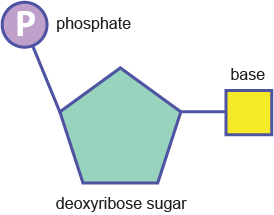
What are the three components of a genetic molecule?
a)
A phosphate group, pentose sugar, and nitrogenous base
b)
Sucrose, Fructose, and Lactose
c)
A phosphate group, Pentose Sugar, and Oxygen base 
d)
A Carbon Group, Pentose sugar, and Oxygen Base
9.
What are the monomers of a polysaccharides?
a)
Amino Acids
b)
Nucleotides
c)
Triglycerides
d)
Monosaccharides
10.

What is the formula of Glucose?

a)

C3H16O36

b)

C632H123O2

c)

C6H12O6

d)

C12H6O12

11.
A large molecule made up of many similar or identical subunits.
a)
lipids
b)
polymer
c)
monomer
d)
monosaccharide
12.
A class of biological molecules whose defining characteristic is their relative insolubility in water. Examples of these include steroids, oils, fats, and fatty acids.
a)
protein
b)
monomer
c)
lipids
d)
glycogen
13.
A large, folded chain of amino acids.
a)
protein
b)
steroid
c)
monosaccharide
d)
enyzme
14.
A series of amino acids linked in a linear fashion
a)
polymer
b)
triglyceride
c)
polypeptide
d)
carbohydrates
15.
Also known as simple sugars, these carbohydrate monomers.
a)
lipids
b)
nucleotide
c)
monosaccharide
d)
monomer
16.
A type of biological molecule that includes fats, oils, hormones, waxes, and components of cellular membranes is...
a)
lipids
b)
proteins
c)
carbohydrates
d)
nucleic acids
17.
Carbohydrates broken down into smaller molecules for what purpose?
a)
to form cell membranes
b)
to form muscle
c)
to transmit genetic information
d)
to provide energy
18.
What two molecules make up a lipid?
a)
glycogen and fatty acids
b)
alpha and beta glucose
c)
glycogen and amino acids
19.
The bonds linking amino acids are called
a)
Peptide bonds
b)
Glycosidic bonds
c)
Ester bonds
20.
What type of fatty acid is this?
a)
Unsaturated
b)
Saturated
c)
Monounsaturated
21.

Which of the following elements is NOT found in all organic molecules.

a)

Carbon

b)

Hydrogen

c)

Sulfur

d)

Oxygen

22.

Glucose is a

a)

Lipid

b)

Protein

c)

Simple sugar (monosaccharide)

d)

Complex sugar (polysaccharide)

23.

Which of the following is not a complex sugar (polysaccharide)?

a)

Cellulose

b)

Glycogen

c)

Ribose

d)

Starch

24.

What element is found in proteins but NOT carbohydrates?

a)

Carbon

b)

Hydrogen

c)

Nitrogen

d)

Oxygen

25.

Which of the following is NOT a function of proteins

a)

Enzymes: speed up chemical reactions

b)

Energy: stored energy in cells

c)

Transport: movement of molecules into/out of cells

d)

Structure: provides shape to cells and tissues

26.
Which of the following tests for starch?
a)
Iodine
b)
Benedicts
c)
Biuret
27.
Which of the following tests for protein?
a)
Iodine
b)
Benedicts
c)
Biuret
28.
Which of the following tests for glucose?
a)
Iodine
b)
Benedicts
c)
Biuret
29.
Which test requires heat?
a)
Benedicts
b)
Biuret
c)
Iodine
30.

What is the colour change if you add Iodine (Brown colour) to the food contains protein?

a)

Red Brick

b)

No changes (Negative Results)

c)

Black

d)

Navy Blue

31.

How do you test for lipids?

a)

By using Ethanol and water

b)

By using Benedicts solution

c)

By using Iodine

d)

By using Biuret test

32.
Which of these is not a disaccharide?
a)
Maltose
b)

Galactose

c)
Sucrose
d)
Lactose
33.

What type of molecule contains glycerol?

a)

simple carbohydrate

b)

fat

c)

complex carbohydrate

d)

protein

34.

What type of molecule is an enzyme?

a)

simple carbohydrate

b)

fat

c)

complex carbohydrate

d)

protein

35.

Select all types of molecule which are used as energy store molecules

a)

starch

b)

fat

c)

protein

d)

glucose

36.
a)

A

b)

B

c)

C

d)

D

37.

Water is a good solvent.

What does this mean?

a)

It dissolves well in many other substances

b)

It flows easily through vessels

c)

It is permeable to gases

d)

Many substances dissolve well in it

38.
What are the nucleotides made of?
a)
Sugar, Phosphate, nitrogen base
b)
Phosphate, Adenine, nitrogen base
c)
Thymine, Adenine, Cytomine
d)
Phosphate, Nitrogen, Adenine
39.
Which of the following best describes a DNA molecule?
a)
double helix
b)
contains ribose
c)
made of amino acids
d)
contains Uracil
40.
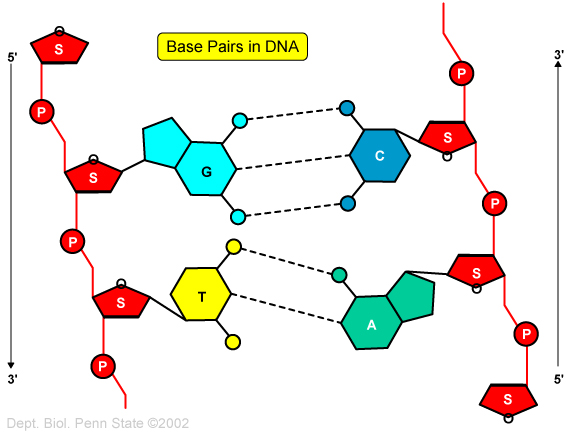
Adenine bonds with ______________.
a)
Guanine
b)
Thymine
c)
Cytosine
d)
Adenine
41.
Guanine bonds with ______________.
a)
Adenine
b)
Guanine
c)
Cytosine
d)
Thymine
42.
Why is DNA important?
a)
it is very small and very complicated
b)
it's in everything
c)
it serves as the blueprint for traits of all living things
d)
because we eat it every day for energy
43.
Which 2 molecules forms the sides (backbone) of the DNA ladder?
a)
deoxyribose and adenine
b)
deoxyribose and a hydrogen bond
c)
sugar and the nucleus
d)
deoxyribose (sugar) and phosphate
44.
Which organelle is DNA usually found in?
a)
cell membrane
b)
vacuole
c)
chloroplast
d)
nucleus
45.
Which sequence of DNA bases would pair with this partial strand
ATG TGA CAG
a)
ATG TGA CAG
b)
TAC ACT GTC
c)
GTA AGT GAC
d)
CAT TCA CTG
46.
Nitrogenous bases are joined by which type of bond?
a)
polar bonds
b)
ionic bonds
c)
covalent bonds
d)
hydrogen bonds
47.
Replicate the following strand of DNA: 
AATCATGGA
a)
AATCATGGA
b)
TTAGTACCT
c)
UUAGUACCU
d)
GGATAUCUA
48.
Nucleotides are made up of a sugar, phosphate, and..?
a)
nitrogenous base
b)
nucleic acid
c)
cholesterol
d)
fatty acid
49.

Which of the following is a base pair?

a)

Adenine - Cytosine

b)

Cytosine - Thymine

c)

Deoxyribose - Cytosine

d)

Cytosine - Guanine

50.

What does DCPIP test for?

a)

Proteins

b)

Lipids

c)

Carbohydrates

d)

Vitamin C