wayground logo

Free Printable Worksheets

NEW

Font size

S
M
L
XL
Worksheets

Science 6 Online Revision 7: SE 2

Total questions: 80

Worksheet time: 40mins

Name
Class
Date
1.
The layer of gases surrounding the Earth
a)
Hydrosphere
b)
Cryosphere
c)
Oxyosphere
d)
Atmosphere
2.
Which layer of the Earth is the thickest?
a)
Core
b)
Crust
c)
Mantle
3.

It gives a lot of information about Earth’s interior by the waves they create.

a)

Volcanoes

b)

Tsunamis

c)

Earthquakes

d)

Cannonballs

4.
The outermost layer of the Earth that contains the continents and the oceans.
a)
mantle
b)
crust
c)
outer core
d)
inner core
5.
The layer of rock between the Earth's core and crust.
a)
outer core
b)
crust
c)
inner core
d)
mantle
6.
Liquid metal layer that surrounds the Earth's inner core.
a)
inner core
b)
crust
c)
outer core
d)
mantle
7.
Solid metal layer at the center of the Earth.
a)
mantle
b)
outer core
c)
inner core
d)
crust
8.
The crust that makes up the continents- the land
a)
tectonic plates
b)
atmosphere
c)
continental crust
d)
oceanic crust
9.
The crust underneath the oceans.
a)
oceanic crust
b)
continental crust
c)
biosphere
d)
tectonic plates
10.
The plates that make up the Earth's crust that are responsible for continental drift.
a)
continental crust
b)
oceanic crust
c)
geologist
d)
tectonic plates
11.
What is the name of the Super-Continent that existed long ago?
a)
Wegener
b)
Pangaea
c)
Geocontinent
12.

Which layer of the Earth is made of iron and some nickel?

a)

crust

b)

mantle

c)

core

13.
Which physical layer is the thinnest?
a)
crust
b)
mantle
c)
core
14.
What is the correct layers of the earth starting with the surface?
a)
crust, outer core, inner core, mantle
b)
mantle, outer core, inner core ,crust
c)
crust, mantle, outer core, inner core
d)
outer core, inner core , crust, mantle
15.
Which layer of Earth is liquid metal?
a)
Outer Core
b)
Mantle
c)
Inner Core
d)
Asthenosphere
16.

formed from the remains of once living things; includes oil, natural gas and coal.

a)

Fossil Fuel

b)

erosion

c)

weathering

d)

renweable resource

17.

A resource that can only be replenished over millions of years.

a)

nonrenewable resource

b)

renewable resource

c)

rain

d)

wind

18.

The breaking down of rocks on Earth's surface into smaller pieces.

a)

weathering

b)

erosion

c)

sedimentary rock

d)

renewable resource

19.

a combustible black or dark brown rock consisting mainly of carbonized plant matter.

a)

coal

b)

oil

c)

renewable resource

d)

igneous rock

20.

A type of rock formed from melted rock that cools and hardens.

a)

igneous rock

b)

metamorphic rock

c)

sedimentary rock

d)

mineral

21.

Formed by high temperature & high pressure deep inside the Earth.

a)

metamorphic rock

b)

igneous rock

c)

sedimentary rock

d)

mineral

22.

formed when layers of sediment are pressed together over a long period of time.

a)

sedimentary rock

b)

metamorphic rock

c)

igneous rock

d)

mineral

23.

What is the process of moving sediments from location to another?

a)

Deposition

b)

Erosion

c)

Weathering

d)

Compaction

24.
What is sediment?
a)
the process of rocks being broken down and carried away
b)
bits of rock, sand, and silt caused by the weathering of rocks
c)
the top layer of the soil
d)
decaying plant or animal material 
25.
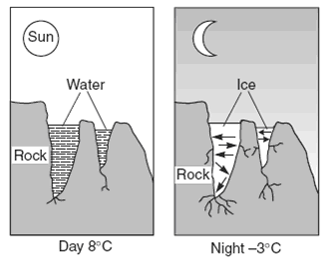
The diagrams  shows a natural process that weathers rock.
 Which statement best explains why this process results in weathering?
a)
frozen water acts as a solute
b)
water expands when it freezes
c)
the mass of water increases when it freezes
d)
frozen water dissolves most types of rock
26.
How does freezing water cause the weathering of rocks?  The freezing water—
a)
keeps the rocks in place
b)
makes the rocks last longer
c)
expands cracks and breaks rocks
d)
causes rocks to fall in landslides
27.

14. What type of event will occur at this boundary?

a)

Earthquake

b)

Volcano Eruption

c)

Tornado

d)

Mountain Building

28.

18. The geological theory of _______ states that pieces of Earth’s lithosphere are in constant, slow motion.

a)

subduction

b)

plate tectonics

c)

deep-ocean trenches

d)

sea-floor spreading

29.
The second type of wave Skyler experienced from the earthquake was called a _____________________. It moves in a side to side “S” shaped motion like a rope. 
a)
Epicenter
b)
Primary wave
c)
Secondary wave
d)
Surface wave
30.
Pat, a seismologist, was studying about last night’s earthquake. She read that the ___________, the point on Earth’s surface directly above where the earthquake began, was only 8 miles from her favorite historic museum.
a)
Epicenter
b)
Primary Wave
c)
Secondary wave
d)
Surface wave
31.
While learning about last night’s earthquake, Pat saw that the ________________ registered a 6.7 on the Richter Scale. 
a)
Epicenter
b)
Magnitude
c)
Seismic waves
d)
Focus
32.
Where do hurricanes develop?
a)
Land
b)
Ocean
c)
Rivers
33.
What is a flood?
a)
a large amount of water that overflowed from a lake or river
b)
a large amount of water from the ocean
c)
a deep lake
d)
a deep river
34.
How do you protect from a hurricane?
a)
evacuate the area and put all outside belongings indoors
b)
go to your basement
c)
call 911
d)
get materials for warmth and hide in your house
35.

Which of the following is not a natural disaster?

a)

tornado

b)

hurricane

c)

tsunami

d)

car accident

36.

Giant ocean-going waves that are caused by an underwater earthquake or volcanic eruptions are called?

a)

hurricanes

b)

volcanoes

c)

tsunamis

d)

tornadoes

37.

A device that uses special weights and magnetic fields to measure and amplify the tiniest movements of the ground is called a?

a)

audiograph

b)

choreograph

c)

telegraph

d)

seismograph

38.

Which natural disaster occurs over 1,000 times each day and is usually too small for people to notice?

a)

earthquakes

b)

hurricanes

c)

tsunamis

d)

floods

39.

The name of the scale used to describe hurricanes.

a)

saffir-simpson

b)

seismograph

c)

telegraph

d)

richter scale

40.

The number of feet the ocean rises above normal high tide during a hurricane.

a)

hurricane

b)

storm surge

c)

tsunami

d)

earthquake

41.

A scale from 1 to 10, used for measuring the strength of an earthquake.

a)

saffir-simpson scale

b)

richter scale

c)

earthquake scale

d)

seismograph

42.

A device for measuring the degrees of movement in the Earth.

a)

seismograph

b)

richter scale

c)

saffir-simpson scale

d)

earthquake scale

43.

The Saffir-Simpson scale includes storm surge, damage and ________.

a)

wind direction

b)

wind speed

c)

hurricanes

d)

earthquakes

44.

What is this?

a)

blizzard

b)

drought

c)

dust storm

45.

What is this?

a)

drought

b)

dust storm

c)

earthquake

46.

What is this?

a)

dust storm

b)

earthquake

c)

fire

47.

What is this?

a)

earthquake

b)

fire

c)

flooding

48.

What is this?

a)

fire

b)

flooding

c)

fog

49.

What is this?

a)

flooding

b)

fog

c)

heatwave

50.

What is this?

a)

heatwave

b)

hurricane

c)

ice

51.

What is this?

a)

hurricane

b)

ice

c)

lightning

52.

What is this?

a)

thunderstorm

b)

tornado

c)

tsunami

53.

What is this?

a)

tornado

b)

tsunami

c)

volcano

54.

What is this?

a)

tsunami

b)

volcano

c)

bilzzard

55.

Snowstorms with high winds, low temperatures, and driving snow.

a)

Avalanche

b)

Tsunami

c)

Blizzard

d)

Earthquake

56.

Long period of time without rain

a)

Wildfire

b)

Drought

c)

Thunderstorm

d)

Flood

57.

Outbreak of infectious disease

a)

Epidemic

b)

Landslide

c)

Tornado

d)

Hurricane

58.

Massive amounts of snow that slide downhill

a)

Avalanche

b)

Blizzard

c)

Landslide

d)

Volcanic Eruption

59.

Movement of rock, debris, or earth downhill

a)

Avalanche

b)

Flood

c)

Volcanic Eruption

d)

Landslide

60.

Negative charge of electricity and positive charge of rain meet inside the cloud and electricity is sparked

a)

Tornado

b)

Thunderstorm

c)

Hurricane

d)

Tsunami

61.

Uncontrollable fire that occurs in wild land areas

a)

Epidemic

b)

Flood

c)

Wildfire

d)

Volcanic Eruption

62.

Pressure build up under the crust

a)

Tsunami

b)

Earthquake

c)

Volcanic Eruption

d)

Avalanche

63.

Which natural disaster causes shaking of the Earth?

a)

Hurricanes

b)

Tornadoes

c)

Wildfires

d)

Earthquakes

64.

What is a natural disaster?

a)

A red letter day

b)

A bad thing caused by a bad person

c)

An event that causes suffering brought on by nature

d)

An event that causes suffering brought on by an enemy

65.

What is the Richter Scale?

a)

A system of measuring the wind

b)

A system of measuring the depth of the ocean

c)

A system of measuring the height of volcanoes

d)

A system of measuring the strength of earthquakes

66.

What is the center of a hurricane called?

a)

The Opening

b)

The Eye

c)

The Middle

67.

What happens during a hurricane?

a)

magma explodes

b)

rain makes the land soft and it slides down a mountain

c)

an earthquake happens underwater and forms huge waves

d)

warm and cold air mix and form storm clouds

68.

What happens during a landslide

a)

snow and ice slide down a mountain

b)

lots of dirt slides down a mountain

c)

magma explodes

d)

an earthquake happens under water

69.
Which natural disaster is a depression or hole in the ground caused by some form of collapse of the surface layer?
a)
Sinkhole
b)
Drought
c)
Hurricane
d)
Thunderstorm
70.
What is a flash flood?
a)
A sophisticated flood
b)
Power lines fallen in flood waters
c)
A deep flood
d)
A flood that happens fast with little warning
71.
When people have to leave a place because of danger.
a)
evacuate
b)
storm
c)
flood
d)
drought
72.
A place where people can sleep in an emergency if they cannot stay in their house.
a)
evacuate
b)
emergency shelter
c)
thunder
d)
aftershock
73.
A disaster when there is no food for people to eat.
a)
earthquake
b)
drought
c)
famine
d)
lightening
74.
A period of bad weather when there is a lot of rain or snow, usually with strong wind.
a)
famine
b)
emergency shelter
c)
tsunami
d)
storm
75.
A spinning windstorm that forms over warm waters in the tropical zone is a...
a)
volcano.
b)
tornado.
c)
tidal wave.
d)
tropical cyclone. 
76.
Earthquakes are caused by all of the following EXCEPT...
a)
movement of tectonic plates.
b)
tsunamis.
c)
volcanic activity. 
d)
underground collapses. 
77.
One region of the world that is very exposed to volcanoes, tsunamis, and earthquakes is...
a)
the Ring of Fire.
b)
the North and South Pole.
c)
the United States.
d)
Eastern Europe.
78.
A natural disaster occurs when a natural hazard...
a)
causes major damage and harms humans.
b)
poses a danger to any part of the earth.
c)
changes the physical features of the earth.
d)
impacts everyday life for humans.
79.
Where do most hurricanes start? 
a)
Near the mountain 
b)
Near land
c)
In the ocean
d)
Over deserts
80.

What is this natural disaster?

a)

Hurricane

b)

Landslide

c)

Avalanche

d)

Thuderstorm