wayground logo

Free Printable Worksheets

NEW

Font size

S
M
L
XL
Worksheets

AP Chemistry Unit 1 Atomic Structure and Properties

Total questions: 37

Worksheet time: 1hrs 14mins

Name
Class
Date
1.

The lines in the emission spectrum of hydrogen result from __________.

a)

electrons given off by hydrogen as it cools

b)

decomposing hydrogen atoms

c)

electrons given off by hydrogen when it burns

d)

energy given off in the form of visible light when an electron moves from a higher energy state to a lower energy state

2.

Which of the subshells below does not exist ?

a)

2p

b)

2s

c)

2d

d)

all of the above

3.

The first ionization energies of the elements __________ as you go from left to right across a period of the periodic table, and __________ as you go from the bottom to the top of a group in the table

a)

increase, increase

b)

increase, decrease

c)

decrease, increase

d)

decrease, decrease

e)

are completely unpredictable

4.

Which ion in the isoelectronic series below has the smallest radius in a crystal?

a)

O2-

b)

N3-

c)

Na+

d)

Al3+

e)

F-

5.

An example of an electron configuration of a transition metal is __________.

a)

1s2 2s2 2p6 3s2 3p6 4s2 3d10 4p6 5s1

b)

1s2 2s2 2p6 3s2 3p5

c)

1s2 2s2 2p6 3s2 3p6 4s2 3d8

d)

1s2 2s2 2p6 3s2 3p6 4s2 3d10 4p6

e)

1s2 2s2 2p4 3s1

6.

Of the choices below, which gives the order for first ionization energies?

a)

Cl > S > Al > Ar > Si

b)

S > Si > Cl > Al > Ar

c)

Al > Si > S > Cl > Ar

d)

Cl > S > Al > Si > Ar

e)

Ar > Cl > S > Si > Al

7.
Four isotopes of lead include lead-204, lead-206, lead-207, and lead-208.  The average atomic mass of lead is 207.2.  Which isotope of lead is likely to be the most abundant.
a)
204
b)
206
c)
207
d)
208
8.
What are valence electrons?
a)
electrons on the first orbital always
b)
nucleus
c)
the outermost shell
d)
the number of electrons on the outermost orbital
9.

What kind of mixture is a combination of substances that has uniform composition and appearance?

a)

colloid

b)

heteregenous

c)

homogeneous

d)

suspension

10.
Why does ionization energy decrease going down a group?
a)
Adding more energy levels makes the ve- further from the nucleus
b)
There are more valence electrons in the outer shell
c)
There are more protons  in the nucleus
d)
There are less protons in the nucleus
11.

What happens to atomic radius across a period?

a)

the atoms get bigger because the nucleus is bigger as more protons are added

b)

the atoms get bigger because there are more ve-

c)

the atoms get smaller because with more attraction to the extra protons, the e- cloud moves closer to the nucleus

12.
If the number of electrons in an atom changes you make a(n) __________________.
a)
ion
b)
isotope
c)
new element
d)
isomer
13.
14.5 grams of gallium (Ga) is equal to how many moles?
[1 mole Ga = 70g Ga]
a)
4.81
b)
3.22
c)
0.207
d)
0.655
14.
What do the heights of the peaks represent in the mass spectrum?
a)
number of isotopes
b)
relative abundance of each isotope
c)
average atomic mass
d)
charge:mass ratio
15.
What is the average atomic mass for this element?
a)
10 amu
b)
10.8 amu
c)
19.9 amu
d)
11 amu
16.

What is the tendency of an atom to attract electrons towards itself?

a)

atomic radius

b)

ionization energy

c)

shielding

d)

Electronegativity

17.
Which is larger... P or P3- ?
a)
P3- because it gains an energy level
b)
P3- due to extra electron repulsion
c)
P because it loses an energy level
d)
P because of extra electron repulsion
18.

Subatomic particles with a negative charge

a)

Electrons

b)

Neutrons

c)

Protons

d)

Quarks

19.
Value representing the number of protons in an element
a)
Atomic Mass
b)
Mass Number
c)
Valence Electrons
d)
Atomic Number
20.
Measure mainly of the nuclear particles: protons + neutrons
a)
Subatomic Particles
b)
Atomic Number
c)
Atomic Mass
d)
Gluons
21.
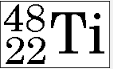
How many protons does this isotope of titanium have?
a)
48
b)
22
c)
26
d)
70
22.
How many neutrons does the isotope below have?     89 36Kr
a)
53
b)
36
c)
89
d)
125
23.
If X is the symbol for an element, which of the following two symbols represent    isotopes of the same element?     I. 7735X  II. 7733X  III. 8137X  IV. 8135 X
a)
I and II
b)
III and IV
c)
I and IV
d)
I and III
24.
How many isotopes are shown in this mass spectrum?
a)
1
b)
84
c)
86
d)
4
25.
The average atomic mass rhenium, Re, is 186.21 amu. If 37.1% of rhenium has mass# = 185, what is the other stable isotope?
a)
Rhenium-183
b)
Rhenium-181
c)
Rhenium-187
d)
Rhenium-189
26.
For an electron to change from ground state to an excited stated it must...
a)
Absorb energy
b)
Release energy
27.

If an electron moves from n=4 to n=2 it ____

a)

absorbs energy

b)

releases energy

28.
What is the empirical formula if you have 36.84% nitrogen and 63.16% oxygen?
a)
NO
b)
N2O3
c)
N2O4
d)
N2O5
29.

A 5.00 g sample of a compound consisting of calcium and chlorine contains 1.82 g of calcium and 3.23 g of chlorine. What is the empirical formula?

a)

CaCl2

b)

Ca2Cl4

c)

Ca2Cl2

d)

Ca4Cl2

30.

How many molecules are in 2.5 mol of NaCl?

a)

1.5 x 1024 molecules

b)

1.5 molecules

c)

4.15 molecules

d)

1.5 x 10²³ molecules

31.
Calculate the number of atoms in 0.0340 g Zn.
a)
5.200 x 10⁻⁴ atoms Zn
b)
3.130 x 10²³ atoms Zn
c)
3.130 x 10²⁰ atoms Zn
d)
1 atom Zn
32.
Which pair has the same empirical formula?
a)
NaCrO4 and Na2Cr2O7
b)
C2H4O2 and C6H12O6
c)
C3H6Oand C2H6O2
d)
CH4 and C2H6
33.
What is the molecular formula if the empirical formula is C2H5 and the molecular molar mass is 58.14 g/mol?
a)
C2H5
b)
C4H10
c)
C1H2.5
d)
C4H8
34.
How many particles would be in 8.4 moles of Octane (C8H18)?
a)
5.77 x 10²³
b)
5.04 x 1024
c)
5.77 x 1026
d)
5.04 x 10²³
35.
Which element is pictured?
a)
neon
b)
fluorine
c)
magnesium
d)
argon
36.
Which electron configuration belongs to Copper (Cu)?
a)
1s2 2s2 2p6 3s2 3p6 4s2 3d8
b)
1s2 2s2 2p6 3s2 3p6 4s2 3d9
c)
1s2 2s2 2p6 3s2 3p6 4s2 3d10
37.

Identify the element based on the Photoelectron spectrum provided.

a)

Hydrogen

b)

Helium

c)

Sodium

d)

Magnesium