wayground logo

Free Printable Worksheets

NEW

Font size

S
M
L
XL
Worksheets

Science 8 Light and Optics Unit Exam

Total questions: 72

Worksheet time: 6hrs 0mins

Name
Class
Date
1.

Which of the following concepts is associated with Sir Isaac Newton?

a)

Sight occurred when light beams from the eyes struck an object.

b)

Sight occurs when light bounces off an object to the eye.

c)

Light travels in straight lines, and the law of reflection.

d)

White light is a mixture of colors.

2.

The best explanation for shadows is

a)

black light is projected onto an object

b)

light bends only part way round solid objects

c)

when light hits an opaque object, it cannot go any further

d)

when light strikes an object, the object projects a black light

3.

Lin’s theatre group wants to create a dark and gloomy forest scene. They cut out a silhouette of trees from thick, black paper and hold it in front of a stage light to create a shadowy effect. The problem is the shadow cast on the backdrop is too small. What could they do to increase the size of the shadow?

a)

Move the light away from the paper cutout.

b)

Move the paper cutout closer to the curtain.

c)

Move the paper cutout closer to the light.

d)

Trim the paper cutout to a smaller size.

4.
Which of the following has the greatest amount of energy
a)
Red Light
b)
UV 
c)
Microwave
d)
X-Ray
5.
A red bird appears red because it REFLECTS what color
a)
Magenta
b)
Red
c)
Cyan
d)
Doesn't reflect any light
6.

High energy light consist of ________ wavelength and _______ frequency

a)

Short, Low

b)

Long, Low

c)

Short, High

d)

Long, High

7.
Which form of light travels the fastest?
a)
Radio
b)
Infrared
c)
Gamma
d)
All travel the same speed
8.
This is an example of...
a)
Reflection
b)
Refraction
c)
Polarization
d)
Spectrum
9.
_____ is a lens that is thicker in the middle.
a)
Convex
b)
Concave
10.
_____ is a lens that is thinner in the middle..
a)
Convex
b)
Concave
11.
Which of the following types of light bulb converts ultraviolet waves into visible light waves?
a)
incandescent
b)
fluorescent
c)
halogen
d)
tungsten
12.
According to the Law of reflection, a light ray striking a mirrow
a)
continues moving through the mirror in the same direction
b)
moves into the mirror at a slightly different angle
c)
bounces off the mirror toward the direction it came from
d)
bounces off the mirror a the same angle it hits.
13.
Nearsighted vision is corrected when lenses
a)
reflect light away from the eye
b)
allow light rays to focus on the retina
c)
allow light to fouca slightly past the retina
d)
help light rays relfect regularly
14.
What kind of waves do cellular telephones use to transmit and receive signals? 
a)
gamma rays
b)
microwaves
c)
ultraviolet rays
d)
infrared rays
15.
Which type of waves are used in broadcasting?
a)
radio waves
b)
infrared rays
c)
x-rays
16.
Which electromagnetic waves have the highest frequencies and the shortest wavelengths?
a)
microwaves
b)
visible light
c)
gamma rays
17.
The point where the rays meet is known as....
a)
Fire
b)
the focal point
c)
refraction
d)
Plane of the lens
18.
If a light ray is shown on a plane mirror with an angle of incidence of 45 degrees, what is the angle of reflection?
a)
15
b)
30
c)
45
d)
90
19.

Which color has the shortest wavelength?

a)

Red

b)

Orange

c)

Green

d)

Violet

20.
A pencil appearing to bend when it is immersed in a glass of water is an example of...
a)
Reflection
b)
Rarefaction
c)
Refraction
d)
Reconstruction
21.

When light passes from one medium to a denser medium _________.

a)

it is bent towards the normal.

b)

it always lies along the normal.

c)

it is unaffected.

d)

it is bent away from the normal.

22.

In a vacuum radio waves, visible light and gamma rays all have the same ________.

a)

frequency

b)

energy

c)

wavelength

d)

speed

23.
Surface A is which type of material? 
a)
transparent
b)
translucent
c)
opaque
24.
Which part of the eye controls the size of the pupil?
a)
pupil
b)
iris
c)
retina
d)
cornea
25.

Which part of the eye allows light in?

a)

Optic nerve

b)

retina

c)

pupil

d)

eyelashes

26.

What is the nerve that leads from the eye to the brain?

a)

Optic nerve

b)

Auditory Nerve

c)

Facial Nerve

d)

Cranial Nerve

27.
The colored part of the eye is called the ___.
a)
lens
b)
pupil
c)
iris
d)
cornea
28.
Which section of the spectrum is the ONLY one we can see?
a)
X-rays
b)
Visible Light
c)
Gamma Rays
d)
Ultraviolet Rays
29.

Which of the following electromagnetic waves are given off as heat?

a)

Radio Waves

b)

Infrared Rays

c)

Visible Light

d)

Gamma Rays

30.
Sunblock provides an opaque layer that prevents ______ from reaching your skin
a)
Infrared Waves 
b)
Microwaves 
c)
Ultraviolet Rays
d)
X Rays 
31.

Select the correct order of waves on the electromagnetic spectrum from lowest to highest frequency.

a)

Radio, Micro, Infra, Visible, Ultra, X-ray, Gamma

b)

Gamma, X-ray, Ultra, Vis, Infra, Micro, Radio

c)

Vis, Micro, Infra, Ultra, X-ray, Gamma, Radio

d)

Micro, Radio, Vis, Infra, Ultra, X-ray, Gamma

32.
What color of visible light is bent most when it refracts?
a)
violet
b)
blue
c)
orange
d)
red
33.

Which of the following statements is true?

a)

Short wavelength means high energy.

b)

Short wavelength means low energy.

c)

Short wavelength means high amplitude.

d)

Short wavelength means low amplitude.

34.
Where might you find a concave mirror?
a)
car headlights
b)
the corner of a convenience store
c)
inside a microscope
d)
in your eyeball
35.
Where might you find a convex mirror?
a)
car headlights
b)
the corner of a convenience store
c)
inside a microscope
d)
in your eyeball
36.
Where might you find a convex lens?
a)
car headlights
b)
the corner of a convenience store
c)
inside a microscope
d)
in your eyeball
37.
This type of wave can go through soft tissue, but they don't go through dense muscle, teeth, or bones.
a)
Microwaves
b)
Ultraviolet Waves
c)
X-rays
d)
Gamma Rays
38.
This type of wave is used as cancer treatment.
a)
Radio waves
b)
Microwaves
c)
X-rays
d)
Gamma Rays
39.
Which color of visible light has the lowest frequency?
a)
red
b)
orange
c)
yellow
d)
blue
40.
The part of the eye that is covered with rods and cones is the
a)
cornea
b)
iris
c)
vitreous humour
d)
retina
41.
These cells sense color.
a)
rods
b)
cones
c)
irises
d)
humours
42.

The primary colors of light are

a)

red, green, indigo

b)

red, green, blue

c)

black, white, yellow

d)

magenta, cyan, yellow

43.

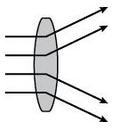
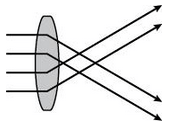
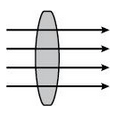
Which lens represents the path light takes through a diverging lens?

a)
b)
c)
d)
44.

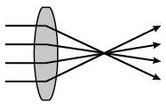
Which figure represents the path light takes through a converging lens?
a)
b)
c)
d)
45.

The production of light by living organisms is

a)

bioluminescence

b)

evolution

c)

adaptation

d)

chemistry

46.
Regulates the amount of light entering the eye and gives the eye its color.
a)
Iris
b)
Lens
c)
Pupil
d)
Retina
47.

Which type of bulb uses the least energy?

a)

LED

b)

Incandescent

c)

Fluorescent or CFL

48.

Pixel stands for

a)

image dot

b)

picture element

c)

image element

d)

none of the above

49.
The lowest part of the wave is?
a)
crest
b)
trough
c)
rarefaction
d)
wavelength
50.
The highest point on a wave
a)
trough
b)
amplitude
c)
crest
d)
wavelength
51.
Material that allows light to pass through allowing you to see "clearly" to the other side
a)
opaque
b)
translucent
c)
transparent
52.

The distance between 2 crests or troughs

a)

wavelength

b)

amplitude

c)

frequency

d)

wave speed

53.

The number of waves that pass in a given amount of time.

a)

wavelength

b)

wave speed

c)

amplitude

d)

frequency

54.

What type of wave does NOT need matter to travel through?

a)

Mechanical

b)

Transverse

c)

Sound

d)

Electromagnetic

55.
Which line represents the wavelength in the diagram?
a)
Between lines B and F
b)
D
c)
Between lines E and G
d)
A
56.
Which line represents the amplitude of the wave?
a)
A
b)
H
c)
From B to the resting point of the wave
d)
From E to G
57.
Which of these waves has a higher frequency?
a)
blue
b)
red
58.
Which picture represents what happens when light travels through a CONVEX lens?
a)
A- left picture
b)
B - Right picture
59.

The bouncing back of light waves off of a surface is...

a)

Reflection

b)

Refraction

c)

Light

d)

Lens

60.

What causes the light to refract as it passes from air to water?

a)

a change in temperature of the light

b)

a change in illumination of the light

c)

a change in speed of the light

d)

a change in brightness of the light

61.

What does light travel fastest in?

a)

solid

b)

liqid

c)

gas

d)

vacuum

62.

What is happening to every color but red?

a)

reflected

b)

absorbed

c)

refracted

63.

# 5 refers to the layer of receptor cells at the back of the eye in which the image is focused

a)

Retina

b)

Lens

c)

Optic Nerve

d)

Lens

64.

#1 Refers to the clear tissue that covers the front of the eye

a)

Retina

b)

Cornea

c)

Pupil

d)

Iris

65.

#3 Refers to the circular structure that surrounds the pupil and regulates the amount of light entering the eye.

a)

Cornea

b)

Pupil

c)

Retina

d)

Iris

66.

#2 refers to

a)

optic nerve

b)

cornea

c)

iris

d)

pupil

67.

Which type of vision allows you to see distance clearly but nearby objects appear blurry?

a)

farsighted

b)

nearsighted

68.

What kind of lens can enable a nearsighted person to see more clearly?

a)

concave lens

b)

convex lens

c)

plane lens

69.

What kind of lens can enable a farsighted person to see more clearly?

a)

concave

b)

convex

70.

Which cells distinguish between black, white and shades of gray?

a)

Cones

b)

Rods

c)

Optic Nerves

d)

Iris

71.

If a real image forms on the retina why don't we see the world upside down?

a)

We do see the world upside down.

b)

A virtual image forms on the retina not a real image.

c)

Our brain automatically flips the image so we see the world right side up.

d)

No one knows

72.

What do you call the spot where there is a lack of cones and rods, where the optic nerve begins at the back of the eye?

a)

Optical Nerve entrance

b)

Optical Divide

c)

Blackspot

d)

Blindspot