wayground logo

Free Printable Worksheets

Font size

S
M
L
XL
Worksheets

Light Optics Review

Total questions: 85

Worksheet time: 2hrs 48mins

Name
Class
Date
1.

In the diagram, which letter represents the angle of incidence?

a)

A

b)

B

c)

C

d)

D

2.
Law of reflection state that - The angle of incidence is .................. to the angle of reflection.
a)
equal
b)
double
c)
half
3.
........... – the angle between the normal and the reflected ray.
a)
Angle of incidence
b)
Angle of reflection
c)
Angle of coincidence
d)
Angle of direction
4.
........... – the angle between the normal and the incident ray.
a)
Angle of incidence
b)
Angle of reflection
c)
Angle of coincidence
d)
Angle of direction
5.

Which diagram represents diffuse reflection?

a)

A

b)

B

c)

C

d)

D

6.

Which diagram represents specular reflection?

a)

A

b)

B

7.
The velocity of light in vacuum is _______ m/s
a)
3x10⁸
b)
3x10¹²
c)
3x10⁶
d)
3x10¹⁰
8.
How does light behave as it enters these mediums?
a)
continue its path as straight line.
b)
bends toward the normal
c)
bends away from the normal
d)
reflects
9.
Absolute refractive index of any medium is always _______.
a)
less than 1
b)
greater than 1
c)
1
d)
0
10.
A ray of light traveling from air into crown glass strikes the surface at an angle of 30 degrees. What is the angle of refraction? (air n=1, crown glass n=1.532)
a)
39.7 degrees
b)
19.2 degrees
c)
59.1 degrees
d)
12.3 degrees
11.
Glass has a _____________ index of refraction than air.
a)
Equal
b)
Greater
c)
Less
d)
Impossible to say
12.
What is the index of refraction of a refractive liquid if the angle of incidence in the air is 35 degrees and the angle of refraction is 14 degrees?
a)
1.33
b)
2.21
c)
2.37
d)
1.72
13.
If the angle of incidence of light traveling through air, and then striking water is 30 degrees what is the angle of refraction? (n=1 air, n=1.33 water)
a)
15 degrees
b)
22 degrees
c)
43 degrees
d)
17 degrees
14.
Light has the lowest velocity in which medium?
flint glass n=1.70
barium glass n=1.60
crown glass n=1.523
water n=1.33
diamond n=2.45
a)
diamond
b)
water
c)
flint glass
d)
barium glass
15.
The point where the rays meet is known as....
a)
Fire
b)
the focal point
c)
refraction
d)
Plane of the lens
16.
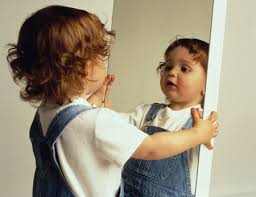
The image formed in a flat mirror is
a)
larger than the object and farther away.
b)
reduced and closer to the mirror.
c)
a real image of the object.
d)
equal to the height and distance of the object.
17.

Based on the image, which medium has a larger index of refraction?

a)

Medium 1 has a larger index of refraction.

b)

Medium 2 has a larger index of refraction.

c)

Both mediums have the same index of refraction.

d)

Cannot be determined.

18.

Based on the image, as light passes from medium 1 to medium 2

a)

light speeds up and bends towards the normal

b)

light speeds up and bends away from the normal

c)

light slows down and bends towards the normal

d)

light slows down and bends away from the normal

19.

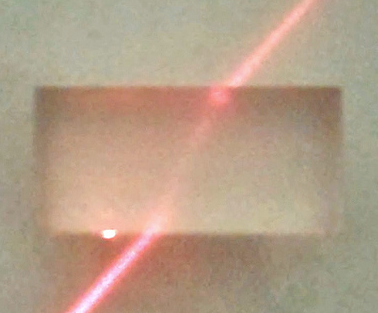
A beam of light strikes a glass block with refractive index of 1.52, at an angle of 5°, what is the angle of refraction?

a)

7.51

b)

0.087

c)

0.13

d)

3.29

20.

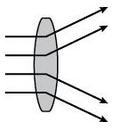
The above lens is a type of ___.

a)

diverging lens

b)

converging lens

c)

divergent lens

d)

convergent lens

21.

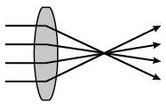
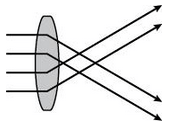
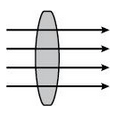
Which figure represents the path light takes through a converging lens?
a)
b)
c)
d)
22.
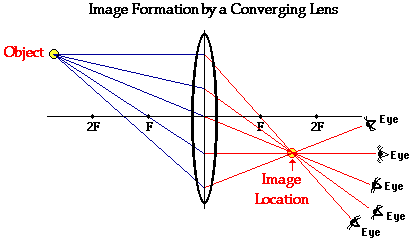
This image is.....
a)
inverted and smaller
b)
inverted and larger
c)
not inverted and smaller
d)
not inverted and larger
23.
This image is...
a)
Inverted and smaller
b)
inverted and bigger
c)
not inverted and smaller
d)
not inverted and bigger
24.

which type of lens

a)

concave

b)

convex

c)

opaque

d)

plano

25.

this is an example of

a)

refraction

b)

diffraction

c)

infraction

d)

reflection

26.
What is B?
a)
Angle of incidence
b)
Angle of reflection
c)
Incident ray
d)
Reflected ray
27.
What is C?
a)
Angle of incidence
b)
Angle of reflection
c)
Incident ray
d)
Reflected ray
28.
What is E?
a)
Angle of incidence
b)
Angle of reflection
c)
Normal
d)
Reflect ray
29.
This is an example of...
a)
Reflection
b)
Refraction
c)
Polarization
d)
Spectrum
30.
If the Dis 30 cm and the Do is 45, what is the focal length?
a)
18 cm
b)
.055556 cm
c)
75 cm
d)
15 cm
31.
If the Dis 30 cm and the Do is 45, what is the magnification of the object?
a)
18 
b)
-0.6667
c)
-18
d)
0.6667
32.

What type of image is formed?

a)

virtual and inverted

b)

virtual and upright

c)

real and upright

d)

real and inverted

33.

An object is located 35.0 cm from a convex lens. The lens forms a real image at a distance of 15.0 cm. What is the focal length?

a)

0.0953 cm

b)

10.5 cm

c)

26.2 cm

d)

0.0678 cm

34.
A normal human eye has a focal length of about 0.023 m. If you look at the tip of a pencil, 0.553 m from your eye, how far is the image from the lens of your eye? 
a)
0.024 m
b)
0.033 m
c)
0.045
d)
0.055
35.
The focal length of the lens in your eye is about 0.015 m. If the object is 1 m from your eye, where is the image produced? 
a)
0.0315 m
b)
0.0243 m
c)
0.0152 m
d)
0.0601 m
36.
A converging lens produces an image twice the size of the original. If the object is placed 0.40 m from the lens, and the image produced is 0.80 m from the lens. What is the focal length of the lens? 
a)
0.351 m
b)
0.267 m
c)
0.416 m
d)
0.112 m
37.

An object 8.5 cm high is placed 28 cm from a converging lens. The focal length of the lens is 12 cm. Determine the height of the image.

*Hint: find di first

a)

6.38 cm

b)

8.5 cm

c)

12cm

d)

21 cm

38.
A ray of light traveling from air into crown glass strikes the surface at an angle of 30 degrees. What is the angle of refraction? (air n=1, crown glass n=1.532)
a)
39.7 degrees
b)
19.2 degrees
c)
59.1 degrees
d)
12.3 degrees
39.

Snell's Law describes the relationship between the ________ angle and the _______ angle of waves passing through two different media

a)

incident - reflected

b)

incident - refracted

c)

incident - bounced

d)

answer is not here

40.

Light travels from water (n = 1.333) into an unknown medium. If the angles of incidence and refraction are 45oand 24º respectively. what is the index of refraction of the unknwon medium? Round off your values to 3 sig. figs.

a)

2.32

b)

2.31

c)

0.77

d)

0.76

41.

how does diffraction work

a)

it goes through water and air

b)

is a beam of light stopping at a wall

c)

it bounces off of light

d)

is the bending of light as it passes around the edge of an object

42.
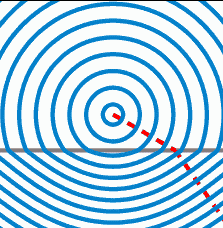
This image is representing what wave interaction?
a)
Refraction
b)
Diffraction
c)
Reflection
d)
Interference
43.
When a wave moves around a barrier or though an opening it is known as what?
a)
Diffraction
b)
Refraction
c)
Rarefaction
d)
Destruction
44.

Light is incident on an air-glass boundary at 60-degrees from the normal but refracts such that its refracted angle is only 35-degrees. Calculate the index of refraction of glass assuming air's index to be ni = 1.

a)

0.67

b)

1.00

c)

1.33

d)

1.50

45.

Two polarizing filters are set up so the transmitted light is at a maximum intensity.

Through which angle should polariser 2 be rotated so that no light is transmitted?

a)

45º

b)

60º

c)

90º

d)

180º

46.
What is this image showing?
a)
Reflection
b)
Refraction
c)
The law of reflection
d)
Concave Mirror
47.

A student placed a pencil in a cup of water. The pencil appears broken because light

a)

always travels in a straight line.

b)

bends when it passes through water.

c)

makes the water in the glass evaporate.

d)

reflects the pencil on the water's surface.

48.

When light passes at an angle to the normal from one medium into another in which its speed is higher

a)

it is bent toward the normal.

b)

it always lies along the normal.

c)

it is unaffected.

d)

it is bent away from the normal.

49.

When light passes at an angle to the normal from one medium into another in which its speed is lower

a)

it is bent towards the normal.

b)

it always lies along the normal.

c)

it is unaffected.

d)

it is bent away from the normal.

50.
How is light affected by an increase in the index of refraction?
a)
Its frequency increases
b)
Its frequency decreases
c)
Its speed increases
d)
Its speed decreases
51.
In what medium does light travel the fastest?
a)
vacuum
b)
air
c)
water
d)
glass
52.
The Law of Reflection:
The angle of incidence is _________ the angle of reflection
a)
bigger than
b)
the same as
c)
smaller than
53.
Which of the following in the diagram is the incident ray?
a)
A
b)
B
c)
C
d)
D
54.
Which of the following in the diagram is the refracted ray?
a)
A
b)
B
c)
C
d)
D
55.
This image is...
a)
Inverted and smaller
b)
inverted and bigger
c)
not inverted and smaller
d)
not inverted and bigger
56.
Which is the angle of refraction?
a)
Angle 1
b)
Angle 2
57.
An object of height 4 cm is placed 10 cm away from a concave lens of focal length 6 cm as shown below.Image is 
a)
virtual.inverted
b)
virtual,upright
c)
real,inverted
d)
real,upright
58.
In the index of refraction is equal to 1.75, what is the speed of light in that material
a)
1.71x10⁸m/s
b)
5.25x10⁸ m/s
c)
3x10⁸ m/s
d)
343 m/s
59.
Light passes from air into another medium at an angle of 25 degrees to the normal. If the angle or refraction is 15 degrees, what is the index of refraction of the new medium?
a)
0.203
b)
4.9
c)
1.63
d)
0.61
60.
The speed of light in some transparent material is 2.1x10⁸ m/s. What is the index of refraction for the material.
a)
1.43
b)
0.70
c)
1.43x10¹⁶m/s
d)
7x10⁷ m/s
61.
If an object is located 15 cm from the convex lens and the focal point is also at 15 cm, what kind of image is formed?
a)
Real
b)
Virtual
c)
No image
62.
An image is located at 5 cm from the convex lens and the focal length is 3 cm. Where is the object located?
a)
3/15 cm
b)
2/15 cm
c)
5 cm
d)
7.5 cm
63.
If the angle of incidence of light traveling through air, and then striking water is 35 degrees what is the angle of refraction? (n=1 air, n= 1.53 water)
a)
.57 degrees
b)
22 degrees
c)
.006 degrees
d)
61 degrees
64.

Which statement about the light rays in the figure is true?

a)

the light originates from the eyes

b)

the light originates from the singer's image

c)

the light originates from the singer

d)

The light originates from a luminous source, such as a lamp or the Sun, and reflects off the singer

65.
The diagram below shows light ray R entering air from water. Through which point is the ray most likely to pass
a)
A
b)
B
c)
C
d)
D
66.
Which image best illustrates refraction?
a)
A
b)
B
c)
C
d)
D
67.
Which angle is the angle of reflection
a)
θa
b)
θb
c)
θc
d)
θd
68.
A ray of white light passes through a prism.  On the other side of the prism, you see a rainbow.  What is this phenomenon called?
a)
Reflection
b)
Refraction
c)
Medium
d)
Dispersion
69.
Why do we see objects as white?
a)
They absorb all light
b)
They reflect all light
c)
They absorb some light and reflect some light
70.
Which of the following electromagnetic waves has the lowest energy?
a)
gamma ray
b)
infrared wave
c)
visible light wave
d)
microwave
71.
Which of the following electromagnetic waves is given off as heat? 
a)
Radio Waves
b)
Infrared Rays
c)
Visible Light
d)
Gamma Rays
72.
Select the correct order of waves on the EMS 
a)
Radio, Micro, Infra, Visible, Ultra, X-ray, Gamma
b)
Gamma, X-ray, Ultra, Vis, Infra, Micro, Radio
c)
Vis, Micro, Infra, Ultra, X-ray, Gamma, Radio
d)
Micro, Radio, Vis, Infra, Ultra, X-ray, Gamma
73.
Which has the LONGEST wavelength and, therefore, the lowest frequency/energy
a)
Gamma Rays
b)
Radio Waves
c)
Visible Light
d)
Infrared rays
74.
What are the 3 primary colors?
a)
red, green, blue
b)
yellow, orange, violet
c)
red, black, green
d)
magenta, cyan, indigo
75.
What happens to blue light when it hits a shirt that appears blue?
a)
The light is reflected.
b)
The light is absorbed.
c)
The light is refracted.
d)
The light is blocked.
76.
Why do we see objects as black?
a)
They absorb all the light
b)
They reflect all the light
c)
They absorb some light and reflect 
77.
Cyan light is a mix of
a)
blue and yellow
b)
green and yellow
c)
blue and green
d)
red and blue
78.
Yellow light is a mix of
a)
blue and red
b)
green and magneta
c)
blue and green
d)
red and green
79.
Magenta light is a mix of
a)
blue and red
b)
green and cyan
c)
blue and green
d)
red and green
80.
Electromagnetic waves are 
a)
are produced by vibrating charges
b)
all travel at the same speed in a vacuum
c)
are electric field lines and magnetic field lines oscillating together.
d)
all options are correct
81.

If polarized filters have their axis oriented at 180 degree (parallel) to each other then

a)

They will block half the light

b)

They will block all the light

c)

They will block a quarter of the light

d)

They will block no light

82.

If polarized filters have their axis oriented at 90 degree (perpendicular) to each other then

a)

They will block half the light

b)

They will block all the light

c)

They will block a quarter of the light

d)

They will block no light

83.
Which of the following is the best description of diffraction
a)
light waves oriented all in one plane
b)
light waves bending as they pass through small openings
c)
light waves changing speed and wavelength when entering a new medium
d)
light waves changing color due to the motion of the object
84.
which of the following is not part of the EM spectrum
a)
sound waves
b)
gamma rays
c)
light rays
d)
radio waves
85.
how do radio waves and gamma rays compare in a vacuum
a)
radio waves are faster
b)
gamma rays are faster
c)
they are the same speed