wayground logo

Free Printable Worksheets

NEW

Font size

S
M
L
XL
Worksheets

Respiratory system

Total questions: 70

Worksheet time: 2hrs 12mins
Name
Class
Date
1.

When you breathe, your lungs take in ___ and remove ___.

a)

air/oxygen

b)

oxygen/carbon dioxide

c)

carbon dioxide/waste

d)

waste/air

2.
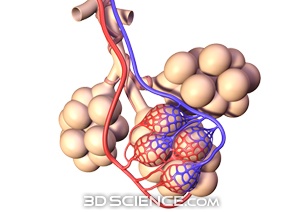
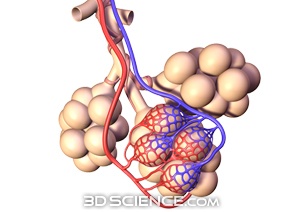
The air sacs that are covered with capillaries where gas exchange takes place
a)
bronchi
b)
lungs
c)
oxygen
d)
alveoli
3.

Flap of tissue that covers the opening to the windpipe during swallowing

a)

Pharynx

b)

Trachea

c)

Epiglottis

4.
What is the main function of the respiratory system?
a)
to provide oxygen and remove carbon dioxide from the body
b)
to bring oxygen to the body
c)
to break down food and absorb nutrients
d)
to remove oxygen from the body and deliver carbon dioxide
5.
Given the following structures:
1. larynx
2. nasal cavity
3. pharynx
4. trachea
Which of the following is the correct order that air would flow during inhalation. 
a)
1,2,3,4
b)
2,3,1,4
c)
2,1,3,4
d)
4,2,3,1 
6.
Which body function is made possible by the fibrous bands stretched across the larynx?
a)
swallowing
b)
breathing
c)
diffusion
d)
speech
7.
The left lung has three lobes and the right lung has two. 
a)
True
b)
False
8.
A chamber behind the nose and mouth that leads to the trachea
a)
pharynx
b)
trachea
c)
epiglottis
d)
larynx
9.

The drawing in of breath; inhalation.

a)

Inspiration

b)

Expiration

10.

Breathing out; exhalation of breath.

a)

Inspiration

b)

Expiration

11.

What is the site of gas exchange?

a)

alveoli

b)

nose

c)

lung

d)

bronchi

12.

A cavity within a bone or other tissue, especially one in the bones of the face or skull connecting with the nasal cavities.

a)

Sinus

b)

Nose

c)

Pharynx

d)

Larynx

13.

The only externally visible part of the respiratory system

a)

Eyes

b)

Nose

c)

Pharynx

d)

Larynx

14.

The division of the trachea forms

a)

nose

b)

main bronchi

c)

lungs

d)

alveoli

15.

Olfactory receptors are located in the mucosa of the nose. What are these receptors used for?

a)

sight

b)

smell

c)

touch

d)

taste

16.
Swelling of the bronchi. It causes coughing, fever, and chest tightness.
a)
Allergies
b)
Bronchitis
c)
Asthma
d)
Pneumonia
17.
The Immune systems response to an ordinarily harmless substance. 
a)
Asthma
b)
Emphysema
c)
Allergies
d)
Lung Cancer
18.
Inflammatory disease that causes the bronchi to become blocked or narrowed. (Not Bronchitis)
a)
Bronchitis
b)
Asthma
c)
Allergies
d)
Emphysema
19.
Disease in which the alveoli are damaged or destroyed. Strongly linked to smoking.
a)
Allergies
b)
Emphysema
c)
Asthma
d)
Pneumonia
20.
Disease in which tissue of the lungs is destroyed by the growth of a tumor.
a)
Allergies
b)
Emphysema
c)
Asthma
d)
Lung Cancer
21.
EXHALE!!!
My lungs are __________________ air. 
a)
taking in
b)
letting out
22.
Inhale!!!!
Your lungs are ___________  air
a)
taking in
b)
letting out
23.
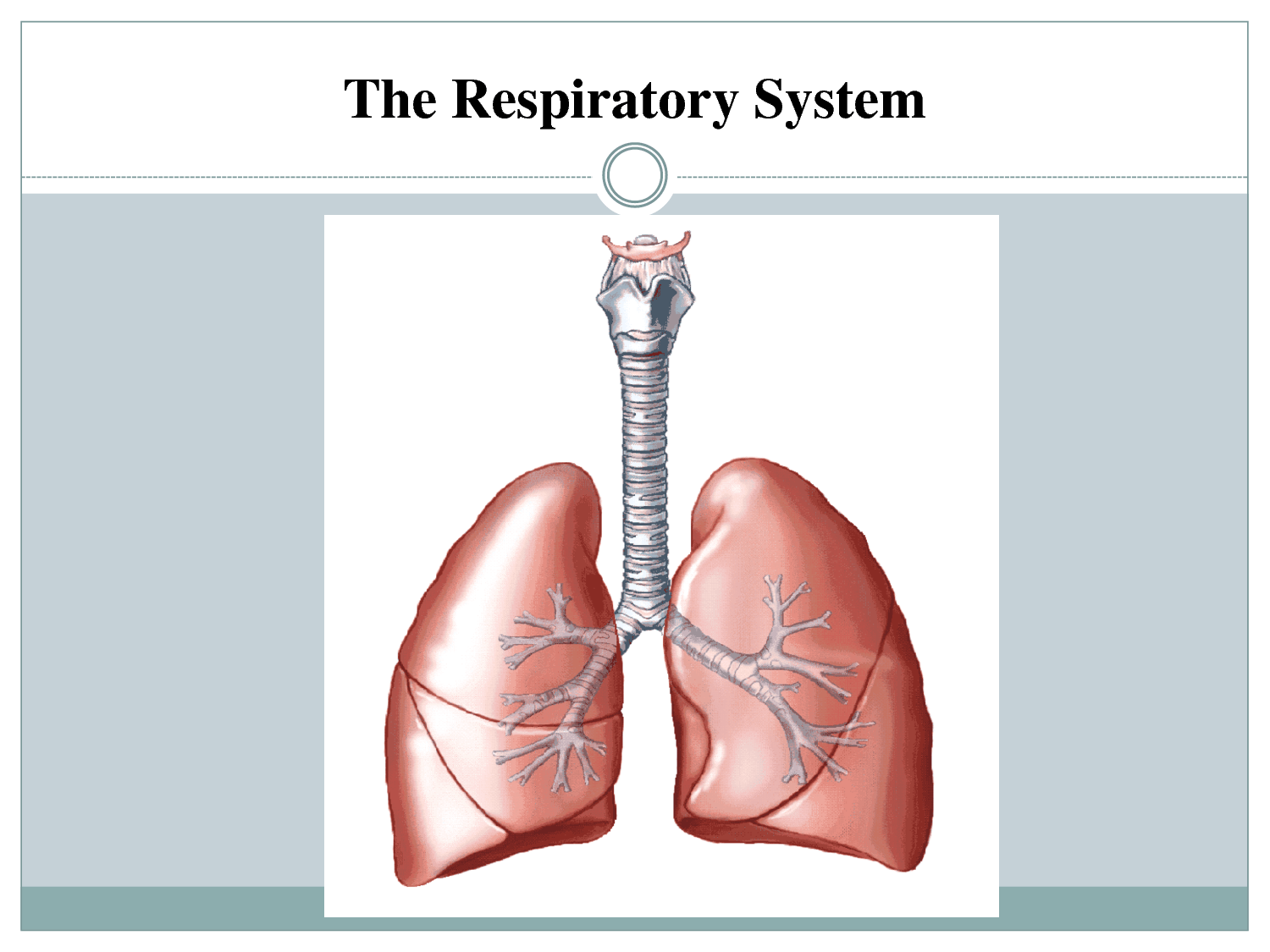
What are the main organs of gas exchange in the respiratory system?
a)
diapragm
b)
lungs
c)
trachea
d)
bronchi
24.
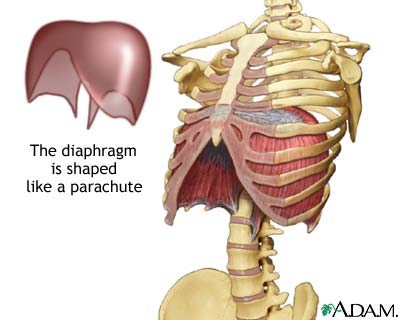
What is function of the dome-shaped diaphragm?
a)
This is where gas exchange happens.
b)
Air passes through the diaphragm on the way to the lungs.
c)
It attaches to the lungs to help in breathing.
d)
It is under the lungs and keeps them from falling down to your stomach.
25.
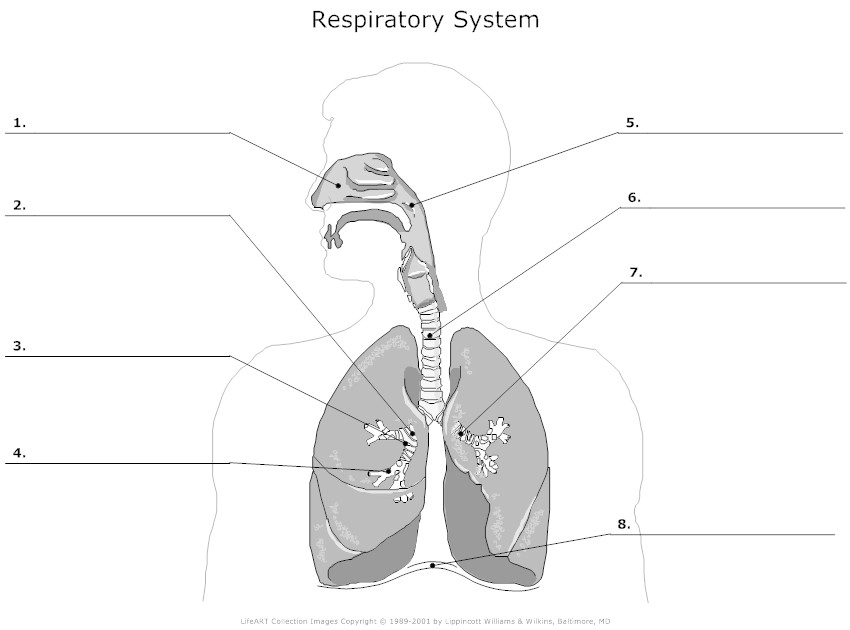
Name the organ label # 6. 
a)
alveoli 
b)
bronchi 
c)
trachea 
d)
lungs 
26.

NUMBER 2:

a)

Pharynx

b)

Bronchi

c)

Alveoli

d)

Lungs

27.

NUMBER 3:

a)

Pharynx

b)

Trachea

c)

Bronchi

d)

Alveoli

28.

Inside the lungs, the bronchi divide into smaller tubes. At the end of these tubes, there are tiny sacs called...

a)

Pharynx

b)

Trachea

c)

Lungs

d)

Alveoli

29.

When we breath in the diaphragm...

a)

Contracts

b)

Relaxes

30.

When we breathe out the diaphragm...

a)

Contracts

b)

Relaxes

31.

When we breathe out, the ____________ leaves our lungs.

a)

Carbon dioxide

b)

Oxygen

32.
Which of the following delivers oxygen to cells?
a)
Red Blood cells
b)
White blood cells
c)
Platelets
d)
Plasma
33.
Which of the following are the blood vessels that helps blood flow to the heart?
a)
Veins
b)
Arteries
c)
Cappillaries
34.
What is the name of the circulation between the heart and lungs?
a)
Diastolic
b)
Systemic
c)
Pulmonary
d)
Coronary
35.
Blood enters the heart at the ....
a)
Right Atrium
b)
Left Atrium
c)
Right Ventricle
d)
Left Ventricle
36.
What is the name of the part labelled 3?
a)
Right Atrium
b)
Left Atrium
c)
Right Ventricle
d)
Left Ventricle
37.
What is the name of the part labelled 2?
a)
Right Atrium
b)
Left Atrium
c)
Right Ventricle
d)
Left Ventricle
38.
What is the name of the part labelled 4?
a)
Right Atrium
b)
Left Atrium
c)
Right Ventricle
d)
Left Ventricle
39.
What is the function of a valve?
a)
Helps blood to clot
b)
Keeps blood flowing in all directions
c)
Keeps blood flowing in one direction
d)
Stops blood from flowing
40.
Which vessels carry blood away from the heart?
a)
arteries
b)
veins
c)
capillaries
41.
How many chambers does the heart have ? 
a)
4
b)
6
c)
3
d)
1
42.
Which part of the heart pumps deoxygenated (oxygen-poor) blood?
a)
Left side
b)
Right side
c)
Top side
d)
Bottom side
43.
Pulmonary vein
a)
carries oxygenated blood to left atrium
b)
carries deoxygenated blood to left ventricle
c)
carries oxygenated blood to left ventricle
d)
carries deoxygenated blood to left atrium
44.

Arteries carry oxygen rich blood away from the heart.

a)

True

b)

False

45.
______________ are the smallest blood vessels.
a)
Arteries
b)
Veins
c)
Capillaries
46.
Which is NOT a function of the circulatory system?
a)
deliver O2 and nutrients to cells
b)
remove CO2 and wastes from cells
c)
break down carbohydrates into glucose
d)
transport other materials through body
47.

Blood transport _____________ and ______________ to the ____________ .

Darah mengangkut ___________________ dan _______________ ke __________________.

a)

waste products, oxygen, brain

bahan kumuh, oksigen, otak

b)

oxygen, nutrients, body cells

oksigen, nutrien, sel badan

c)

carbon dioxide, oxygen, body cells

karbon dioksida, oksigen, sel badan

48.
The extracellular matrix of blood is called
a)
plasma
b)
erythrocytes
c)
buffy coat
d)
lympocytes
49.
Which blood cells are most abundant in the body?
a)
erythrocytes
b)
platelets
c)
lymphocytes
d)
eosinophils
50.
If you have a high white blood cell count, which of these would you have?
a)
leukopenia
b)
leukocytosis
c)
polycythemia
d)
anemia
51.
The three step process that stops blood flowing from a cut is called _________
a)
hemostasis
b)
homeostasis
c)
coagulation
d)
agglutination
52.
Where does hematopoiesis take place, producing new RBCs?
a)
red bone marrow
b)
yellow bone marrow
c)
synovial membrane
d)
articular cartilage
53.

Which system is responsible for creating red blood cells?

a)

skeletal

b)

muscular

c)

respiratory

d)

nervous

54.

Which system of the human body provides protection to most of the major organs?

a)

skeletal system

b)

circulatory system

c)

respiratory system

d)

muscular system

55.

Which of the following best describes the job of the skeletal system?

a)

Gives shape and support to the body.

b)

Sends messages from the stomach to the brain.

c)

Brings in and breaks down all nutrients for the body

56.

The joint with a rounded end of bone fitting snug within another bone.

a)

ball and socket joint

b)

hinge joint

c)

pivot joint

d)

gliding joint

57.

The joint that moves in one direction, like a door

a)

ball and socket joint

b)

hinge joint

c)

pivot joint

d)

gliding joint

58.

What is the number of bones that compose the adult skeleton?

a)

205

b)

206

c)

208

d)

200

59.

The ends of a long bone are called the

a)

diaphysis

b)

epiphyses

c)

periosteum

d)

endosteum

60.

Which of the following is NOT an example of a long bone?

a)

humerus

b)

tibia

c)

radius

d)

talus

61.

Bone tissue composed of small needle-like pieces of bone with open spaces:

a)

lacunae

b)

compact bone

c)

canaliculi

d)

spongy bone

62.

Process of bone formation before birth:

a)

ossification

b)

hematopoiesis

c)

appositional growth

d)

atrophy

63.

The long shaft of a bone:

a)

epiphyses

b)

diaphysis

c)

periosteum

d)

endosteum

64.

What muscle is highlighted in the picture?

a)

Triceps

b)

Biceps

c)

Quads

d)

Deltoids

65.

What muscle is highlighted in the picture?

a)

Triceps

b)

Biceps

c)

Quads

d)

Deltoids

66.

What muscle is highlighted?

a)

Triceps

b)

Biceps

c)

Quads

d)

Deltoids

67.

What muscles is highlighted?

a)

Deltoid

b)

Trapezius

c)

Tricep

d)

Pectoralis

68.

What muscle is highlighted?

a)

Trapezius

b)

Lats

c)

Pectoralis

d)

Deltoids

69.

What muscle is highlighted?

a)

Lats

b)

Abdominals

c)

Pectoralis

d)

Quads

70.

What muscle is highlighted?

a)

Abdominals

b)

Quads

c)

Gluteus

d)

Hamstring