
 Worksheets
Punnet square practice
Total questions: 36
Worksheet time: 2hrs 23mins
Name
Class
Date
1.
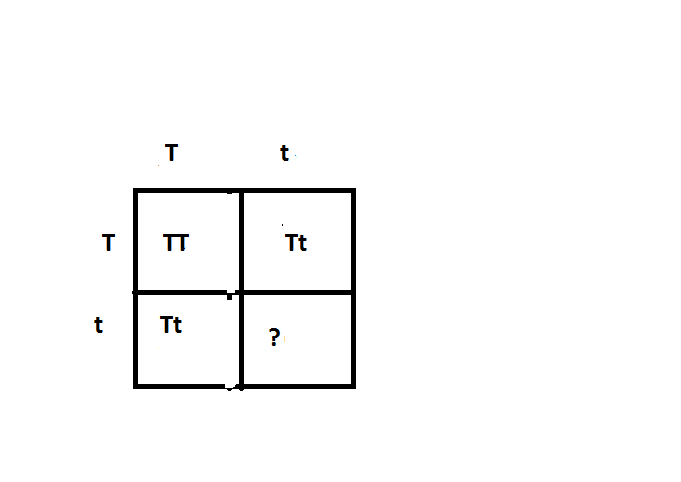
T - tall and t = short
In the punnett square below, what belongs in the missing square
In the punnett square below, what belongs in the missing square
a)
tt
b)
Tt
c)
Bb
d)
TT
2.
AA and Aa always show up as
a)
dominant
b)
recessive
3.
aa always shows up as
a)
dominant
b)
recessive
4.
Aa is
a)
homozygous
b)
heterozygous
5.
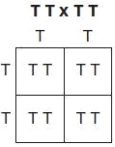
What ratio of the offspring from the cross shown will be homozygous recessive for the trait of tallness?
a)
0 in 4
b)
1 in 4
c)
2 in 4
d)
4 in 4
6.
Which of the following genotypes is homozygous dominant?
a)
A
b)
Aa
c)
AA
d)
aa
7.

How many boxes would say BB?
a)
1
b)
2
c)
4
d)
0
8.

T - tall and t = short
In the punnett square below, what belongs in the missing square
In the punnett square below, what belongs in the missing square
a)
tt
b)
Tt
c)
Bb
d)
TT
9.

What allele combination should go in the missing box?
a)
AA
b)
Aa
c)
aa
d)
none of these
10.

If B = brown hair and b = blonde hair, what is the probability of brown hair?
a)
25%
b)
50%
c)
0%
d)
75%
11.
Black hair color is dominant to white hair color in mice. Determine the phenotypic ratio for the offpring of a heterozygous black mouse and a white mouse.
a)
4 Black: 0 White
b)
3 Black: 1 White
c)
2 Black: 2 White
d)
0 Black: 4 White
12.
In a certain species of rabbits, black coat color is dominant over brown coat color. What is the probability of producing a rabbit with brown coat color from two rabbits that are both heterozygous for black coat color?
a)
0%
b)
25%
c)
75%
d)
100%
13.
Biologists have found that a form of deafness is a recessive trait in dogs. If a female dog that is heterozygous for the trait mates with a male dog that is deaf, what percent of their offspring will be deaf?
a)
0%
b)
50%
c)
75%
d)
100%
14.
Phenylketonuria (PKU) is inherited as a recessive condition. A man with PKU marries a woman without any alleles for PKU. What is the probability that their child will inherit PKU?
a)
0%
b)
25%
c)
50%
d)
75%
15.

In rabbits, black fur (B) is dominant over brown fur (b). If a rabbit has brown fur, what can you conclude about its genotype?
a)
It is BB.
b)
It is Bb
c)
It is brown
d)
It is bb.
16.

A ________________________ is used to predict the possible genotype from certain parents
a)
Mendel Grid
b)
Genetic Tic Tac Toe
c)
Punnett Square
d)
Pedigree Plot
17.
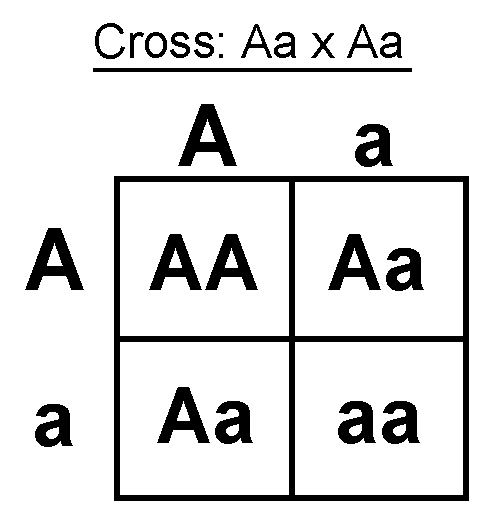
What is the phenotype of the offspring? (A-Brown hair; a-blond hair)
a)
50 % Brown Hair and 50% Blond Hair
b)
25 % Brown Hair and 75% Blond Hair
c)
75 % Brown Hair and 25% Blond Hair
d)
0% Brown Hair and 100% Blond Hair
18.
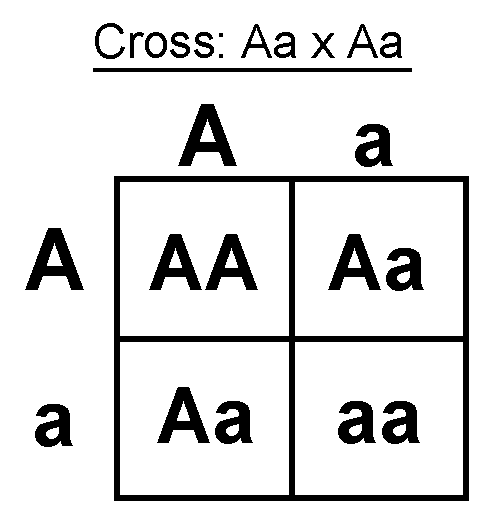
What percent of offspring will have the recessive trait?
a)
25
b)
50
c)
75
d)
100
19.
What is a phenotype
a)
The genetic make up (code)
b)
The physical trait
20.

What is the probability of heterozygous offspring?
a)
25%
b)
50%
c)
0%
d)
100%
21.
A man, who has red-green colorblindness, and his wife, who is a carrier for colorblindness, have a colorblind son. What is the probability that their next son will also be colorblind?
a)
0%
b)
25%
c)
50%
d)
100%
22.
What are the possible phenotype(s) of the offspring? (A-Brown hair; a-blond hair)
a)
50 % Brown Hair and 50% Blond Hair
b)
25 % Brown Hair and 75% Blond Hair
c)
75 % Brown Hair and 25% Blond Hair
d)
0% Brown Hair and 100% Blond Hair
23.
In pea plants: T=tall t=short
What ratio of the offspring could be short?
a)
0 in 4
b)
1 in 4
c)
2 in 4
d)
4 in 4
24.

What genotype would go in box 2?
a)
BB
b)
Bb
c)
bb
25.

What is the probability of heterozygous offspring?
a)
0%
b)
100%
c)
50%
d)
25%
26.
What genotype would go in box 4?
a)
BB
b)
Bb
c)
bb
27.
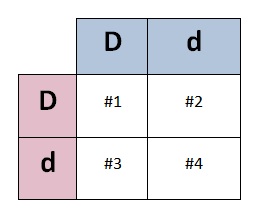
What is the possibility of this offspring having the dominant trait?
a)
50%
b)
75%
c)
25%
d)
0%
28.

Being tall or short are examples of _______________
a)
Dominant
b)
Homozygous
c)
Genotype
d)
Phenotype
29.

An organism's _______ describes its genetic composition. An organism's _______ describes its appearance or observable characteristics.
a)
phenotype; genotype
b)
species; heredity
c)
heredity; species
d)
genotype; phenotype
30.

A heterozygous long-tusked elephant is crossed with a homozygous recessive short-tusked elephant. What is the probability of the offspring having short tusks?
a)
0%
b)
25%
c)
50%
d)
75%
31.

What is the probability of a purple-horned unicorn if a heterozygous pink-horned unicorn is crossed with a heterozygous pink-horned unicorn?
a)
0%
b)
25%
c)
50%
d)
75%
32.

Georgette wants to breed her pet phoenixes, but she isn't sure if the babies will burst into blue flames or red flames. Her documents show that her female phoenix is homozygous dominant for red flames, while her male phoenix is homozygous recessive for blue flames. What color flames will the babies have?
a)
Red
b)
Blue
c)
Purple
d)
50% Red, 50% Blue
33.

Leonardo bet his friend Olivet that two heterozygous green-eyed sea monsters could not have a recessive blue-eyed baby sea monster. Olivet said they can have a blue-eyed sea monster.
Who wins the bet?
Who wins the bet?
a)
Leonardo
b)
Olivet
c)
Both
d)
Neither
34.

A brown-furred ewok has 12 babies with a black-furred ewok. 9 ewok babies have black fur, while 3 ewok babies have brown fur. What are the probable genotypes of the parents?
a)
BB and bb
b)
BB and Bb
c)
Bb and Bb
d)
Bb and bb
35.

Jabba the Hutt has finally decided to settle down and have a family. He has undergone genetic testing and learned that he is heterozygous for Hutt Fungal Syndrome, which is caused by recessive alleles. He is worried that his children might suffer from this syndrome. His Hutt mate has undergone genetic testing and discovered she is homozygous dominant for the syndrome. Should Jabba be worried?
a)
Yes
b)
No
36.

Bob the abominable snowman lives in the snowy Andes mountains. He has white fur, which blends in nicely. He is therefore dismayed when his mate keeps having red-furred babies. What is Bob's likely genotype?
a)
Homozygous Dominant
b)
Heterozygous
c)
Homozygous Recessive
100 %

