
Font size
 Worksheets
redox reactions
Total questions: 60
Worksheet time: 2hrs 34mins


2Ca(s) + O2(g) --> 2CaO(s), calcium is __________
which element, if any, is oxidized?
A redox reaction is NOT:
all reactions
a combustion reaction
a reduction-oxidation reaction
a reaction in which electrons are transferred from one atom to another
Defined as the loss of electrons.
oxidation
reduction
redox
OIL RIG
Defined as the gain of electrons.
oxidation
redox
reduction
LEO GER
Cl2 + 2e- --> 2Cl - is an example of:
a chemical reaction
redox
oxidation
reduction
An increase in oxidation number.
more acidic
reduction
less basic
oxidation
2CaO--> 2Ca + O2
4Fe + 3O2 --> 2Fe2O3
Oxidation is the _________ of electrons.
loss
gain
sharing
transfer
Reduction is the ___________ of electrons.
loss
gain
sharing
transfer
4Fe + 3O2 --> 2Fe2O3
Mg → Mg2+ + 2e–
2CaO--> 2Ca + O2
Choose all the statements which contain correct definitions of reduction
the removal of oxygen
the removal of hydrogen
the removal of electrons
the decrease in oxidation state
Which one of the following conversions is an example of reduction?
Copper (II) oxide to copper (II) sulfate
Copper (II) oxide to copper
Hydrochloric acid to chlorine
Lead (II) nitrate to lead (II) chloride

Defined as the gain of electrons.
oxidation
redox
reduction
LEO GER

Defined as the loss of electrons.
oxidation
reduction
redox
OIL RIG
Which of the following represents oxidation?
C → CH4
Fe3+ → Fe2+
Cl2 → 2Cl-
Zn → ZnO
Gaining hydrogen is an example of...
oxidation
reduction
Gaining oxygen is an example of...
oxidation
reduction
In a redox reaction, spectator ions...
become oxidised
become reduced
remain unchanged
In the half equation:
Cu --> Cu2+ + 2e-
Copper undergoes...
Spectatorship
Reduction
Deprotonation
Oxidation
If the oxidation number of an element reduces in a redox reaction, then this corresponds to the process of...
Reduction
Oxidation
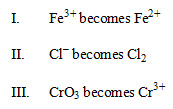


What is the oxidation number of C in SrCO3?
-4
+2
-6
+4
What is the oxidation number of Cr in Cr2O72- ?
+14
+6
-6
-14
An increase in oxidation number.
more acidic
reduction
less basic
oxidation
The sum of the oxidation numbers in SCN- is equivalent to
0
-1
+1
+3
a compound having +2 oxidation state of O is
H2O
H2O2
OF2
O2F2
When a gas changes iron (III) oxide to iron (II) oxide, it shows that the gas is
a reducing agent
an oxidizing agent
a combustible gas
a diffusible gas
Choose all the statements which are correct for an oxidising agent.
removes hydrogen
gains oxygen
is reduced at the end of the reaction
accepts electrons
In the reaction, Fe2O3(s) + 3CO(g) → 2Fe(l) + 3CO2(g)
carbon monoxide is reduced
carbon monoxide is the oxidising agent
iron(III) oxide is oxidised
iron(III) oxide is the oxidising agent
State the reducing agent in this reaction.
Cu + 4HNO3 -> Cu(NO3)2 + 2H2O + 2NO2
Cu
HNO3
Cu(NO3)2
NO2
Check all the equations whereby the underlined substances has been oxidized.
carbon dioxide + carbon -> carbon monoxide
iron (II) oxide + aluminium -> aluminium oxide + iron
copper (II) oxide + ammonia -> copper + nitrogen + water
hydrogen + oxygen -> water

An increase in oxidation number.
more acidic
reduction
less basic
oxidation

A decrease in oxidation number.
concentrated
reduction
oxidation
dilute

What is the reducing agent here: N2 + 3H2 --> 2NH3
N2
H2
NH3
2NH3

In the reaction
2Ca(s) + O2(g) --> 2CaO(s), calcium is __________
Reduced
Synthesized
Oxidized
None of the above
The sum of the oxidation numbers in Na2CO3 is equivalent to
0
-2
+1
-1
Mg → Mg2+ + 2e–
What is the oxidation number of chlorine in HClO?
0
-1
+1
+5
What is the oxidizing agent of this reaction?
3Mg + N2−−−−> Mg3N2
Mg
N2
Mg3N2
MgN
3Mg + N2−−−−> Mg3N2
2Al(s) + 6H+(aq) −−−> 2Al3+ (aq) + 3H2(g)
2Al(s) + 6H+(aq) −−−> 2Al3+ (aq) + 3H2(g)
What is the oxidation number of iodine in KIO3?
0
-1
+5
+1

