
 Worksheets
Coasts/Plate Tectonics
Total questions: 62
Worksheet time: 55mins

What is the correct order (starting from the surface) of Earth’s layers?
crust, outer core, inner core, mantle
mantle, outer core, inner core, crust
crust, mantle, outer core, inner core
outer core, inner core, crust, mantle
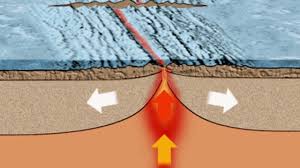
In sea-floor spreading, molten material rises from the mantle and erupts
along the edges of all the continents.
along mid-ocean ridges.
in deep-ocean trenches.
at the north and south poles.
A place where two plates slip past each other, moving in opposite directions, is known as a _______
transform boundary
divergent boundary.
convergent boundary.
rift valley.

Below is a picture of sea-floor spreading. How are the ocean crusts moving?
Converging
Diverging
Sliding
No movement
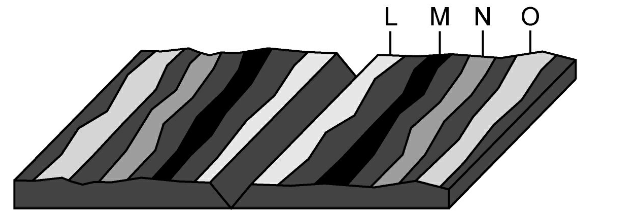

Breaks in the crust called __________ form where plates meet.
mountains
rift valleys
faults
trenches
What is the motion of Earth's plates like?
fast and in stages
slow and in stages
fast and constant
slow and constant
Which feature forms at convergent boundaries?
trench
rift valley
mountain range
mid-ocean ridge
Non-explosive, gently sloping volcano made of flat layers of lava
Cinder cone
Shield
Composite
Transform
In an earthquake, the point underground where the rocks first begin to move
Epicenter
Normal fault
Focus
Reverse fault
The point on Earth's surface directly above the focus of an earthquake
Juan de fuca plate
Focus
Seismic wave
Epicenter
In these faults, blocks of rock move sideways on either side of the fault plane
Reverse faults
Convergent boundary
Normal faults
Strike-slip faults
In these faults, the block of rock above the fault plane slides down relative to the other block
Normal fault
Reverse fault
Backwards fault
Strike-slip fault
which of these are costal erosions ?
sea wearing away the land
how the waves are created
waves crashing into the shore
select 4 proccesses of costal erosion?
hydralic action
attrition
abrasion
corrosion
nutrition
bays are formed because.....
they are made up of soft rock, which erodes faster than hard rock
they are made up of hard rock which erodes slower than soft rock
constructive waves contribute in creating...
cliff landforms
oceans
erosinal landforms
depositional land forms

These rocks are likely to be a result of ..
solution
hydraulic action
attrition
abrasion

Name this landform
(a)
Constructive waves are found on ______ coasts.
steep
gentle
Destructive waves have _______ wave frequency and _____ wave height compared to constructive waves
higher, higher
higher, lower
lower, higher
lower, lower
constructive waves have ______ swash and _____ backwash.
strong, strong
strong, weak
weak, strong
weak, weak
Due to wave refraction, waves __________ at protruding headlands and _________ at bays.
converge, diverge
diverge, converge
deflect , reflect
reflect, deflect


Identify the landform shown in the photo.
Geo
Sea cave
Spit
Tombolo
Which of the following geographical term means how far the wind travels?
Wind speed
Fetch
Wind fetch
Prevailing wind
Which of the following geographical term means the wind which predominantly blows at a particular place over a period of time?
Wind speed
Fetch
Monsoon
Prevailing wind
Which of the following is NOT a type of coastal erosional processes?
Solution
Saltation
Hydraulic action
Attrition
How do you call the exposed coasts where the rocks are sticking out into the sea?
Bays
Coasts
Headlands
Stacks
Waves moving up the coast is known as (a) .

Name Part A of the wave.
crest
trough
wave height
wave length
Name Part B of the wave.
crest
trough
wave height
wave length
The strength of the wind is dependent on ... (click all suitable options.)
wave direction
fetch
wind speed
wind duration
Fetch refers to
where the wind is coming from
how long the wind is blowing
the distance covered by the wind over the oceans
the speed of the wind
The process when rock particles knock against the base of the cliff causing parts of the cliff to breakdown.
Attrition
Solution
Hydraulic action
Abrasion
Air is trapped at the the cracks of cliffs by the incoming waves. The pressure buildup causes the joints to weaken and rocks to shatter.
Hydraulic action
Solution
Attrition
Abrasion

