wayground logo

Free Printable Worksheets

Font size

S
M
L
XL
Worksheets

Unit D Electricity

Total questions: 90

Worksheet time: 1hrs 4mins

Name
Class
Date
1.

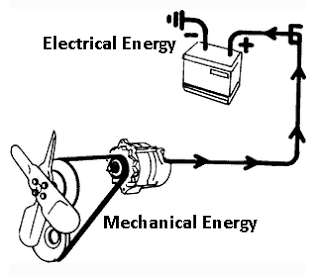
What kind of device turns mechanical energy into electrical energy?

a)

parallel circuit

b)

generator

c)

motor

d)

magnet

2.

What kind of device turns electrical energy into mechanical energy?

a)

parallel circuit

b)

generator

c)

motor

d)

magnet

3.
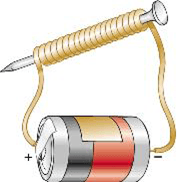
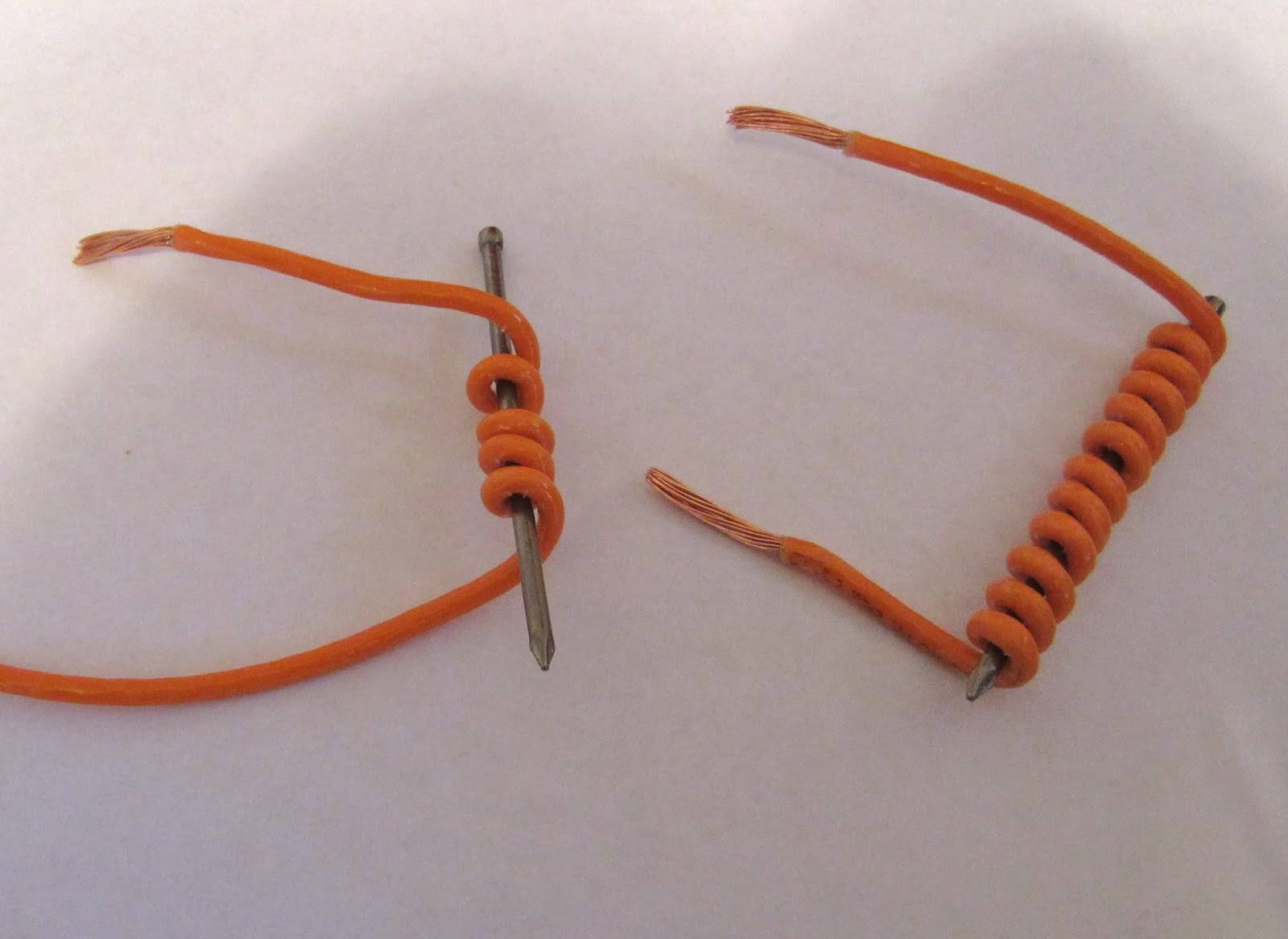
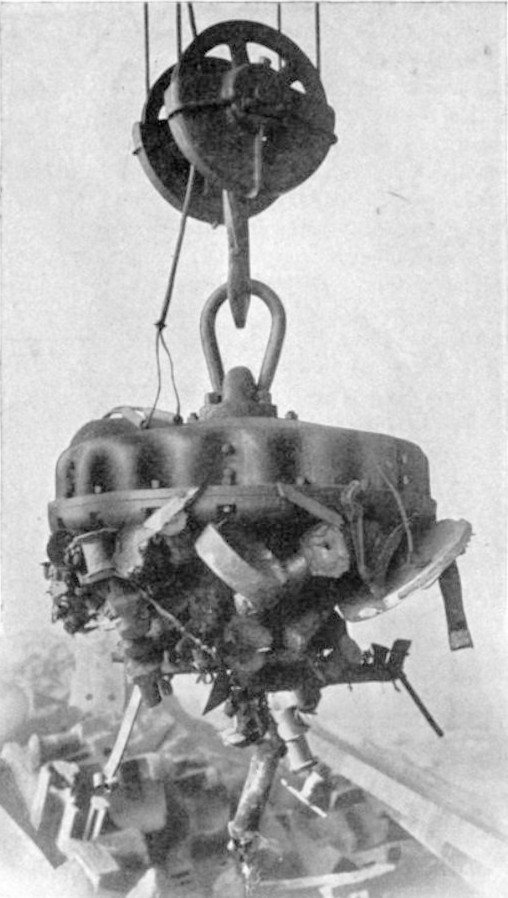
What is the device seen here?
a)
generator
b)
electric motor
c)
electromagnet
d)
magnet
4.
What is formed when a wire in an electric circuit is wrapped around an iron core producing a magnetic field?
a)
electromagnet
b)
generator
c)
magnet
d)
electric motor
5.
Generators are devices that convert _____ energy into _____ energy.
a)
chemical; mechanical
b)
mechanical; electrical
c)
electrical; mechanical
d)
potential; kinetic
6.
Electric motors are devices that convert _____ energy into  _____ energy.
a)
electrical; mechanical
b)
mechanical; electrical
c)
chemical; potential
d)
mechanical; kinetic
7.
When plugged into an outlet, the clock lights up to show the time.  What kind of energy transformation is this?
a)
chemical to light
b)
mechanical to chemical
c)
electrical to mechanical
d)
electrical to light
8.
What type of energy transformation occurs in a toaster?
a)
chemical to electrical
b)
electrical to heat
c)
sound to chemical
d)
electrical to solar
9.
When John plugs in a toy and turns it on, a marble is carried up to the top of a slide. At the top, a marble is released and it goes down a slide. What kind of energy transformation occurs to make this toy work?
a)
chemical to heat
b)
electrical to chemical
c)
sound to electrical
d)
electrical to mechanical
10.
What happens to the strength of an electromagnet as you add more coils around it?
a)
Increases
b)
Decreases
c)
Stays the same
d)
Stops completely
11.
How are electromagnets different from magnets?
a)
magnets can be turned on/off
b)
you can turn an electromagnet on/off
c)
magnets are more powerful
d)
magnets have a North and South pole
12.
In an electric motor, the energy transformation begins as  ----
a)
electrical and becomes chemical
b)
mechanical and becomes electrical
c)
electrical and becomes mechanical
d)
mechanical and becomes chemical
13.
The Law of Conservation of Energy states that
a)
energy stops at sunset
b)
energy can’t be created or destroyed
c)
energy only transfers to solids
d)
energy never transforms
14.
What energy transformation takes place in a battery powered fan that is spinning?
a)
kinetic to chemical to electrical
b)
chemical to kinetic
c)
chemical to electrical to kinetic
d)
electrical to kinetic to chemical
15.
Electrical power can be calculated using
a)
Resistance x Voltage
b)
Voltage x Current 
c)
Voltage ÷ Current
16.
The voltage supplied to a circuit is 17 V and the current running through is 10 A. What is the power generated?
a)
170 W
b)
170 A
c)
1.7 V
d)
1.7 W
17.
Calculate the electric power of an electrical appliance in which 10 A of current is flowing through a resistor of 2 ohms.
 
Remember: V=IR and P=VI
a)
80 W
b)
200 W
c)
2.5 A
d)
22.5 KJ
18.

Efficiency is calculated by useful energy output divided by total energy input, expressed as a percentage

a)

False

b)

True

19.

Energy efficiency of incandescent lightbulbs is

a)

50%

b)

25%

c)

15%

d)

5%

20.
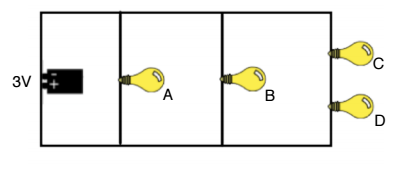
This image represents what type of circuit.
a)
closed
b)
opened
c)
series 
d)
parallel
21.
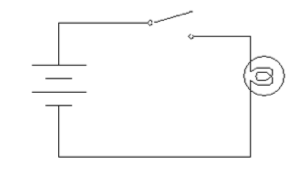
Will the light bulb in this circuit light and why/why not?
a)
yes, because it has two batteries.
b)
yes, because it is in a circuit
c)
no, because the switch is open.
d)
no, because the bulb is burned out.
22.
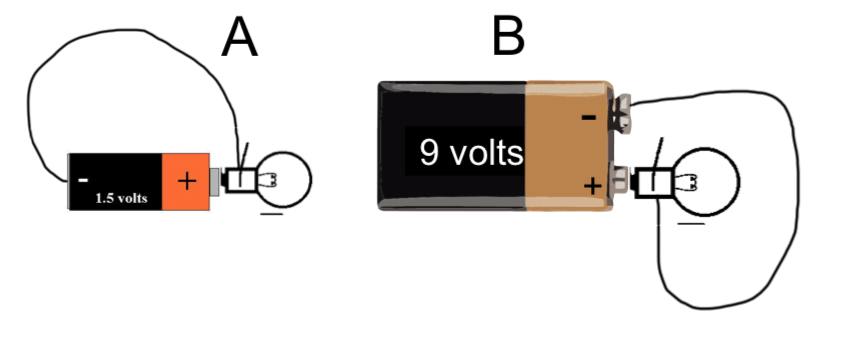
Which light will be brighter and why?
a)
Bulb A because it's circuit is closed.
b)
Bulb B because it's circuit is closed.
c)
Bulb B because it has more volts.
d)
Bulb A because it has less volts.
23.
When voltage increases, what happens to the current?
a)
decreases
b)
increases
c)
both increase and decrease
24.
Electricity flows in a:
a)
circuit
b)
current
c)
wire
d)
water
25.
this is the symbol for a _____?
a)
switch
b)
light 
c)
battery
d)
wires
26.
what is this symbol for?
a)
light bulb
b)
cell
c)
battery
d)
resistor
27.

Calculate the power of an appliance that uses 1000 joules of energy in 5 seconds.

a)

100 W

b)

200 W

c)

300 W

d)

400 W

28.

Lights strung together in a line along a circuit would be an example of a _____ circuit.

a)

short

b)

parallel

c)

series

d)

resistor

29.

What is electricity?

a)

the flow of electric charge

b)

the flow of negative electric charge

c)

the orbit of electrons around a nucleus

d)

the flow of positive electric charge

30.
When the resistance increases in a circuit, what happens to the current?
a)
decreases
b)
increases
c)
both
31.
Thicker wires have _______ resistance than thinner wires.
a)
more
b)
less
c)
the same
32.
What is the unit for resistance?
a)
Volts
b)
Amperes
c)
Ohms
33.
Which formulas represents Ohm's law?
a)
V=IR
b)
R=IV
c)
I=RV
34.
A Charging system producing 14.5 Volts with a current flow of 43.5 Amps, what is the circuit resistance
a)
58 Amps
b)
0.33 Amps
c)
13 Amps
d)
1 Amp
35.
If the current through a circuit is 2 A and the resistance of a light bulb in the circuit is 10 Ohms, what is the voltage difference across the light bulb?
a)
5 V
b)
12 V
c)
0.2 V
d)
20 V
36.
What is Resistance?
a)
the degree to which a circuit component opposes the passage of an electric current, causing energy dissipation
b)
How hard the energy is pushed
c)
The amount of charges that pass by a given point per second
d)
None of the above
37.
How does resistance affect current?
a)
less resistance - less current
b)
more resistance - less current
c)
more resistance - more current
d)
resistance does not affect current
38.

How do you calculate current from voltage and resistance?

a)

Current = voltage x resistance

b)

Current = resistance x power

c)

Current = voltage ÷ resistance

d)

Current = resistance ÷ voltage

39.

How does the thickness of a wire affect resistance?

a)

A thicker wire has more resistance

b)

A thinner wire has more resistance

c)

Thickness of a wire does not affect resistance

40.
a)

zig zag

b)

Resistor

c)

Ammeter

41.

Electricity is the movement of _____.

a)

circuit

b)

electrons

c)

molecules

d)

atoms

42.
Two objects with LIKE static charges will
a)
attract each other
b)
even out in the end
c)
repel each other
d)
cause a spark
43.
Two objects with LIKE static charges will
a)
attract each other
b)
even out in the end
c)
repel each other
d)
cause a spark
44.
The girl's hair and the comb are attracting  one another.  The hair and the comb have
a)
opposite charges
b)
like charges
45.
True or False
Like charges repel
a)
True
b)
False
46.
What is the major difference between static electricity and current electricity?
a)
Current electricity involves a continuous flow of neutrons; static electricity is a sudden transfer of protons
b)
Current electricity can be deadly; static electricity is almost always safe
c)
In current electricity, there's a single transfer of electrons; in static electricity, there's a steady flow of electrons
d)
Current electricity involves a flow of electrons; static electricity involves a single transfer of electrons
47.
The fuse in a circuit melts when:
a)
An appliance isn't earthed
b)
Too much current flows
c)
Too much voltage flows
48.

A student is testing the conductivity of 4 different substances. He uses a 2.5 V battery and records the current in the circuit in each of the 4 substances. The chart below indicates the current measured.

Which substance is most likely an insulator?

a)

Substance Q

b)

Substance R

c)

Substance S

d)

Substance T

49.

Which of the following changes to the cell shown above would result in voltage being produced?

a)

Reversing the leads on the voltmeter

b)

Using a greater volume of sulfuric acid

c)

Replacing 5% sulfuric acid with 20% sulfuric acid

d)

Changing one of the electrodes to a zinc electrode

50.
Lightning is an example of _________.
a)
static electricity
b)
current electricity
c)
watts
d)
voltage
51.
Electric current is measured in ______.
a)
Watts
b)
Volts
c)
Amperes
52.

How can it be explained that someone's hair can stick to a balloon?

a)

There is static electricity.

b)

There is too much dust in the air.

c)

The person needs to wash his hair.

53.

Opposite charges _______________.

a)

attract

b)

repel

c)

nothing changes

54.

Like charges _______________.

a)

attract

b)

repel

c)

nothing changes

55.

Facts About Electricity:


  1. Electrons can be discharged when clothes are removed from a clothes dryer.
  2. Electrons flow continuously through a conductor.
  3. Electricity can be used to operate a motor.
  4. Electricity can build up and produce lightning.


Which facts describe properties of static electricity?

a)

1 and 2

b)

1 and 4

c)

2 and 3

d)

2 and 4

56.

Which of the diagrams above most accurately represents the charges in the wall when the balloon comes near the wall?

a)

A

b)

B

c)

C

d)

D

57.
a)

A

b)

B

c)

C

d)

D

58.

When electrons suddenly leave your body and enter a metal doorknob, it is called ...

a)

A. electrocharging

b)

B. electrical discharge

c)

C. electrical charge up

d)

D. charge separation

59.

how does a fuse work?

a)

A. the metal melts, and interrupts the current

b)

B. the metal melts, and causes resistance

c)

C. the metal increases the flow of electrons

d)

D. the metal builds up electrons

60.

If a 15A circuit breaker is replaced with a 20A breaker, it is

dangerous because ….

a)

A. nothing would happen

b)

B. less current will flow to the devices on the circuit

c)

C. too much resistance will be added to the circuit

d)

D. too much current could flow through the circuit and without the proper breaker, the circuit breaker would not disrupt the circuit and could potentially cause a house fire

61.
a)

A

b)

B

c)

C

d)

D

62.

the device used to measure voltage is

a)

a thermometer

b)

a fuse

c)

amperes

d)

a voltmeter

63.
a switch that automatically opens if the current in the circuit is too high
a)
parallel circuit
b)
circuit breaker
c)
series circuit
d)
load
64.
2 different metals that lose or gain electrons in a battery (zinc and copper
a)
wet cells
b)
dry cells
c)
electrolytes
d)
electrodes
65.
liquid in a battery that allows electrons to move from one metal to the other (fruit juice, vinegar)
a)
Wet Cells
b)
Dry Cells
c)
Electrolyte
d)
Electrodes
66.
a type of cell that contains solid or pastelike electrolytes
a)
Wet Cells
b)
Dry Cells
c)
Electrolytes
d)
Electrodes
67.
a cell that has a liquid electrolyte
a)
wet cells
b)
dry cells
c)
electrolytes
d)
electrodes
68.

What is a wet cell battery?

a)

one that uses water to make electricity

b)

one that uses a liquid electrolyte solution

c)

one that uses a powdered electrolyte solution

69.

What is a dry cell battery

a)

one that uses water to make electricity

b)

one that uses a liquid electrolyte solution

c)

one that uses a paste electrolyte

70.
A wet cell contains how many different metals?
a)
One
b)
Two
c)
Three
d)
Four
71.
What is electrolysis?
a)
breaking down of a compound using a current
b)
making a compound using a current
72.

The electricity in your household is

a)

AC or alternating current

b)

BC or basic current

c)

CC or constant current

d)

DC or direct current

73.

What is the electrical consumption of a 400W per day (24 hrs)?

a)

0.4 kWh

b)

0.96 kWh

c)

4 kWh

d)

9.6 kWh

74.

A conductor has a resistance of 2.8 Ω\Omega  .

If the potential difference across it is 9.0 V, what current is flowing through it?

a)

1.3 A

b)

3.2 A

c)

4.3 A

d)

5.7 A

75.

In which circuit the bulbs will light up brighter?

a)

X

b)

Y

76.

A bulb requires a voltage of 120V and has a current draw of 0.5A. What is the power rating of the bulb?

a)

60W

b)

240W

c)

120W

d)

1/2W

77.

How much electrical energy is used when you have a 60W lightbulb on for 5 minutes?

a)

18,000J

b)

12J

c)

1800J

d)

300J

78.

What is the efficiency of a lightbulb that produce 150,000J of light energy and uses 180,000J of electrical energy

a)

83J

b)

83%

c)

120%

d)

120J

79.

What type of transformer is a location B?

a)

step up

b)

step down

80.

What type of transformer is a location D?

a)

step up

b)

step down

81.

What type of transformer is A?

a)

Step up

b)

Step down

82.

What type of transformer is D?

a)

Step up

b)

Step down

83.

A step-up transformer has more turns on the primary coil than the secondary coil.

a)

True

b)

False

84.

If a transformer reduces voltage, it is called a....................... transformer.

a)

step left

b)

step right

c)

step up

d)

step down

85.

If a transformer increases voltage, it is called a ......... transformer.

a)

step right

b)

step left

c)

step up

d)

step down

86.

Batteries are devices that change _______________ energy into _______________ energy.

a)

chemical, thermal

b)

thermal, electrical

c)

chemical, electrical

d)

electrical, mechanical

87.

Match the following

1 - unit which resistance is measured in

2 - abbreviation for current used in Ohm’s Law

3 - units which potential difference is measured in

4 - units which current is measured in

(a)  

88.

Electrical circuits can be set up as either parallel circuits or as series circuits. For each example given below, identify whether it is a parallel circuit or a series circuit.

1 = parallel circuit

2 = series circuit

(a)  

89.

Which of the following choices correctly labels the three parts?

a)

A - split-ring; B: brush; Commutator

b)

A - brush; B - coil; C - armature

c)

A - armature; B - split ring; C - coil

d)

A - brush; B - split ring; C - coil

90.

What is the function of part B?

a)

Provides a current to the system.

b)

Repels and attracts the permanent magnet.

c)

Increases the magnetic field.

d)

Alternates current so the motor continues spinning.