
Font size
 Worksheets
6ºEP_Heat, light and electricity_Extra unit
Total questions: 93
Worksheet time: 1hrs 10mins

What is electricity?
Gas
Liquid
Energy
Material

What type of component is a cell?
Generator
Conductor
Load device
Control device

Particles with the same charge...
they do nothing
they tend to pull closer
they tend to disappear
they tend to pull apart

Electrical energy is...
easy to obtain
easy to transport over long distances
easy to transform into other ttypes of energy
all choices are correct

What particles are found in the nucleus of an atom?
Neutrons
Protons and electrons
Protons and neutrons
Neutrons and electrons

A buzzer transforms electrical energy into....
sound
movement
heat
light

If a component provides electrical energy to the rest of the circuit is called
conductor
load device
control device
power source

The directional movement of electrons between atoms is called ...
Electric pulse
Electric current
Electric energy
Electric flow

What's wrong with this circuit?
The battery has no charge
The bell won't turn on because it's in an incomplete pathway
The lightbulb won't turn on because it's in an incomplete pathway
There's no switch

How would you call this circuit?
Closed and Complete
Closed and Incomplete.
Opened and Complete.
Opened and Incomplete
Tools and machines make our lives....
hard
difficult
easier
funny

A trumpet produces ...
sound
heat

The Sun produces...
heat
light
sound
Heat, light and sound are forms of ...
machines
energy
projects
Sun, wind and water provides us ...
renewable energy
non - renewable energy
What is the correct behaviour?


To get and transform solar energy we use...
Turbines
Solar panels
Windmill (molino de viento)
All the answers are right
Which of these energy sources is not renewable?
Water
Sunlight
Coal
Wind
Current is the amount of electrons that flow along the circuit.
true
false
Appliances produce electricity?
true
false
Energy sources can be renewable and no-renewable
True
False
What are the major sources of renewable energy?
Coal, Wind, Water
Air, Water, Wind
Sunlight, Wind, Water
Potential and Kinetic Energy make ___________ .
Thermal Energy
Chemical Energy
Mechanical Energy
Chemical reactions that happen inside batteries is an example of
thermal energy
potential energy
kinetic energy
chemical energy
Our bodies chainging food into energy is an example of
chemical energy
light energy
electrical energy
kinetic energy
This form of energy can be natural or artificial
light energy
sound energy
electrical energy
we can convert this form of energy into light , heat, sound and movement.
mechanical energy
natural energy
electical energy
Chemical energy
thermal energy flows from warmer objects to
hotter objects
cooler objects
what energy does a radio produce
chemical energy
mechanical energy
sound energy
kenetic energy
It can produce a change of state in the matter.
Enería eléctrica.
Energía luminosa.
Energía sonora.
Energía mecánica.
Energía térmica.
Material que transmite energía.
Un conductor.
El circuito.
Un aislante.
A device that stores electrical energy.
Insulator.
Electrical current.
Battery.

What type of circuit shows this picture?
Series.
Paralel.

What type of circuit shows this picture?
Series.
Paralel.

What type of circuit shows this picture?
Series.
Paralel.

What type of circuit shows this picture?
Series.
Paralel.

It is an example of ...
absortion.
reflexion.
refraction.
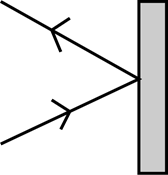
It is an example of ...
absorption.
refraction.
reflexion.

It is an example of ...
refraction.
absorption.
reflexion.

It is an example of ...
reflexion.
refraction.

It is an example of ...
refraction.
reflexion.

What does a prism do to white light?
Dispersion: different colors that make up white light become separated.
Reflexion: light changes it's direction
Absorption: light is absorbed by the prism and converted into energy.

What does a lens do to light?
With convex lenses rays of light converge (they are brought closer together)
With convex lenses rays of light diverge (parallel light rays curve outward or diverge)
With concave lenses rays of light diverge (parallel light rays curve outward or diverge)
With concave lenses rays of light converge (they are brought closer together)

This is...
Reflection
Refraction
Absorption
Select the TWO characteristics of light:
It moves very quickly in all directions
It travels in a straight line.
It moves very slowly and only in one direction.

This is...
Reflection
Refraction

This is...
Transparent
Translucent
Opaque

This is...
Transparent
Translucent
Opaque

This is...
Transparent
Translucent
Opaque
When a material lets light pass through, we say it is...
Impermeable
Opaque
Transparent
Conductor
Which of these things are matter
Oxygen
Oil
Love
Happyness

Biomass is...
renewable sources of energy
non renewable sources of energy

Fossil fuels are...
uranium
wind, water and Sun
petrol, coal and gas

The next picture is a source of energy...
Renewable energy source
Non-renewable energy source

HEAT. The next picture is...
A change of temperature
A change of volume
A change of state

HEAT. The next picture is...
A change of temperature
A change of volume
A change of state

HEAT. When we say that something is hot or cold, what we really mean is that ...
Its temperature is high or low
Its temperature is big or small
Its contraction or expansion

The next picture is a source of energy...
Renewable energy source
Non-renewable energy source

The next picture is a source of energy...
Renewable energy source
Non-renewable energy source

HEAT. The next picture is...
A change of temperature
A change of volume
A change of state

HEAT. What type of change is happening with this ice-cream?
change of volume
change of state
contaction and expansion

This is an example of ...
reflection
refraction

This is an example of...
Reflection
Refraction

Refraction is...
light hits and object and changes direction
light changes direction and passes from one mediun to antother

LIGHT. The glass allows light to pass through. It is...
Transparent
Opaque
Translucent

LIGHT. Plastic allows light to pass through but it is diverted. It is...
Transparent
Opaque
Translucent

Reflection is
the light hits an object and changes of direction
the light changes of direction when it passes from one medium to another

When the light can not pass throught an object
transparent
translucent
opaque

Identify the type of energy...
sound
thermal
mechanical
electrical

Identify the type of energy...
nuclear
electrical
sound
thermal

Identify the type of energy...
electrical
sound
chemical
mechanical

Identify the type of energy
sound
thermal
electrical
mechanical

When materials have the same electrical charge they...
repel
attract

Materials with different electrical charges ...
repel
attract

In an electrical circuit , the switch
supplies the electrical current.
transform electricity into light
opens and closes the circuit

This is the..... in an electrical circuit
power source
wire
electrical device
switch

In an electrical circuit the power source...
opens and closes the circuit
supplies electrical current
conducts electrcity

This is the.... in an electrical circuit
wire
battery
bulb
swich

This electrical circuit is ....
opened
closed

This electrical circuit is...
opened
closed
What does a lens do to light?
They work by reflection: the light will reflect at the same angle as it hit the surface.
They work by absorption: They absorb light.
They work by refraction: it bends light rays as they pass through it so they change direction.

