
Font size
 Worksheets
Electric charge and force
Total questions: 148
Worksheet time: 5hrs 15mins
A plastic rod is rubbed with a piece of animal fur. The plastic rod acquires a negative charge during this process. Which of the following is true about the charge on the piece of fur?
It acquires a positive charge but greater in magnitude than the rod
It acquires a positive charge but less in magnitude than the rod
It acquires a negative charge but greater in magnitude than the rod
It acquires a negative charge but less in magnitude than the rod
It acquires a positive charge with the same magnitude as the rod
Find the magnitude of the electrostatic force between two charges of 1.0 C each, which are 1.0 meter apart?
9 x 10^19 N
9 x 10^9 N
1.1 x10^10 N
1.1x 10^-10 N
Calculate the force exerted between two charged objects separated by a distance of 0.6 m. One object has a charge of -5 C and the other has a charge of +2.0 C.
-1.5E-11 N
2.5E-11 N
-2.5E11 N
-7.5E-10 N
FE= (k*q1*q2) / r2

As shown in the figure, the charge Q is midway between two other charges. If Q= -7.5 nC what must be the charge q1 so that charge q2 remains stationary as Q and q1 are held in place?
30 nC
15 nC
7.5 nC
60 nC
The net force due to different charges around a single charge can be determined using superposition principle. True or False?
True
False
According to Coulomb's Law, The greater the separation distance between two charges the greater the magnitude of the electric force. True or False?
True
False
Coulomb's Law states that the electric force is directly proportional to the product of the two charges and inversely proportional to the distance between them. True or False?
True
False
not enough information
Which of the following charges is the best example of 'Charged is Quantized'?
2.1nC
3.0µC
2.75µC
3333.1µC
The mass of a single electron is equal to 9.109x10⁻³¹C. True or False?
True
False
The separation distance between two charges is equal to r=√(k.(q1q2/Fe)). True of False
True
False
Electric field is directly proportional to the charge and inversely proportional to the magnitude of electric force. True or False?
True
False
Two identical conducting spheres are separated by a distance. Sphere A has a net charge of 5 µC and sphere B has a net charge of 1 µC. If the spheres touch and are moved apart, the net charge on Sphere A will be:
10 µC
3 µC
–6 µC
–5 µC
A negatively charged rod is brought near one end of an uncharged metal bar. The end of the metal bar farthest from the charged rod will be charged
positive
neutral
negative
none of the other answer choices are correct
Sphere A carries a net charge and sphere B is neutral. They are placed near each other on an insulated table. Which statement best describes the electrostatic force between them?
There is no force between them since one is neutral.
There is a force of attraction between them.
There is a force of repulsion between them.
The force is attractive if A is charged positively and repulsive if A is charged negatively.

Sphere A carries a net positive charge, and sphere B is neutral. They are placed near each other on an insulated table. Sphere B is briefly touched with a wire that is grounded (see picture). Which statement is correct?
sphere B remains neutral
sphere B is now negatively charged
sphere B is now positively charged
sphere B is now positive and sphere A is negative

Two positive charges A and B are placed at the corners of equilateral triangle. What is the direction of the net electric force on charge –Q located at point C?


Two positive charges A and B are placed at the corners of equilateral triangle. What is the direction of the net electric force on charge –Q located at point C?


MULTICORRECT (Choose 2): As shown on the right, a positively charged sphere, Q1 = 3Q is separated from a negatively charged sphere, Q2 = -10Q by a distance r. The spheres briefly touch each other and move to the original distance r. Which of the following is true about the new charge on the spheres and the new force between the spheres?
The new charge on each sphere is
6.5Q.
The new force between the spheres
is repulsive
The new charge on each sphere is
–3.5Q.
The new force between the spheres
is attractive

A balloon has a negative charge. A glass rod has a positive charge. What will happen when the rod is brought near the balloon?
the balloon will be attracted to the rod
the balloon will remain in place
the balloon will be repelled by the rod
the balloon will spin in circles
Two charges are near each other. The magnitude of both charges is doubled. By what factor will the Coulomb force change?
2
4
1/2
1/4
If the distance between two charges triples, by what factor will the force between them change?
3
9
1/3
1/9
What is the magnitude of the electric force between two charges of 1.0C separated by a distance of 1.0m?
9.0x10^9 N
1.1x10^10 N
9.0x10^19 N
1.1x10^-10 N

As shown in the figure, the charge Q is midway between two other charges. If Q= -7.5 nC what must be the charge q1 so that charge q2 remains stationary as Q and q1 are held in place?
30 nC
15nC
7.5nC
60nC

Two small hollow metal spheres hung on insulating threads attract one another as shown. It is known that a positively charged rod will attract sphere A. Which statements can be correctly concluded about the charge on the spheres?
A has a positive charge
B has a negative charge
A and B have opposite charges
A is neutral

As shown above, two particles, each of charge +Q, are fixed at opposite corners of a square that lies in the plane of the page. A positive test charge +q is placed at a third corner. What is the direction of the net force on the test charge due to the other two charges?


Given the formula above which is a true statement?
C is directly proportional to A; C is inversly proportional to d in the Capacitance formula
C is directly proportional to A; C is directly proportional to d in the Capacitance formula
C is inversely proportional to A; C is inversly proportional to d in the Capacitance formula
C is directly proportional to A; C is inversly proportional to E in the Capacitance formula


What capacitance is needed to store 5.50 μC of charge at a voltage of 120 V (if Q=CxV)
250 uF
.025 uF
.046 uF
458 uF


If Two charges were seperated by .075 decimeters (dm) with an opposite charge equal to four electrons and three protons (*see the funamental charge for quantity), what would be the resulting Electric Force?
7.2x10^(-4) N repel
2.304x10^(-22) N repel
4.92x10^(-23) N attract
2.304x10^(-22) N attract
If Two charges were seperated by .25 nanometers (nm) with an same charge equal to 4 electrons per charge (*see the funamental charge for quantity), what would be the resulting Electric Force?
8.29x10^(-23) N attract
46 N repel
8.29x10^(-23) N repel
5.9x10^(-8) N repel

How far apart must two protons be if the force between them is 1.125x10^(-5) N
2.304x10^(-16) m repel
4.5 x10^(-12) m repel
1.2x10^(-8) m attract
1.44x10^(-16) m attract


If I=q/t and there is a charge of 2 protons (fundamental charge of electron/proton is 1.6x10^(-19)C) and it takes 25 centiseconds to pass through the wire, what the current?
3.2x10^(-19) A
8x10^(-20) A
1.28x10^(-18) A
6.4x10^(-21) A
If E=F/q and there is a charge of 2 electrons (fundamental charge of electron/proton is 1.6x10^(-19)C) and it takes 25x10^(-12) N of Force, what is the electric field strength of this charge?
7.8x10^(7) N/C
1.6^(8) N/C
1.28x10^(-18) N/C
6.4x10^(-21) N/C


The diagram shows two charged objects, X and Y.
Based on the field lines, what are the charges of the objects?
X: positive
Y: negative
X: negative
Y: positive
X: negative
Y: negative
X: positive
Y: positive
In order to create an electric charge, what type of particle must be added or removed from an object?
proton
electron
neutron
alpha particle

what is the type of this charge?
positive
negative

which of the following has more electric filed?
B
c
A
B and A
What direction are the electric field lines around a proton?
towards the charge
away from the charge
Which orientation of an electric dipole in a uniform electric field would correspond to stable equilibrium ?
Parallel
Perpendicular
Non of this
Not dependent
What is the electric flux through a cube of side 1 cm which encloses an electric dipole?
(a)
Given a uniform electric field E=5 x 10^3N/Ci, find the flux of this field through a square of 10 cm on a side whose plane is parallel to the y-z plane.
50Nm^2/C
30Nm^2/C
25Nm^2/C
500Nm^2/C
Given a uniform electric field E = 5 x 10^3iN/C , passing through a square of 10 cm on a side whose plane is parallel to the y-z plane. What would be the flux through the same square if the plane makes a 30° angle with the x-axis?
100Nm^2/C
25√3 Nm^2/C
25 Nm^2/C
50√3 Nm^2/C
A charge Q placed at each of the positive corners of a square. A charge q is placed at each of the other two corners. If the net force on charge Q is zero then, what is Q/q
1
-1/√2
-2√2
1/√2

A Gaussian surface in the figure is shown by dotted line. The electric field on the surface will be
Due to q1 and q2 only
Due to q2 only
0
Due to all
Dimension of permittivity of free space
M^(-1) L^2 A^3 T^2
M^(-1) L^(-3) A^2 T^4
M^(-1) L^(-3) A^4 T^2
Non of these

Six charges of equal magnitude , 3 negative are to be placed on PQRSTU comers of a regular hexagon, such that field at the centre is double that of what it would have been if only one +ve charge is placed at R.
+,-,+,-,+,-
+,+,-,+,-,-
-,+,+,-,+,-
+,-,+,-,-,+
Between two point charged bodies, the force of electrical interaction is 12 mN. If the charge of one body is increased by 3 times, and the charge of the other body is reduced by 4 times and the distance between the bodies is reduced by 2 times, then what will be the strength of the interaction between the bodies? (Give the answer in mN.)
12 мН
24 мН
36 мН
48 мН
Two point charges - negative, equal in absolute value to 3 μC, and positive, equal in absolute value to 4 μC, are located at a distance of 1 m from each other. At a distance of 1 meter from each of these charges, a positive charge Q is placed, whose modulus is 2 μC. Determine the modulus of the force acting on the charge Q from the other two charges. Express the answer in mN and round to the nearest whole number.
35 мН
65 мН
53 мН
56 мН
With what force do two small charged balls interact at a distance of 4 m from each other in a vacuum? The charge of each ball is 8 · 10 −8 C. Express the response in microns.
1,2 мкН
2,4 мкН
3,6 мкН
4,8 мкН
The law, governing the force between electric charges is known as
Ampere's law
Ohm's law
Coulomb's law
Faraday's law
The ratio of the forces between two small spheres with constant charge (a) in air (b) in a medium of dielectric constant K is
1 : K
K : 1
1 : K2
K 2: 1
A body can be negatively charged by
Giving excess of electrons to it
Removing some neutrons from it
Removing some electrons from it
Giving some protons to it
Two point charges placed at a certain distance r in air exert a force F on each other. Then the distance r' at which these charges will exert the same force in a medium of dielectric constant k is given by
r
r/K
kr
rk
Two charges of equal magnitudes and at a distance r exert a force F on each other. If the charges are halved and distance between them is doubled, then the new force acting on each charge is
F / 8
F / 4
4F
F/16

Six charges, three positive and three negative of equal magnitude are to be placed at the vertices of a regular hexagon such that the electric force on a test charge at O is double the electric force when only one positive charge of same magnitude is placed at R. Which of the following arrangements of charges is possible for P, Q, R, S, T and U respectively
+ , - , +, - , - , +
+ , - , + , - , + , -
+ , + , - , + , - , -
-, + , + , - , + , -
The charge q is projected into a uniform electric field E, work done when it moves a distance Y is
qEy
qY/E
qE/Y
Y/qE
Tick the correct option.
Electrostatic force is a conservative in nature.
Two identical metallic spheres of exactly equal masses are taken. One is given a positive charge Q Coulombs and the other an equal negative charge. Their masses after charging are different.
The electric force between two charges changes, if we bring a third charge closer to them.
Electrostatic force is both attractive and repulsive.


A repelling force occurs between two charged objects when the charges are of
unlike signs
like signs
equal magnitude
unequal magnitude
An attracting force occurs between two charged objects when the charges are of
unlike signs
like signs
equal magnitude
unequal magnitude
Electric charge is
found only in a conductor
conserved
found only in insulators
not conserved
Which sentence best describes electrical conductors?
electrical conductors have low mass density
electrical conductors have high tensile strength
electrical conductors have electric charges that move freely
electrical conductors have poor heat conductors
The process of charging a conductor by bringing it near another charged object and then grounding the conductor is called
contact charging
induction
polarization
neutralization

In the diagram shown above, the circles represent small balls that have electric charges. Ball 1 has a negative charge, and ball 2 is repelled by ball 1. Next, you see that ball 2 repels ball 3 and that ball 3 attracts ball 4. What is the electric charge on ball 4?
ball 4 may have either a positive or negative charge
ball 4 has a negative charge
ball 4 has a positive charge
it is not possible to determine the charge on ball 4

The figure shown above demonstrates charging by
grounding
induction
polarization
contact
Two point charges, initially 2 cm apart, are moved to a distance of 10 cm apart. By what factor does the resulting electric force between them change?
25
5
1/5
1/25
Which is the most correct statements regarding the drawing of electric field lines?
electric field lines always connect from one charge to another
electric field lines always form closed loops
electric field lines can start on a charge of either polarity
electric field lines never cross each other
Electric field strength depends on
charge and distance
charge and mass
Coulomb constant and mass
elementary charge and radius
Resultant force on a charge is the ______ sum of the individual forces on that charge.
scalar
vector
individual
negative
Which of the following most closely resembles an electromagnetic?


1. Two charges 3x 10⁻⁵ C and 5x 10⁴ C are placed at a distance 10 cm from each other. Find the value of electrostatic force acting between them.
13.5×10¹¹ N
40 × 1011
180×109
13.5×10¹⁰
What is the S. I. unit of electric flux?
CNm2
m2NC2
N m2
m2NC
What is the value of minimum force acting between two charges placed at 1 m apart from each other
K e
K e2
4Ke
9Ke2
A glass rod acquires charge by rubbing it with silk cloth. The charge on glass rod is due to :
Conduction
Induction
Radiation
Friction
For a point charge, the graph between electric field versus distance is given by :


What will be the value of electric field at the centre of the electric dipole : -
Zero
Equal to the electric field due to one charge at centre
Twice the electric field due to one charge at centre
half the value of electric field due to one charge at centre
Electric field lines contracts lengthwise, It shows
repulsion between same charges
Attraction between apposite charges
No relation between force & contraction.
Electric field lines does not moves on straight path.
On charging a neutral Balloon its size -
Increases
Decreases
Remains same
No relation between charge & size
Charge Q is kept in a sphere of 5 cm first than it is kept in a cube of side 5 cm. the outgoing flux will be-
More in case of sphere
More in case of cube
Same in both cases
None of the above
Which Quantity is vector Quantity among the following -
Electric flux
Electric field Intensity
Electric Potential
Electric charge
What is the S. I. unit of electric flux?
Nm2C−1
NmC−1
Nm−2C2
NmC−2
Three charges, each of value Q, are placed at the vertex of an equilateral triangle. A fourth charge q is placed at the centre of the triangle. If the charges remains stationery then, q = ______
Q/√2
−Q/√3
−Q/√2
Q/√3


What must be the charge of the two particles and how do you know?
They are both positive, the electric field lines repel each other and are heading out of the charges
They are both positive, field lines repel each other and are heading toward the charges
They are both negative, field lines repel each other and are heading out of the charges
They are both negative, field lines repel each other and are heading toward the charges
Equal charges ‘q’ are placed at the vertices A and B of an equilateral triangle ABC of side ‘a’. The magnitude of electric field at the point C is
Kq/a2
√2Kq/a2
√3Kq/a2
3Kq/a2
The dimensional formula of electric charge is
M0L0T1A1
M0L0T−1A1
M0L0T1A−1
M0L0T−1A−1

Four charges are arranged at the corners of a square ABCD, as shown in the adjoining figure. The force on the charge kept at the centre O is
Zero
along the diagonal AC
along the diagonal BD
perpendicular to side AB

The graph shows the relationship between the force of interaction and the magnitude of charge. What type of relationship is this?
Direct
Indirect
Inverse
Reverse

The image shows two charged particles with a force of 2.4 N. What would you predict the force of interaction would be when the magnitude of charge on q2 doubles?
9.6 N
4.8 N
1.2 N
.6 N
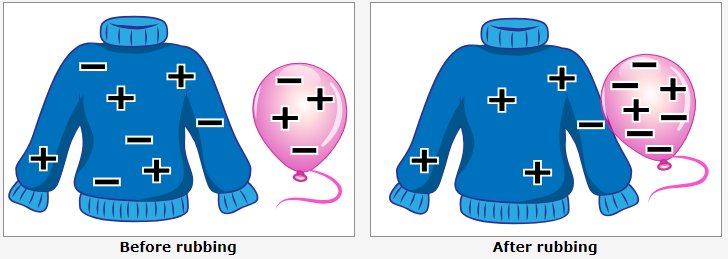
Before the balloons and sweaters are rubbed together, both objects are __________ charged. After they are rubbed together the sweater is __________ charged and the balloon is ___________ charged
negative/positive/negative
neutral/positive/negative
positive/negative/neutral
neutral/negative/positive
Which picture correctly shows how the atoms in an insulator polarize when a positively-charged plate is brought nearby?


A neutral electroscope is charged by bringing a negative rod next to it, then touching it.
A
B
C
D
E

