
 Worksheets
Ecosystems,Biomes,&Biogeochemcycles APES ch3&ch4mod.12&13
Total questions: 79
Worksheet time: 3hrs 5mins

One characteristic feature of the tundra is that only the surface thaws in the summer and refreezes in the winter, leaving a permanently frozen subsoil. This characteristic is known as
Hoarfrost
Glaciation
Permafrost
Crystallization

The kangaroo rat is able to get all of the water it needs through its food and therefore, never needs to drink liquid. This animal has adapted to survive in which biome?
Forest
Tundra
Desert
Grassland


Which biome covers most of the land mass near Earth's equator?
Desert
Grassland
Tropical rainforest
Temperate forest

The rain forest soil is
poor and rocky
frozen soil
thick and nutrient rich
thin and nutrient poor

__________ primary productivity is the total amount of energy that producers convert to chemical energy in organic molecules per unit of time.
Net
Total
Gross
Secondary

__________ primary productivity = the organic materials that remain after photosynthetic organisms in the ecosystem have used some of these compounds for their cellular energy needs (cellular respiration).
Gross
Total
Net
Secondary

The total quantity of all living matter in an area is called:
Troposphere
Net Primary Productivity
Biomass
Ecosystem

Ecological efficiency from one trophic level to the next is generally:
1%
10%
75%
90%


I. dominant plant growth forms
II. depth
III. salinity
An ecosystem is a location on Earth that includes
only biotic components
only abiotic components
interacting biotic and abiotic components
positive and negative feedback loops
Place the ecology levels of organization in proper order (smallest to largest)
organism > population > community > ecosystem > biosphere
community > organism > ecosystem > biosphere > population
organism > community > biosphere > population > ecosystem
population > biosphere > ecosystem > community > organism

In which biome would you expect to find an area with an average temperature of 10oC and 200 cm of precipitation annually?
Temperate seasonal forest
Temperate rainforest
Woodland/shrubland
Tropical seasonal forest
In which biome would you expect to find an area with an average temperature of 4oC and 50 cm of precipitation annually?
Tundra
Boreal forest
Temperate grassland/cold desert
Woodland/shrubland
A keystone species is best defined as
an organism that eats all others
an organism that runs the fastest
an organism that keeps the food web stable
an organism that has the most advantages
Which of the following are examples of wetlands?
swamps
marshes
bogs
all of these are correct
The direction of an arrow in a food chain represents
the flow of energy from organism B to A
the movement of organisms
the directionality of the sun
the flow of energy from organism A to B


Why do living things need nitrogen?
To get energy
To make amino acids
To make proteins
To make proteins AND amino acids
What cycle are fossil fuels part of ?
carbon
oxygen
nitrogen
phosphorus
What is the largest reservoir for water?
the ocean
rocks and minerals
the atmosphere
glaciers
Where is the largest reservoir for the phosphorus cycle?
rocks and minerals
the ocean
the atmopshere
fossil fuels
What is the largest reservoir for nitrogen?
the ocean
rocks and minerals
the atmosphere
bacteria

Which is the most abundant gas in the atmosphere?
hydrogen
oxygen
helium
nitrogen

The process where rocks are broken down over time by wind and water, releasing phosphorus.
combustion
corrosion
deposition
erosion
What is the correct formula for nitrogen gas found in the atmosphere?
N2
NO3-
NH4+
NO2-
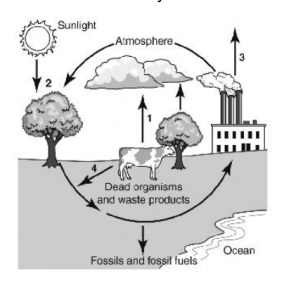

Coal, natural gas, and oil are examples of _________
the carbon cycle
products of photosynthesis
good fuels for barbecues
fossil fuels
Which of the following is true of carbon as it cycles in nature?
Carbon dioxide is released during photosynthesis
Carbon compounds rarely exist in the gaseous state
Carbons sinks include forests and oceans
The carbon dioxide concentration in the atmosphere is reduce by cutting trees
Carbon is concentrated in igneous rocks

A ____________ is a reservoir that takes up a chemical element and stores it for a long period of time.
Sink
Source
Bucket
Location
What is a greenhouse gas?
A gas that helps plants grow
Any gas in the atmosphere
A gas that absorbs solar radiation allowing the Earth to stay at a livable temperature
A gas that can only be harmful and poisonous
How is the ocean involved in the carbon cycle?
Aquatic plants absorb CO2 to perform photosynthesis
The surface of the ocean absorbs and dissolves CO2
Certain aquatic plants take in carbon to make their shells
The ocean releases carbon that was stored in the remains of dead organisms
All of the options are correct
What types of organisms need carbon to survive?
Insects
Plants
Mamals
All types of organisms
How does a cow transfer carbon to other parts of the environment?
It releases CO2 through respiration
It releases carbon as waste
it transfers carbon to humans when we eat it
all of the answers are correct
Energy flows through an ecosystem and is transferred as ____________, but chemical elements are ____________.
light, heat
heat, lost
light, gained
heat, recycled
Which of the following is NOT a SOLID form of carbon in the carbon cycle?
Diamond
Plants
Coal
Carbon Dioxide
This is a source of Nitrogen ______________ and the problem is ________________
fertilizers (synthetic and manure)..............it causes algal blooms in bodies of water
smelting, refining and burning coal........................it causes acid rain
rocks.....................causes algal blooms in water sources
volcanoes......................it is a greenhouse gas
Burning gas in your car and buying bags of fertilizer are all problems associated with the Nitrogen cycle....this is another source?
volcanoes
burning coal
waste or feces from animals
mining rocks
The biggest threat to the environment from excessive Sulfur is......
global warming
acid rain
algal blooms in lakes
all of these are problems associated with Sulfur
Other than smelting and refining this is probably the largest input of sulfur into the atmosphere.....
burning coal
burning gasoline
animal waste
One natural source of sulfur into the atmosphere is.........
earthquakes
volcanoes
hurricanes
tornados
Both plants and animals use nitrogen to make _________ and __________
nitrates and lightning
proteins and DNA
water and air
gas and liquids
Energy enters a system as sunlight and a producer is able to produce 10 kilograms of tissue. If eaten, the producer would produce about ___ kilograms of a consumer tissue that would provide about ____ kilograms of tissue for a secondary consumer
100; 10
10; 1
100; 1
1; 0.1
The length and complexity of a food web in the Arctic would be ____ when compared to one in the tropical rainforest.
Short and less complex
short and more complex
long and less complex
long and more complex
Intraspecific Competition is between the same species. true or false?
True
False
Diurnal and Nocturnal creatures share their resources through the use of which of the following processes?
Competition
Resource Partitioning
Different trophic levels
Coevolution

