wayground logo

Free Printable Worksheets

Font size

S
M
L
XL
Worksheets

SATII

Total questions: 107

Worksheet time: 1hrs 13mins

Name
Class
Date
1.
What are the nucleotides made of?
a)
Sugar, Phosphate, nitrogen base
b)
Phosphate, Adenine, nitrogen base
c)
Thymine, Adenine, Cytomine
d)
Phosphate, Nitrogen, Adenine
2.
Adenine bonds with ______________.
a)
Guanine
b)
Thymine
c)
Cytosine
d)
Adenine
3.
Guanine bonds with ______________.
a)
Adenine
b)
Guanine
c)
Cytosine
d)
Thymine
4.
What are the 4 nitrogen bases?
a)
adenine, thymine, cytoplasm, and guanine
b)
adenine, thymine cytosine, and guanine
c)
adenine, thymine, cytosine, and gylcerol
d)
adenine, thymine, cytosine, and glucose
5.
Which of the following best describes a DNA molecule?
a)
double helix
b)
contains ribose
c)
made of amino acids
d)
contains Uracil
6.
DNA is a polymer made of:
a)
Nucleotides
b)
Ribosomes
c)
Purines
d)
Pyrimidines
7.
In a molecule of double-stranded DNA, the amount of Adenine present is always equal to the amount of
a)
cytosine
b)
guanine
c)
thymine
d)
uracil
8.
What will the matching sequence be on a strand that reads AAGCTAT?
a)
AACGATA
b)
TTCGTTA
c)
CCTGATA
d)
TTCGATA
9.
DNA codes for...
a)
bases
b)
proteins
c)
amino acids
d)
phosphates
10.
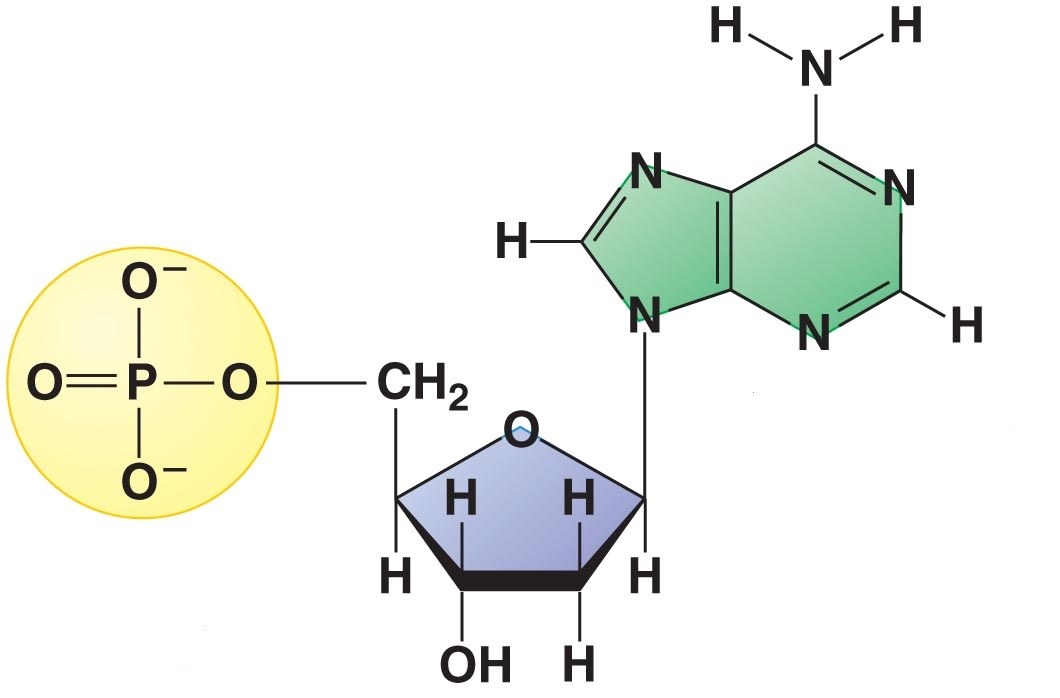
Name this structure
a)
double helix
b)
nucelotide
c)
twisted ladder
d)
hydrogen bond
11.
DNA polymerase is a(n)
a)
lipid
b)
enzyme
c)
sugar
d)
starch
12.
Which series is arranged in order from largest to smallest in size?
a)
gene, chromosome, nucleus, cell, DNA, nucleotide
b)
cell, nucleus, chromosome, DNA, gene, nucleotide
c)
nucleotide, chromosome, cell, DNA, nucleus
d)
cell, DNA, gene, nucleotide, nucleus, chromosome
13.
The two strands of nitrogenous bases in DNA are joined by which type of bond?
a)
polar bonds
b)
ionic bonds
c)
covalent bonds
d)
hydrogen bonds
14.

A process in which DNA has the unique ability to make an exact copy of itself.

a)

Replication

b)

Translation

c)

Transcription

d)

Protein Synthesis

15.
Which enzyme has the job of unzipping the double helix?
a)
Helicase
b)
Polymerase
c)
Ligase
d)
Primerase
16.
Which enzyme fixes the Okazaki fragments in the lagging strand?
a)
Helicase
b)
Polymerase
c)
Ligase
d)
Primerase
17.
If a strand reads:
3' A A A T T T C 5'
The matching strand would read...
a)
5' T T T A A A G 3'
b)
3' T T T A A A G 5'
c)
5' A A A T T T C 3'
d)
3' U U U A A A G 5'
18.
What are the gaps between the newly synthesized DNA on the lagging strand called?
a)
Okazaki fragments
b)
Polymer gaps
c)
Helicase fragments
d)
Acidic gaps
19.
This picture is illustrating the ____ nature of DNA.
a)
anti-parallel
b)
deoxyribosic
c)
helical
d)
radioactive
20.
Polymerase is able to replicate the new DNA ______ along the leading strand.
a)
continuously
b)
only in short fragments
c)
very slowly
d)
prokaryotically
21.
Sometimes, DNA is called "semi-conservative." Why might this be?
a)
The old strand is "conserved" and used to make the new strands
b)
Uracil is "conserved" in that it is only used to make the new strands
c)
ATP is "conserved" via the usage of facilitated diffusion
d)
Ligase is "conserved" in that it is denatured by the process
22.

DNA polymerase moves in the _________ to ____________ direction

a)

3' to 5'

b)

easiest

c)

5" to 3"

d)

9 to 5

23.

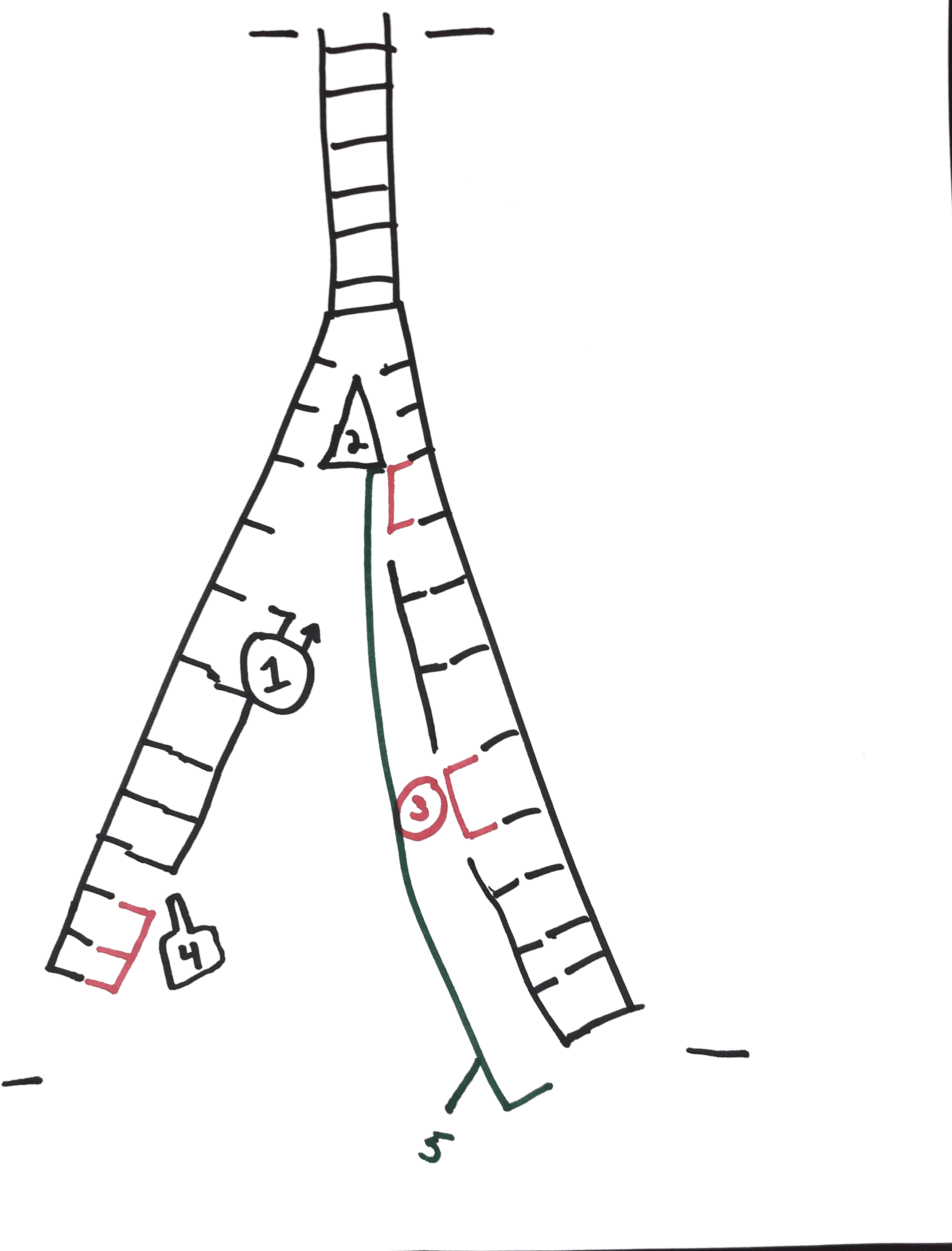
Number 1 in the picture above

a)

Replication

b)

DNA Polymerase

c)

Primase

d)

Ligase

24.
order of replication
a)
3, 4, 2, 1
b)
3, 1, 4, 2
c)
2, 1, 4, 3
d)
3, 4, 1, 2
25.
In what phase of the cell cycle does DNA replication take place?
a)
G1
b)
S
c)
G2
d)
M
26.
The process of DNA replication is called semi conservative because it results in
a)
none of these
b)
Two DNA molecules.  One original molecule and one with two new strands
c)
two exact copies with new strands
d)
two identical molecules, each with 1 original strand and one new.
27.
Based on the diagram, the enzyme (represented in gray) is most likely...
a)
DNA polymerase
b)
DNA Ligase
c)
Nuclease
d)
Helicase
28.
Which of the following is not a base found in DNA?
a)
adenine
b)
thymine
c)
cytosine
d)
uracil
29.
If a segment of double-stranded DNA has 40 percent A, how much of it is C?
a)
40
b)
10
c)
15
d)
20
30.
The polymerase chain reaction (PCR) is used to
a)
insert DNA from one organism into a new host.
b)
screen for a particular gene.
c)
produce many copies of a selected DNA sequence.
31.
What does rRNA do?
a)
provides information from DNA to ribosomes
b)
transfers amino acids to the ribosomes
c)
makes up ribosomes
d)
builds proteins
32.
What does tRNA do?
a)
provides information from DNA to ribosomes
b)
transfers amino acids to the ribosomes
c)
makes up ribosomes
d)
builds proteins
33.
What is the process that copies information from DNA into RNA?
a)
protein synthesis
b)
transcription
c)
translation
d)
DNA Polymerase
34.
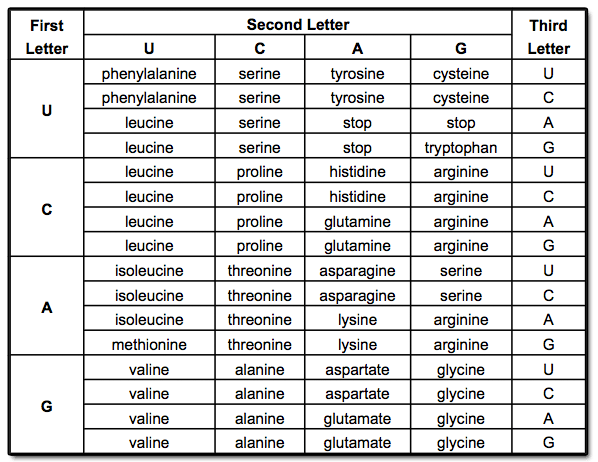
What is the correct amino acid sequence for the mRNA code AUGCCAGUAUGA
a)
Met-Pro-Ala-Val
b)
Met-Pro-Val
c)
Tyr-Gly-His
d)
Tyr-Gly-Arg-His
35.
Transcribe the following piece of DNA:
ATCGTA
a)
UAGCAU
b)
TAGCAT
c)
ATCGTA
d)
AUCGUA
36.
The process of making RNA (i.e. mRNA) from DNA is called
a)
Replication
b)
Transcription
c)
Translation
d)
Protein synthesis
37.
Which  represents the bases of mRNA?
a)
A U C G
b)
A T U G
c)
A T C G
d)
U T C G
38.
What is the correct sequence?
a)
RNA --> DNA --> Protein
b)
Protein --> RNA --> DNA
c)
DNA --> RNA --> Protein
d)
DNA --> Protein --> RNA
39.

During protein synthesis, an RNA strand is transcribed from one strand of DNA (GCG TTA CCT) What is the complementary RNA strand?

a)

CGC UUT CCT

b)

CGC AAU GGA

c)

GCG UUA CCU

d)

CGC AAT GGA

40.

Which enzyme creates the new mRNA polyer by adding the complementary free RNA nucleotides?

a)

RNA polymerase

b)

DNA polymerase

c)

Exonuclease

d)

DNA Helicase

41.

If 25% of the DNA is Adenine, what percent is Thymine?

a)

25%

b)

75%

c)

50%

d)

15%

42.

Translation takes place before transcription.

a)

a) True

b)

b) False

43.

TRANSLATION takes place in

a)

nucleus

b)

cytoplasm

c)

lysosome

d)

nucleolus

44.

Which of the following are non-sense codons?

a)

a) AUG

b)

b) GUG

c)

c) UAA

d)

d) UCU

45.
Translation takes place in the 
a)
ribosome
b)
chloroplast
c)
nucleus
d)
mitochondria
46.
What would be the tRNA anticodon for the mRNA codon CAG?
a)
GTC
b)
GUC
c)
CUG
d)
CAG
47.
What is the term for a three-nucleotide sequence that codes for an amino acid?
a)
base
b)
codon
c)
amine
d)
serine
48.
Which phrase best describes translation?
a)
converts mRNA into a polypeptide
b)
catalyzes bonds between amino acids
c)
produces RNA from DNA molecules
d)
recycles tRNA molecules for reuse
49.
Which phase of which process does this picture show?
a)
Transcription
b)
Translation
c)
Replication
50.

A mom with the heterozygous gene for Widows peak and a father with the heterozygous gene for Widows peak: odds their baby HAS a widow's peak?

a)

0%

b)

25%

c)

75%

d)

100%

51.

A mom with a dominant HOMOZYGOUS gene of a hitchhiker's thumb and a dad with a homozygous recessive gene for a straight thumb. What is the baby's phenotype?

a)

50% straight thumb

b)

100% Hitchhiker's Thumb

c)

25% Hitchhiker's Thumb

52.
What would the ratio for genotypes be for this Punnett Square?
a)
2Bb:2bb
b)
2BB:2Bb
c)
1BB:2Bb:1bb
d)
4Bb
53.

This laboratory procedure is known as

a)

CLONING

b)

gel electrophoresis

c)

chromatography

d)

use of a dichotomous key

54.

In preparation for an electrophoresis procedure, enzymes are added to DNA in order to

a)

convert the DNA into gel

b)

cut the DNA into fragments

c)

change the color of the DNA

d)

produce longer sections of DNA

55.

The parents of a new baby believe they brought the wrong child home from the hospital. Gel electrophoresis was performed using DNA samples from the parents and the child. A section of the gel

electrophoresis results is shown below. Which conclusion is valid based on the gel electrophoresis results?

a)

They have the correct child, because her genetic information is identical to that of the father.


b)

They have the wrong child, because her genetic information does not match that of either parent.

c)

They have the correct child, because her genetic information came from both parents.


d)

They have the wrong child, because her genetic information matches only that of the mother.

56.

A student performed a gel electrophoresis experiment. The results are represented in the diagram

below. Compared to the fragments at the top of the gel, the fragments at the lower end are

a)

larger, and move slower

b)

larger, and move faster

c)

smaller, and move faster

d)

smaller, and move slower

57.
Based on these results whose blood was found in the blood stain at the crime scene?
a)
Bob
b)
Sue
c)
John
d)
Lisa
58.
Which two bear species are most closely related?
a)
Bear 1 and Bear 2
b)
Bear 1 and Bear 3
c)
Bear 2 and Bear 3
d)
There’s no way to tell
59.

This technique used to analyze DNA involves the

a)

synthesis of new DNA strands from subunits

b)

separation of DNA fragments based on size

c)

production of genetically engineered DNA molecules

d)

removal of defective genes from DNA

60.
This chamber of the heart RECEIVES blood returning from the body
a)
Right Atrium
b)
Right Ventricle
c)
Left Atrium
d)
Left Ventricle
61.
Structure(s) that keep the blood flowing in one direction.
a)
Valve(s)
b)
Septum(s)
c)
Neuron(s)
d)
Bronchiole(s)
62.

These cells play a vital role in defending the body against infection

a)

Leucocytes

b)

Erythrocytes

c)

Blastocytes

d)

Plasmacytes

63.

_______ function in the life-saving process of clotting blood.

a)

Phagocytes

b)

Leucocytes

c)

Erythrocytes

d)

Platelets

64.

The blood in the vena cava is...

a)

oxygenated, returning to the heart

b)

deoxygenated, returning to the heart

c)

oxygenated, leaving the heart

d)

deoxygenated, leaving the heart

65.

The type of blood vessel that normally carries de-oxygenated blood back to the heart from body cells?

a)

arteries

b)

capillaries

c)

veins

66.

Where does absorption primarily take place?

a)

Stomach

b)

Small intestine

c)

Large intestine

d)

Gall bladder

67.

Where is bile produced?

a)

Kidney

b)

Pancreas

c)

Liver

d)

Small intestine

68.

What are these structures call that are found on the lining of the small intestine?

a)

Gallbladder

b)

Villi

c)

Sphincter

d)

Duodenum

69.

What enzyme is found in saliva that starts digesting carbohydrates?

a)

amylase

b)

chyme

c)

pepsin

d)

bile

70.

Which are the nutrients digested in the mouth?

a)

Carbohydrates and proteins

b)

Proteins

c)

Carbohydrates

d)

Fats

e)

All the abov

71.

Which is the nutrient that bile facilitates its digestion?

a)

Proteins

b)

Lipids

c)

Carbohydrates

d)

Protein and lipids

72.
Which enzyme below is involved in the following chemical digestion process?
FATS---->FATTY ACIDS/GLYCEROL
a)
Lipase
b)
Trypsin
c)
Amylase
d)
Pepsin
73.
Pepsin is an enzyme that acts on
a)
lipids
b)
proteins
c)
carbohydrates
d)
nucleic acids
74.
Digestion is COMPLETED in the
a)
stomach
b)
liver
c)
small intestine
d)
large intestine
75.

Which type of mutation occurs when there is an addition or removal of a base?

a)

missense mutation

b)

nonsense mutation

c)

frameshift mutation

d)

point mutation

76.

What type of mutation is shown in the diagram?

a)

Point mutation - missense

b)

Frameshift Mutation - deletion

c)

Frameshift Mutation - addition

d)

Point mutation - nonsense

77.

A type of mutation that affect every codon beyond the point of mutation.

a)

Point Mutation

b)

Silent Mutation

c)

Nonsense Mutation

d)

Frameshift Mutation

78.

A type of mutation that affect every codon beyond the point of mutation.

a)

Point Mutation

b)

Silent Mutation

c)

Nonsense Mutation

d)

Frameshift Mutation

79.

What type of mutation is this?

a)

Nonsense mutation

b)

Missense mutation

c)

Silent mutation

d)

Frameshift mutation

80.

Occurs when the DNA change does not alter the amino acid sequence of the polypeptide.

a)

Frameshift Mutation

b)

Insertion

c)

Missense mutation

d)

Silent Mutation

81.

Name the process happening at number 1 in the diagram.

a)

DNA Replication

b)

Translation

c)

Mutation

d)

Transcription

82.

Which of the following statement is NOT true?

a)

Point mutation involves a chemical change in just one base pair.

b)

Frameshift mutation occurs when there is an addition or removal of a base.

c)

Nonsense mutation occurs when the DNA change creates a stop codon that causes the translation to terminate early.

d)

Point mutation affect every codon beyond the point of mutation .

83.
Which shows a mutated segment of DNA? 
ATTCGC
a)
UAAGCG
b)
TAAGCG
c)
TAGGCG
84.
Non disjunction of chromosomes occurs during
?
a)
Meiosis
b)
Mitosis
c)
Replication 
85.
What situation causes an inversion ?
a)
Part of the chromosome is missing
b)
Part of the chromosome is attached backwards
c)
Part of the chromosome breaks off and attaches to a different chromosome
d)
Part of a chromosome is duplicated 
86.
What situation causes a translocation?
a)
Part of the chromosome is missing
b)
Part of the chromosome is attached backwards
c)
Part of the chromosome breaks off and attaches to a different chromosome
d)
Part of a chromosome is duplicated 
87.
When you combine DNA from two different organisms the DNA is said to be?
a)
A mutant
b)
Recombinant 
c)
A Polyploid
88.
What mutation would cause a protein to be shorter then normal?
a)
Insertion
b)
Start codon found
c)
Stop Codon Found
d)
Inversion
89.
a)
Male
b)
Female
90.
Which of the following would result in a frameshift mutation?
a)
Insertions only
b)
Substitution only
c)
Deletion only
d)
Insertions and Deletions
91.
When there is one less base on the mRNA strand than the DNA strand it is a _________ mutation
a)
missense
b)
nonsense
c)
deletion
d)
insertion
92.
DNA molecule segment is : TTACGCAAG
The mutated DNA segment is TTCGCAAG. This is an example of ___ mutation.
a)
Substitution
b)
Deletion
c)
Insertion
d)
Inversion
93.

chromosomal mutations cause a segment of the chromosome to repeat itself during replication.

a)

inversion

b)

duplication

c)

translocation

d)

deletion

94.

Point mutation involves

a)

deletion

b)

insertion

c)

duplication

d)

changes in single base pair

95.
What type of gene mutation has occurred here? 
T-G-A-C-C-A
T-G-A-C-C-A-A
a)
Base Substitution
b)
Base Deletion
c)
Base Insertion
d)
Frameshift 
96.

Part of a chromosome is reversed.

a)

Inversion Mutation

b)

Deletion Mutation

c)

Translocation

d)

Point Mutation

97.

Part of one chromosome is transported and attached

to a non-homologous chromosome

a)

Inversion Mutation

b)

Translocation Mutation

c)

Duplication Mutation

d)

Point Mutation

98.

Failure of homologous chromosomes

to separate during meiosis.

Results in gametes with either one extra or one missing chromosome.

a)

Translocation

b)

Nondisjunction

c)

Replication

d)

Transcription

99.

What hormone stimulates the production of sperm cells?

a)

Spermatogenesis

b)

Testosterone

c)

FSH (Follicle-stimulating hormone)

d)

LH (Luteinizing hormone)

100.

These sex hormones are responsible for puberty in girls

a)

oestrogen

b)

testosterone

c)

progesterone

102.

Insulin and glucagon are produced by

a)

the liver

b)

the pancreas

c)

the kidneys

102.

Insulin and glucagon are produced by

a)

the liver

b)

the pancreas

c)

the kidneys

103.

Which one here reduces the amount of glucose in the blood?

a)

Glucagon

b)

Insulin

c)

Glycogen

d)

ADH

104.

Which gland regulate the amount of calcium in your body?

a)

thyroid

b)

parathyroid

c)

testes

d)

ovary

106.
Which hormone is not secreted by the anterior pituitary.
a)
Oxytocin
b)
FSH
c)
TSH
d)
ACTH
106.
Which hormone is not secreted by the anterior pituitary.
a)
Oxytocin
b)
FSH
c)
TSH
d)
ACTH
107.
Which hormone is secreted directly from the Posterior Pituitary Gland?
a)
ADH
b)
LH
c)
ACTH
d)
FSH