wayground logo

Free Printable Worksheets

NEW

Font size

S
M
L
XL
Worksheets

Matter Mass Volume Density

Total questions: 41

Worksheet time: 31mins

Name
Class
Date
1.

A spring scale is used to measure weight. Which of the following does it measure?

a)

The force of gravity on an object.

b)

The amount of matter in an object.

c)

The composition of an object.

d)

The average density of an object.

2.

Nick is preparing a solution and needs to measure the mass of some copper sulfate. Which one of the objects should he use to measure MASS?

a)

Electric Scale

b)

Ruler

c)

Triple Beam Balance

d)

Graduated Cylinder

3.

Jen is explaining the difference between weight and mass to her sister. In comparing the two, which of the following could Jen use to CORRECTLY describe the weight of an object?

a)

Weight is the same everywhere in space.

b)

Weight is how much matter is in an object.

c)

Weight is the amount of gravitational pull on an object.

d)

Weight is not impacted by the force of gravity.

4.
a)

15 cm3

b)

50 cm3

c)

150 cm3

d)

180 cm3

5.

Density is a physical property of matter and can be used to classify substances. Density is calculated by which of the following?

a)

d=v/m

b)

d=m/v

c)

d=w/v

d)

d=m/w

6.
Volume is __________.
a)
how many atoms
b)
how much matter is in an object
c)
how  much something weighs
d)
how much space an object takes up
7.
The metric unit used to measure the volume of a solid objects.
a)
grams
b)
miliLiter
c)
cm3
d)
Liter (L)
8.

Matter is anything that has

a)

length width and hieght

b)

anything that has mass and volume

c)

a definite shape

d)

energy

9.

How much liquid is represented?

a)

56 mL

b)

50.6 mL

c)

58 mL

d)

50.8 mL

10.

mass per unit of volume

a)

density

b)

volume

c)

weight

d)

mass

11.

amount of matter in an object

a)

density

b)

volume

c)

weight

d)

mass

12.

A cubic centimeter (cm3) is equal to

a)

1 milliliter (mL)

b)

1 liter (L)

c)

1 foot

d)

1 meter (M)

13.

These two blocks have the same mass. Which is more dense?

a)

Red block

b)

Blue block

14.

Which of the three blocks has the greatest density?

a)

A

b)

B

c)

C

15.

A mechanical pencil has the density of 3.0 g/cm3. The volume of the pencil is 15.8 cubic centimeters. What is the mass of the pencil?

a)

47.4 g

b)

50 g

c)

0.190 g

d)

5.27 g

16.
The mass of an object is 30 g.  The volume is 5 mL.  What is the density of this object?
a)
6 g/cm
b)
6 g/mL
c)
6
17.
Particles in this state of matter are moving the fastest.
a)
solid
b)
liquid
c)
gas
18.
Particles in this state of matter are moving the slowest.
a)
solid
b)
gas
c)
liquid
19.
In this state of matter, the molecules can move around each other, but cannot break the force of attraction between them.
a)
liquid
b)
gas
c)
solid
20.
In this state of matter, the molecules have enough energy to separate from each other. 
a)
gas
b)
solid 
c)
liquid
21.
When water beads on the outside of a cold glass of water.
a)
vaperization
b)
condensation
c)
melting
d)
freezing 
22.
When boiling water creates steam.
a)
condensation
b)
melting 
c)
freezing
d)
vaporization
23.
When dripping water turns into icicles. 
a)
melting
b)
freezing
c)
vaporization
d)
condensation 
24.
When a scoop of ice cream drips down the side of the cone.
a)
freezing 
b)
vaporization
c)
melting
d)
condensation
25.
What is the definition of sublimation?
a)
a chemical process where a solid turns into a gas without going through a liquid stage
b)
the process of a liquid changing into a gas
26.
Change from Gas to Solid is called........
a)
Sublimation
b)
Deposition
c)
Fusion
d)
condensation
27.
What is this tool to get volume?
a)
triple beam balance
b)
ruler
c)
thermometer
d)
graduate cylinder
28.
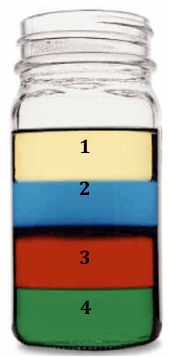
Put the liquids in order from most dense to least dense?
a)
4, 3, 2, 1
b)
1, 2, 3, 4
c)
3, 4, 2, 1, 
d)
4, 3, 1, 2
29.
Why does ice float?
a)
Liquid water is less dense than solid water.
b)
Solid water is less dense than liquid water.
c)
Gaseous water is less dense than solid water.
d)
Liquid water is less dense than gaseous water.
30.
In general what is the most dense form of matter?
a)
solid
b)
liquid
c)
gas
d)
plasmas
31.
If an object has a density of .6 g/cm^3 and you put it into water, will it sink or float?  
a)
sink
b)
float
32.
If an object has a density of 3.6 g/cm^3 and you put it into water, will it sink or float?  
a)
sink
b)
float
33.
Anything that has mass & takes up space
a)
gravity
b)
force
c)
matter
d)
volume
34.

A 55-gram egg is placed in a pot. After the egg is boiled, which is most likely the mass of the egg?

a)

50

b)

55

c)

57

d)

53

35.
Jason poured 500 grams of water into a container and tightly sealed it. The water was allowed to freeze. Which is most likely true about the ice that formed?
a)
The mass of the ice is the same as the mass of the water.
b)
The mass of the ice is greater than the mass of the water.
c)
The ice formed is a different substance than the water.
d)
The ice formed is the same temperature as the water.
36.

Who developed the Law of Conservation of Mass?

a)

Amedeo Avogadro

b)

Henri Becquerel

c)

John Dalton

d)

Demokritos

e)

Antoine Lavoisier

37.
What is the law of Conservation of Mass?
a)
A measure of how much mass is created or destroyed. 
b)
Mass can neither be created nor destroyed during a chemical reaction. 
38.
A rock has a mass of 14g and a volume of 2cm3. What is the density of the rock?
a)
7 mL
b)
7 g/cm3
c)
28 g/cm3
d)
1/7 g/cm3
39.
What is the density of a liquid that has a mass of 27g and a volume of 30mL?
a)
0.9 g/mL
b)
3 g/mL
c)
57 g/mL
d)
810 g/mL
40.

If you have a gold brick that has a volume of 24 cm3 and has a density of 19.3 g/cm3, what is its mass?

a)

463.2 g/cm3

b)

463.2 g

c)

0.804 kg

d)

0.804 g

41.
Calculate the mass of a substance which has a volume of 35 cm3 and a density of 0.5g/cm3.
a)
70 g
b)
0.014 g
c)
17.5 g 
d)
35.5 g