wayground logo

Free Printable Worksheets

Font size

S
M
L
XL
Worksheets

MIDTERM Review

Total questions: 100

Worksheet time: 2hrs 44mins

Name
Class
Date
1.
A series of steps used by scientists to solve a problem or answer a question. 
a)
scientific method
b)
recipe
c)
data collection
d)
metric system
2.
A possible explanation to a problem that has not yet been tested. 
a)
data
b)
theory
c)
hypothesis
d)
fact
3.
The factors in an experiment that can be changed. 
a)
variables
b)
quantitative data
c)
hypothesis
d)
steps
4.
This part of the experiment serves as a basis of comparison; the one variable being tested has been omitted. 
a)
experimental group
b)
control group
c)
data
d)
variables
5.
This variable in an experiment is the one being deliberately changed by the scientist. 
a)
dependent variable
b)
independent variable
c)
data
d)
control group
6.
This variable is the actual data collected during the experiment. 
a)
independent variable
b)
dependent variable
c)
control group
d)
data group
7.
A broad and comprehensive statement of what is thought to be true; it is supported by much evidence.
a)
hypothesis
b)
theory
c)
guess
d)
fact
8.
An experiment is performed on plants to see how different liquids affect plant growth. Each plant in the experiment is given a different liquid; water, apple juice, or milk. Each plant has the same amount of soil, sunlight, and listens to the same music. In this investigation, the independent variable is ...
a)
The type of plant
b)
The amount of sunlight
c)
The type of music
d)
The type of liquid
9.
An experiment is performed on plants to see how different liquids affect plant growth. Each plant in the experiment is given a different liquid; water, apple juice, or milk. Each plant has the same amount of soil, sunlight, and listens to the same music. In this investigation, what are the controlled variables?
a)
Type of plant, amount of music, and sunlight
b)
Water, apple juice, milk
c)
Plant growth
10.
The summary at the end of an experiment that explains the results. 
a)
conclusion
b)
procedures
c)
materials
d)
responding variable
11.
Maria wants to know if birds prefer to eat in one place over another. She makes three feeders out of 2-liter bottles and paints all of them red. She fills each of the feeders with the same amount of mixed birdseed, and plans to keep the feeders out for 10 days before measuring how much seed is eaten from each feeder. She puts each of the feeders in her back yard: one feeder in a large dead tree, another feeder she sits on the dog house, and the last she sits in a small bushy tree.
What is the controlled variable?
a)
Location of bird feeder
b)
Amount of birdseed eaten
c)
Type of birdseed
12.
Anything that takes up space and has mass is known as _______________.
a)
Matter
b)
Molecules
c)
Compounds
d)
Stuff
13.
what is the symbol of Carbon element
a)
S
b)
C
c)
Si
d)
Ca
14.
what is the name of H2O
a)
water
b)
oxide
c)
hydrogen
d)
calcium
15.
When water loves other surfaces. 
a)
Cohesion 
b)
Universal Solvent 
c)
High Specific Heat 
d)
Adhesion 
16.
A bond where electrons are shared between atoms. 
a)
Ionic Bond
b)
Covalent Bond
17.
A bond where electrons are transferred between atoms. 
a)
Covalent Bond  
b)
Ionic Bond 
c)
Hydrogen Bond
18.
What is the atomic number for carbon?
a)
3
b)
5
c)
6
d)
7
19.
Valence electrons are the...
a)
Innermost electrons
b)
Middle electrons
c)
Outermost electrons
d)
Any electrons
20.

Water molecules tend to make _____________ bonds with each other.

a)

ionic

b)

polar covalent

c)

metallic

d)

hydrogen

21.
A water strider can skate along the top of a pond because:
a)
covalent bonds result in water cohesion
b)
hydrogen bonds result in water cohesion (surface tension)
c)
water striders have adapted to take advantage of water cohesion
d)
low surface tension of water
22.
Why can water have no net charge but have slight charges in different parts of the molecule?
a)
The oxygen end is slightly negative and the hydrogen end is slightly positive
b)
The hydrogen end is slightly negative and the oxygen end is slightly positive
c)
The hydrogen and oxygen ends change in polarity
d)
Because it is hydrophobic
23.
The attraction that causes water and other liquids to form drops on thin films is called ________________. This is also water’s ability to be attraction to other water molecules.
a)
adhesion
b)
capillary action
c)
cohesion
d)
surface tension
24.
Which is NOT a unique property of water?
a)
Frozen water floats on liquid water.
b)
Water covers most of the Earth’s surface and retains a large amount of heat.
c)
Water molecules stick to each other through hydrogen bonds.
d)
Water cools very rapidly.
25.
Why does ice float?
a)
As water freezes, it expands and its density decreases.
b)
As water freezes, it takes up more hydrogen from the atmosphere, causing it to have a greater buoyancy.
c)
As water freezes, air becomes trapped between the hydrogen bonds of water molecules.
d)
As water freezes, it takes up more oxygen from the atmosphere, causing it to have a greater buoyancy.
26.
Which of the following is LEAST likely to dissolve in water?
a)
nonpolar fats and oils
b)
polar sugar molecules
c)
salt made of a positive sodium ion and a negative chloride ion
d)
all of the substances will dissolve easily in water
27.
The pH scale is a range from:
a)
1-7
b)
0-14
c)
1-5
d)
1-20
28.
If the [H3O+1] > [OH-1] the solution is...
a)
acidic 
b)
basic
c)
neutral
29.
If the [H3O+1] < [OH-1] the solution is...
a)
acidic 
b)
basic
c)
neutral
30.
If the [H3O+1] = [OH-1] the solution is...
a)
acidic 
b)
basic
c)
neutral
31.

Stronger the Acid more H+ ions it will have

Substance X

pH 3

Substance W

pH 4

Substance Y

pH 2

Substance Z

pH 1

Which Substance will have the most H+ions

a)

X

b)

W

c)

Y

d)

Z

32.
What are the four biological molecules?
a)
proteins, carbohydrates, lipids, nucleic acids
b)
A, T, C, G
c)
water, air, earth, and fire
33.
A biological polymer made of amino acid monomers is a 
a)
protein
b)
lipid
c)
carbohydrate
d)
nucleic acid
34.
A group of organic molecules that includes sugars, starch, and cellulose care called...
a)
proteins
b)
carbohydrates
c)
nucleic acids
d)
lipids
35.
A biological polymer that stores and transmits genetic information is a ...
a)
nucleic acid
b)
carbohydrate
c)
lipid
d)
protein
36.
A type of biological molecule that includes fats, oils, hormones, waxes, and components of cellular membranes is...
a)
lipids
b)
proteins
c)
carbohydrates
d)
nucleic acids
37.
Carbohydrates broken down into smaller molecules for what purpose?
a)
to form cell membranes
b)
to form muscle
c)
to transmit genetic information
d)
to provide energy
38.
Adenine bonds with ______________.
a)
Guanine
b)
Thymine
c)
Cytosine
d)
Adenine
39.
Lipids are
a)
fats
b)
a type of sugar
c)
the building block of DNA
d)
not macromolecules
40.
Lipid containing four carbon rings.
a)
steroid
b)
enyzme
c)
nucleotide
d)
functional groups
41.

Organic molecules that always contain carbon, oxygen and hydrogen, often in a 1:2:1 ratio

a)

carbohydrates

b)

functional groups

c)

enyzme

d)

monosaccaride

42.
A large, folded chain of amino acids.
a)
protein
b)
steroid
c)
monosaccharide
d)
enyzme
43.
Storage form of glucose.
a)
monomer
b)
carbohydrates
c)
glycogen
d)
glycerol
44.
Which polysaccharide is found in plant cell walls?
a)
Glycogen
b)

Cellulose

c)

Amylopectin

d)

Amylose

45.
Which end of the phospholipid molecule is hydrophobic?
a)
The tail
b)
The head
46.
What is the main function of phospholipids?
a)
Storage
b)
Cell membranes
c)
Protection
d)
Support
47.
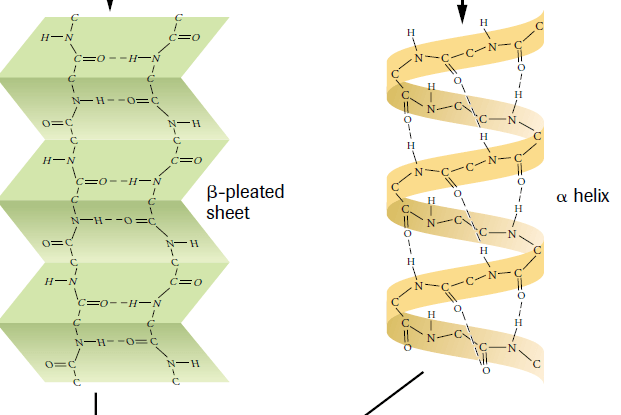
What level of protein structure is this?
a)
Primary
b)
Secondary
c)
Tertiary
d)
Quaternary
48.

which of the following terms refers to the order in which amino acids are linked together in a protein.

a)

Primary

b)

Secondary

c)

Tertiary

d)

Quaternary

49.

The entire polypeptide forms a three-dimensional structure

a)

Primary

b)

Secondary

c)

Tertiary

d)

Quaternary

50.

Two or more polypeptides attached together and work as one unit

a)

Primary

b)

Secondary

c)

Tertiary

d)

Quaternary

51.
All living things are made from cells.  
a)
True
b)
False
52.
Which organelle provides storage of food, water, and nutrients?
a)
Cell membrane
b)
mitochondria
c)
Vacuole
d)
Vacuume
53.

Which organelle acts as the"construction worker" because it assembles proteins?

a)

Golgi bodies

b)

ribosomes

c)

Chloroplasts

d)

Mitochondria

54.
Plant cells are the same as animal cells.
a)
True
b)
False
55.
Plant cells ......
a)
are called Prokaryotic cells.
b)
have a cell wall and chloroplast.
c)
are usually circular in shape
d)
All choices are correct.
56.
I produce the energy a cell needs.  I am a mighty power house.  Who am I?
a)
Mitochondria
b)
Nucleus
c)
Lysosome
d)
Cell Membrane
57.
Which organelle is like a post office because it receives materials, packages, and distributes them?
a)
Chloroplasts
b)
Ribosomes
c)
Golgi Bodies
d)
Nucleolus
58.
I control movement in and out of a cell. Who am I?
a)
Cell Wall
b)
Cyto
c)
Cell Membrane 
d)
Nucleus
59.

I am the "garbage disposal" because I break down waste. Which organelle am I?

a)

Lysosomes

b)

Mitochondria

c)

Nucleus

d)

Cyto

60.
What is the gel like substance that holds organelles in cells?
a)
Cytoplasm
b)
Chloroplast
c)
Nucleus
d)
Mitochondria
61.
There are some similarities between prokaryotic and eukaryotic cells. Which of the following structures is found in both prokaryotic and eukaryotic cells?
a)
lysosome
b)
mitochondrion
c)
nucleus
d)
ribosome
62.
This cell is simple. Only genetic material, cytoplasm and ribosomes inside.
a)
Eukaryotic
b)
Prokaryotic
c)
Plant
d)
Animal
63.
Complex cell. Can be plant or animal. Contains membrane bound organelles. 
a)
Eukaryotic Cell
b)
Prokaryotic Cell
c)
Bacteria
d)
Blood cell
64.
This organelle protects/holds the DNA
a)
Mitochondria
b)
Chloroplasts
c)
Nucleolus
d)
Nucleus
65.
This organelle makes/transports fats or lipids. 
a)
Rough E.R.
b)
Smooth E.R.
c)
Golgi Bodies
d)
Lysosomes
66.
Human cells are examples of which cell type?
a)
Prokaryotic
b)
Eukaryotic
c)
both
d)
neither
67.
This organelle helps transport proteins.
a)
Ribosomes
b)
Rough E.R.
c)
Golgi Body
d)
Smooth E.R.
68.
Cell membranes are found in
a)
Only animal cells
b)
Only plant cells
c)
Some plant and animal cells
d)
All plant and animal cells
69.
Which of the following parts could you find in a prokaryotic cell?
a)
capsule
b)
endoplasmic reticulum
c)
nucleolus
d)
vesicle
70.
This organelle traps sunlight and uses that energy to convert it to food.
a)
Mitochondria
b)
Chloroplasts
c)
Lysosomes
d)
Chlorophyll
71.
In biological membranes, the phospholipids are arranged in a _______, with the_______.
a)
bilayer; fatty acids pointing toward each other
b)
bilayer; fatty acids facing outward
c)
single layer; fatty acids facing the interior of the cell
d)
single layer; phosphorus-containing region facing the interior of the cell
72.
If a hospital patient is mistakenly given an IV of pure water instead of a saline solution that is isotonic to blood, the patient’s red blood cells will
a)
shrink and collapse
b)
release water to the plasma along its concentration gradient
c)
absorb water from the plasma and eventually burst
d)
transport equal amounts of water across the cell membrane in both directions
73.
Which of the following is the driving force for simple diffusion?
a)
Concentration gradient
b)
ATP hydrolysis
c)
ADP hydrolysis
d)
Phosphorylation
74.
When cells are placed in a __________ solution they begin to swell.
a)
Hypertonic
b)
Isotonic
c)
Hypotonic
d)
Equalized
75.
 If a cell containing 5% salt is placed into a glass of water with 20% salt, the water is _______ compared to the cell.
a)
hypertonic-
b)
hypotonic
c)
isotonic
76.
Special proteins help move particles, but NO energy is needed. This is..
a)
facilitated diffusion
b)
exocytosis
c)
active transport
d)
equilibrium
77.
Hydrophilic portion of cell membrane?
a)
A
b)
C
c)
D
d)
78.
Hydrophobic region of the cell membrane?
a)
E
b)
B
c)
C
d)
79.
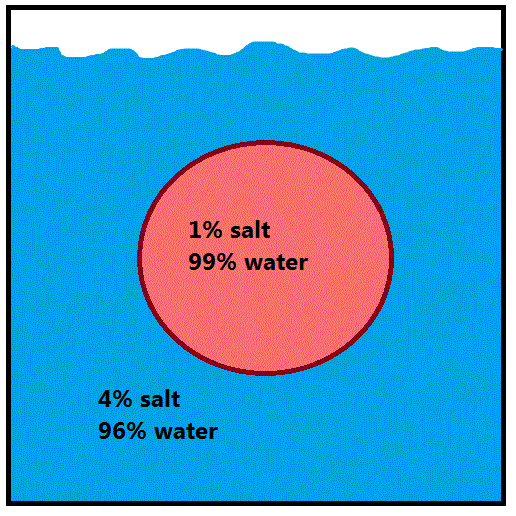
Where will the water go?
a)
Into the cell
b)
Out of the cell
c)
Equally in & out - it's isotonic
d)
There is no water
80.
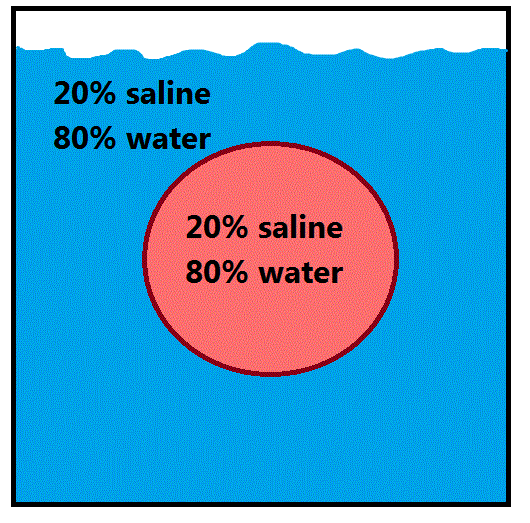
A blood cell is placed into the jar, as seen. Where will the water go?
a)
Into the cell
b)
Out of the cell
c)
Equally in & out - it's isotonic
d)
The water is a lie
81.
During diffusion
a)
substances (things) moves from high to low concentration
b)
water moves when energy is used
c)
large or oddly shaped molecules move across a cell membrane
d)
water moves from high to low concentration
82.
Part of the plasma membrane responsible for cell recognition... 
a)
C
b)
E
c)
B
d)
D
83.
A cell in an isotonic solution will
a)
swell
b)
shrink
c)
stay the same size
d)
impossible to tell
84.
This picture represents which type of cellular transport?
a)
passive transport
b)
endocytosis
c)
exocytosis
d)
osmosis
85.
What are two types of passive transport?
a)
endo and exocytosis 
b)
cookies and milk
c)
active and passive 
d)
Osmosis and diffusion
86.
Something is ___________ ____________
when some molecules can cross the membrane while others cannot. 
a)
Selectively (or Semi) Permeable 
b)
Totally Transparent
c)
Liquid Licorice 
d)
Heavily Patrolled 
87.
Which form of active transport is being shown? (Inside of  the cell is tan colored) 
a)
Facilitated Diffusion
b)
Exocytosis
c)
Endocytosis
d)
Receptor-mediated endocytosis
88.
The difference between osmosis and diffusion is that
a)
diffusion is passive transport, whereas osmosis is active transport
b)
only in diffusion do molecules move from areas of high concentration to areas of low concentration
c)
osmosis is the opposite of diffusion and only involves the movement of water
d)
osmosis refers specifically to the movement of water, whereas diffusion refers to the movement of any type of molecules
89.

Buffer is defined as

a)

ability to resist pH change

b)

ability to prevent pH from decreasing

c)

ability to resist a pH increase

90.
Osmosis is the movement of _____ across a membrane.
a)
food
b)
energy
c)
oxygen
d)
water
91.
In the given scenario what will happen to the organism: salt is poured onto eggplant.
a)
Water will move out of the eggplant cells and the cells will shrink.
b)
Water will move out of the eggplant cells and the cells will swell.
c)
Water will move into the eggplant cells and the cells will swell.
92.
In the given scenario what will happen?  An egg is placed in pure water for 48 hours.
a)
The egg will gain water and swell.
b)
Water will move in and out of the cell equally, and the cell with neither shrink nor swell.
c)
The egg will lose water and shrink.
93.
An animal cell placed in a hypertonic (salty) solution will
a)
Shrink
b)
Swell
c)
Stay the same
94.
Ideally, your cells should be in a(n) _______ solution
a)
Hypertonic
b)
Hypotonic
c)
Isotonic
d)
Cola
95.

 If the volume of a cell 

increases when it is placed 

in a solution, that solution is

 said to be __________ to the 

cell
a)
 hypertonic
b)
subatomic
c)
 isotonic
d)
 hypotonic 
96.
Which types of compounds dissolve easily in water?
a)
Polar and Nonpolar
b)
Polar and Ionic
c)
Nonpolar and Ionic
d)
Covalent and Nonpolar
97.
What property of water helps to moderate earth's temperature?
a)
adhesion
b)
chohesion
c)
Specific heat capacity
d)
Latent heat of vaporization
98.
Which cell structure is correctly paired with its primary function? 
a)
ribosome-protein synthesis
b)
mitochondrion-movement
c)
vacuole-cell division
d)
nucelus-storage of nutrients
99.
Where are ribosomes produced?
a)
Nucleolus
b)
Endoplasmic reticulum
c)
Golgi body
d)
Vessicle
100.
Which structure changes in the 20 different amino acids?
a)
#1
b)
#2
c)
#3
d)
#4