Wayground logo

Free Printable Worksheets

Font size

S
M
L
XL
Worksheets

Cell structure and function

Total questions: 113

Worksheet time: 1hrs 26mins

Name
Class
Date
1.
surrounds the cell; controls what enters/leaves cell; maintains homeostasis
a)
vacuole
b)
cell wall
c)
cell membrane
d)
lysosome
2.

holds organelles in the cell

a)
cytoplasm
b)
cell membrane
c)
cell wall
d)
ribosomes
3.
control the cell's activities; contains the cell's DNA
a)
mitochondria
b)
cell membrane
c)
nucleus
d)
golgi body
4.

uses sugar to release energy in the form of ATP

a)
nucleus
b)
lysosomes
c)
mitochondria
d)
vacuole
5.
makes proteins
a)
nucleus
b)
ribosomes
c)
lysosomes
d)
vacuole
6.

modifies and packages cell products

a)
nucleus
b)
cell wall
c)
vacuole
d)
golgi body
7.

contains enzymes that break down waste

a)
lysosome
b)
ribosome
c)
nucleus
d)
golgi body
8.
holds materials like water and is very large in a plant cell
a)
nucleus
b)
golgi body
c)
chloroplast
d)
vacuole
9.

ONLY found in plant cells, fungi and bacteria

a)
nucleus
b)
cell wall
c)
cell membrane
d)
lysosome
10.
ONLY found in a plant cell
a)
lysosome
b)
cell membrane
c)
chloroplast
d)
nucleus
11.
cells that contain a true nucleus
a)
prokaryotes
b)
eukaryotes
c)
carbohydrate
d)
plant cells
12.
Where is the genetic material found in the cell? 
a)
Nucleolus
b)
Cytoplasm
c)
Nucleus
d)
Chloroplast
13.
What distinguishes a eukaryotic cell from a prokaryotic cell is the presence of 
a)
A cell wall
b)
A nucleus
c)
DNA
d)
Ribosomes
14.
Which one of the following is not part of the cell theory?
a)
all living things are made of cells
b)
cells are the basic units of structure and function of living things
c)
new cells are produced from existing cells
d)
cells never die
15.
What structure is responsible for making proteins?
a)
Nucleus
b)
Mitochondria
c)
Golgi Apparatus
d)
Ribosome
16.

This organelle transports proteins or lipids to the Golgi

a)
Endoplasmic Reticulum
b)
Ribosomes
c)

Lysosome

d)

Nucleolus

17.

What is the cell wall of fungi made of?

a)

Chitin

b)

Cellulose

c)

Peptidoglycan

d)

Starch

18.

Cells only come ___

a)

from prokaryotes

b)

from other cells dividing

c)

from fungi

d)

from eukaryotes

19.

The smallest unit of life is ____

a)

a protist

b)

an atom

c)

bacteria

d)

a cell

20.

Prokaryote ___

a)

contain simple cells

b)

are unicellular

c)

alway have a flagellum

d)

are a product of endosymbiosis

21.

An organism made of only one cell is called . . .

a)

Eukaryotic

b)

Monocellular

c)

Multicellular

d)

Unicellular

22.

This organelle is a rigid outer layer that protects plant cells.

a)

Cell Membrane

b)

Cell Wall

c)

Nucleus

d)

Chloroplast

23.

A _____ organism is made of many cells, each specialized to do certain jobs.

a)

Eukaryotic

b)

Multicellular

c)

Prokaryotic

d)

Unicellular

24.

These tiny cell structures assemble protein molecules from amino acids.

a)

Carbohydrates

b)

Lipids

c)

Nucleic Acids

d)

Ribosomes

25.

These organelles in plants capture light energy and store it in glucose molecules to be used as food.

a)

Chloroplasts

b)

Mitochondria

c)

Endoplasmic Reticulum

d)

Vacuoles

26.
What is the function of the lysosome?
a)
site of digestive enzymes
b)
site of ATP (energy) production
c)
site of photosynthesis
d)
site of protein production
27.
What is the function of the mitochondria?
a)
site of digestive enzymes
b)
site of ATP (energy) production
c)
site of photosynthesis
d)
site of protein production
28.
What is the function of the Golgi body?
a)
to control the activities within the cell
b)

to modify and package cellular materials

c)
to store water and nutrients 
d)
to control the materials that pass into and out of the cell
29.
What is the function of the vacuole?
a)
to control the activities within the cell
b)
to package and ship cellular materials
c)
to store water and nutrients 
d)
to control the materials that pass into and out of the cell
30.
What is the function of the nucleus?
a)
to control the activities within the cell
b)
to package and ship cellular materials
c)
to store water and nutrients 
d)
to control the materials that pass into and out of the cell
31.

What structure does this organism use for locomotion (movement)

a)
1, nucleus
b)
2, chloroplast
c)
3, vacuole
d)
4, flagella
32.

Which is not true about Prokaryotic cells?

a)

They do not have a nucleus.

b)

They have DNA.

c)

They are larger than Eukaryotic cells.

d)

Examples include cyanobacteria and E. coli.

33.

Small structures in the cytoplasm that do special jobs.

a)

Nucleus

b)

Ribosomes

c)

Organelles

d)

Vacuoles

34.
What is the structure labeled #1?
a)
Chloroplast
b)
Nucleus
c)
Cell Membrane
d)
Mitochondria
35.
What is the structure labeled #5?
a)
Vacuole
b)
Chloroplast
c)
Mitochondria
d)
Lysosome
36.
What is the structure labeled #3?
a)
Golgi body
b)
Endoplasmic reticulum
c)
Vacuole
d)
Mitochondria
37.
What is the structure labeled #9?
a)
Cell Wall
b)
Cytoplasm
c)
Chloroplast
d)
Mitochondria
38.
What is the structure labeled #6?
a)
Smooth ER
b)
Golgi Body
c)
Nucleus
d)
Rough ER
39.
What is the structure labeled #8?
a)
Vacuole
b)
Golgi body
c)
Nucleus
d)
Lysosome
40.
What is the structure labeled #4?
a)
Vacuole
b)
Cell wall
c)
Cytoplasm
d)
Cell membrane
41.
What is the structure labeled #7?
a)
Rough ER
b)
Smooth ER
c)
Golgi body
d)
Flagella
42.
What is the structure labeled #2?
a)
Lysosome
b)
Vesicle
c)
Ribosome
d)
Mitochondria
43.
What is the structure labeled #10?
a)
Cell membrane
b)
Cell wall
c)
Cytoplasm
d)
Centriole
44.
What is the structure labeled #13?
a)
Centrioles
b)
Cytoplasm
c)
Lysosome
d)
Mitochondria
45.
What is another name for cell membrane?
a)
Great Wall of China
b)
Berlin Wall
c)
Plasma Membrane
d)
Cell Wall
46.
What makes up the cell membrane?
a)

Lipid layer

b)

Phospholipid Bilayer

c)
Protiens
d)
Carbohydrate Chains
47.
What is made in the nucleolus?
a)
DNA
b)
Protiens
c)
Ribosomes
d)
ATP
48.
What structure is responsible for making proteins?
a)
Nucleus
b)
Mitochondria
c)
Golgi Apparatus
d)
Ribosome
49.
Besides the cytoplasm, where else do we find ribosomes?
a)
Vacoule
b)
Cell Membrane
c)
Endoplasmic Reticulum
d)
Lysosome
50.
What is the function of the rough endoplasmic reticulum?
a)
to make energy
b)

transport proteins made by the ribosomes on it

c)
store water and other vital molecules
d)
to make new membranes and neutralize toxins
51.
Which type of cell?
a)
Prokaryote
b)
Eukaryote
c)
plant cell
d)
animal cell
52.
What am I?
a)
mitochondria
b)
lysosomes
c)
chloroplast
d)
endoplasmic reticulum
53.
What am I?
a)
cell wall
b)
mitochondria
c)
cytoplasm
d)
chloroplast
54.
What am I?
a)
Nucleus
b)
Golgi Body
c)
Mitochondrion
d)
Plasma Membrane
55.

The scientist who first described living cells as seen through a simple microscope was

a)

van Leeuwenhoek

b)

Schleiden

c)

Hooke

d)

Schwann

56.

If a cell contains a nucleus, it must be a(n)

a)

plant cell

b)

eukaryotic cell

c)

animal cell

d)

prokaryotic cell

57.

Specialized cells are found only in

a)

animals

b)

unicellular organisms

c)

bacteria

d)

multicellular organisms

58.
The group of tissues working together to perform a specific function.  Example heart, brain, and stomach.
a)
Organ Systems
b)
Tissues
c)
Organs
d)
Cells
59.
Which statement is not part of the cell theory?
a)
All cells come from other cells.
b)
All living things have one or more cells.
c)
Cells are a living thing's basic unit of structure and function.
d)
All cells have a nucleus.
60.
What is the name of the genetic material that is inside the nucleus?
a)
ER
b)
ATP
c)
YOLO
d)
DNA
61.
Which of the following scientists concluded that all animals are made of cells?
a)
Rudolf Virchow
b)
Matthais Schleiden
c)
Robert Hooke
d)
Theodor Schwann
62.
Who was the "scientist" who observed pond water and teeth scrapings in his microscope?
a)
Hooke
b)
Leeuwenhoek
c)
Schleidian
d)
Virchow
63.
Who looked at cork and named the cell?
a)
Robert Hooke
b)
Van Leeuwenhoek
c)
Robert Brown
d)
Francesco Redi
64.
All plants are made of cells.  This was discovered by....
a)
Matthias Schleiden
b)
Rudolf Virchow
c)
Robert Hooke
d)
Aristotle
65.
A group of similar cells that perform the same function.
a)
tissue
b)
organelle
c)
mass
d)
tendon
66.
A group of organs that work together to perform a major function is an organ
a)
system
b)
column
c)
bank
d)
stack
67.
Which of the following is the correct order of organization in living things from most basic (simple) to most complex?
a)
a.  Organism, cell, tissue, organ, organ system
b)
a.  Organ system, organ, tissue, cell, organism
c)
a.  Cell, tissue, organ, organ system, organism
d)
a.  Cell, organ, tissue, organ, organism, organ system
68.
A group of similar cells that come together to perform a specific function is a/an
a)
organ
b)
organism
c)
organ system
d)
tissue
69.
When a group of organs work together to perform a particular function they create a/an
a)
organ system
b)
organism
c)
tissue
d)
organ
70.
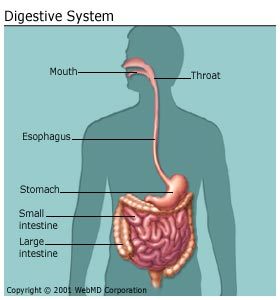
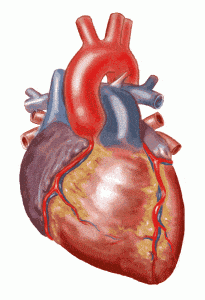
This is a example of........ 
a)
organ system
b)
cells
c)
organ
d)
tissue
71.
This is a example of ........
a)
cell
b)
organ system
c)
organ
d)
tissue
72.

All of the following are Eukaryotic EXCEPT . . . .

a)

animal cells

b)

plant cells

c)

fungi

d)

bacteria

73.

What is E?

a)

cell wall

b)

cell membrane

c)

cilia

d)

flagella

74.

What is A?

a)

cytoplasm

b)

nucleus

c)

DNA

d)

vacuole

75.

What is D?

a)

cilia

b)

cytoplasm

c)

ribosome

d)

flagella

76.

This organelle produces the spindle fiber used during mitosis (cell division)

a)

lysosome

b)

centriole

c)

cytoplasm

d)

ribosome

77.

the short hair like structures

a)

flagella

b)

cilia

c)

lysosome

d)

ribosome

78.

long whip like structures used for movement

a)

hair

b)

cilia

c)

flagella

d)

cytoskeleton

79.

2 organelles only found in animal cells

a)

cytoplasm,centriole

b)

centriole,vacuole

c)

centriole,lysosome

d)

lysosome,vacuole

80.

The pigment found in chloroplasts.

a)

chlorophyll

b)

green

c)

starch

d)

cellulose

81.
Where is genetic information stored in this organism?
a)
A
b)
B
c)
C
d)
D
82.

An amoeba uses cytoplasmic these projections to move?

a)

Cilia

b)

Pseudopodia

c)

Flagella

d)

Contractile Vacuole

83.
How are eukaryotic and prokaryotic cells similar?
a)
Both have true nuclei.
b)
Both may contain mitochondria.
c)
Both contain ribosomes.
d)
Both contain centrioles.
84.
Which structures would be found in BOTH plant and animal cells?
a)
mitochondria
b)
cell walls
c)
chloroplasts
d)
centrioles
85.
How are eukaryotic and prokaryotic cells different?
a)
Eukaryotic cells are less complex than prokaryotic cells.
b)
Prokaryotic cells are larger than eukaryotic cells.
c)
Eukaryotic cells are more complex than prokaryotic cells.
d)
Prokaryotic cells contain membrane-bound organelles and eukaryotic cells do not contain membrane-bound organelles.
86.
The word "pseudopodia" means:
a)
small cell
b)
false foot
c)
fake eye
d)
first animal
87.
Was first to state that "All cells come from existing cells."
a)
Redi
b)
Virchow
c)
Chargaff
d)
Darwin
88.

Cells differentiate to perform different functions because

a)

all genes are turned on inside that cell

b)

all genes are turned off inside that cell

c)

different genes are turned on inside that cell

d)

different genes are turned on or off inside that cell

89.

During the process of differentiation

a)

all sections of DNA are activated to determine the structure of a body cell

b)

ONLY ONE section of DNA are deactivated to determine the structure of a body cell

c)

only specific sections of DNA sequence are activated to determine the structure and functions of a body cell

90.

What is cell differentiation?

a)

Process by which cells produce more cells

b)

Process by which cells become specialized

c)

Process by which cells become unspecialized

d)

Process by which cells die

91.

Enzymes are

a)

Lipids

b)

Protein

c)

Carbohydrates

d)

Nucleic Acids

92.

Enzymes are responsible for-

a)

Speeding up reactions

b)

Giving the body energy

c)

Slowing down reactions

93.

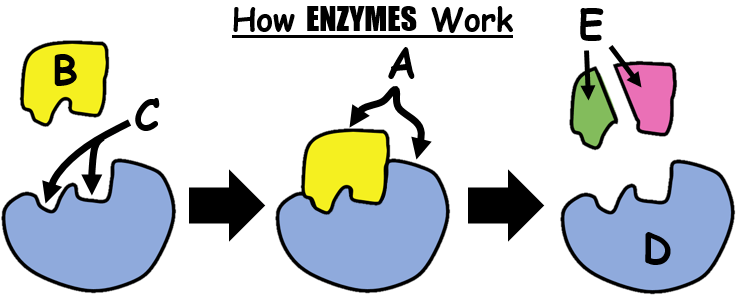
Letter D...

a)

active site

b)

enzyme

c)

substrate

d)

products

94.

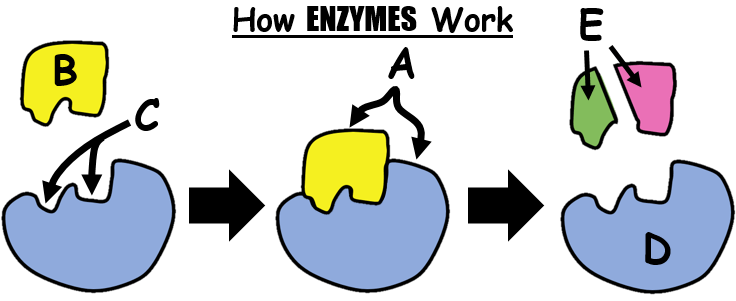
Letter B...

a)

active site

b)

enzyme

c)

substrate

d)

products

95.

Letter c...

a)

active site

b)

enzyme

c)

substrate

d)

products

96.
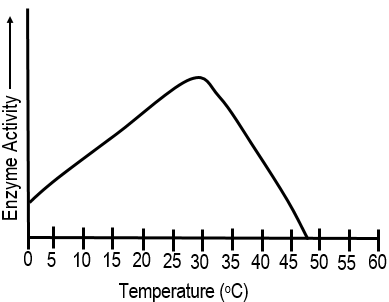
Based on the graph, what is the optimal temperature for this enzyme? 
a)
15oC
b)
40oC
c)
30oC
d)
35oC
97.
What is the primary function of CARBOHYDRATES?
a)
Source of energy
b)
Long term storage of energy
c)
Transmitting genetic information
d)
Cell processes and cell signaling
98.
What is the primary function of LIPIDS?
a)
Source of energy
b)
Long term storage of energy
c)
Transmitting genetic information
d)
Cell processes and cell signaling
99.
Proteins are made of monomers called ___________
a)
Nucleotides
b)
Monosaccharides
c)
Amino Acids
d)
Glycerol and fatty acids
100.
Nucleotides are monomers of
a)
Carbohydrates
b)
Lipids
c)
Proteins
d)

Nitrogen Bases

101.

Monosaccharides(sugars) are monomers of

a)
Carbohydrates
b)
Lipids
c)
Proteins
d)
Nucleic Acids
102.
Building blocks of the body, hair , muscles etc.
a)
protein
b)
nucleic acid
c)
lipids
d)
carbohydrates
103.
Is found in the cell membrane as a bilayer. 
a)
lipids
b)
protein
c)
nucleic acid
d)
carbohydrate
104.

What are examples of proteins?

a)

triglycerides, waxes, fats, and oils

b)

form polypeptides such as antibodies, enzymes, and hormones

c)

glucose, fructose, cellulose, and lactose

d)

DNA and RNA

105.

The cell membrane of a cell consists of

a)

protein molecules arranged around 2 layers

b)

two layers of lipids with embedded proteins built in

c)

lipid molecules positioned between two carbohydrate layers

d)

protein molecules which are made of sugar

106.

What is the monomer for carbohydrates?

a)

Monosaccarides

b)

Fatty Acids

c)

Amino Acids

d)

Nucleotides

107.

What is the monomer for Lipids?

a)

Monosaccarides

b)

Fatty Acids

c)

Amino Acids

d)

Nucleotides

108.

What is the monomer for proteins?

a)

Monosaccarides

b)

Fatty Acids

c)

Amino Acids

d)

Nucleotides

109.

What is the monomer for nucleic acid?

a)

Monosaccarides

b)

Fatty Acids

c)

Amino Acids

d)

Nucleotides

110.

Which of the following is the structural polysaccharide found in the cell wall of fungi?

a)

chitin

b)

cellulose

c)

peptidoglycan

d)

glycogen

111.

Which of the following is the structural polysaccharide found in the cell wall of prokaryotes?

a)

chitin

b)

cellulose

c)

peptidoglycan

d)

glycogen

112.

Which of the following is the structural polysaccharide found in the cell wall of plants?

a)

chitin

b)

cellulose

c)

peptidoglycan

d)

glycogen

113.

What macromolecule is made up of C,H,O,N?

a)

Carbohydrates

b)

Lipids

c)

Proteins

d)

Nucleic acids