
NEW
Font size
 Worksheets
Natural disasters: patterns, forces, protection (review)
Total questions: 50
Worksheet time: 45mins

Which natural disaster causes most of its damage due to shaking?
tornadoes
tsunamis
hurricanes
earthquakes
What is the area of the world called where most of the world's volcanoes and earthquakes occur?
Volcano Ring
Ring of Fire
Tsunami Circle

What does this map show?
There are no predictable patterns to earthquakes.
Earthquakes start fires all around the world.
There is a pattern to global earthquakes.

According to this map, which part of the United States receives the most earthquakes?
northern
eastern
southern
western
Melted rock under Earth's surface is called________. In some places, this magma rises to the surface and breaks through during volcanic eruptions. Once magma reaches the surface, it is called__________.
lava, lava
magma, lava
lava, magma
magma, magma


Which type of wave is the first to arrive after an earthquake occurs?
P Wave
Rayleigh Wave
S Wave
These waves move along Earth's surface & cause the most damage
Surface waves
Primary waves
Secondary waves
D waves
In these faults, blocks of rock move sideways on either side of the fault plane
Reverse faults
Convergent boundary
Normal faults
Strike-slip faults
In these faults, the block of rock above the fault plane slides down relative to the other block
Normal fault
Reverse fault
Backwards fault
Strike-slip fault
Along these faults, the block of rock above the fault plane moves up relative to the other block
Reverse fault
Normal fault
Upside down fault
Strike-slip fault
The 2nd seismic waves to arrive at any particular location after an earthquake, also called S waves
Surface waves
Primary waves
Secondary waves
Tidal waves
How can earthquake damage be reduced? ___________________
by building base isolated buildings
by reinforcing building walls
by anchoring buildings to solid rock
all of the above


As a safety measure, engineers have developed new technologies to make sure that buildings will ________
fall more slowly.
collapse instead of explode.
bend instead of break.
crumble and fall straight down.


This statement is a(n)

In which type of fault does one wall move up over the edge of the opposite wall.
Normal fault
Reverse fault
Strike-Slip Fault
None of these

Earthquakes occur __________.
only near tectonic plate boundaries
along any fracture in the Earth's crust, near or far from plate boundaries
only along faults distant from plate boundaries
only underneath continental crust

Which type of stress forms a reverse fault?
Shearing
Compression
Tension

Rank the seismic waves in order of appearance when an earthquake first occurs as measured by a seismograph.
S waves, P waves, then surface waves
P waves, S waves, then surface waves
S and P waves at the same time, then surface waves
Surface waves, then S and P waves at the same time


Stress that squeezes rock until it folds or breaks is called ______________
fault
compression
shearing
tension
Stress that stretches rock so that it becomes thinner in the middle is called __________________
tension
stress
dormat
fault
Stress that pushes masses of rock in opposite directions, in a sideways movement is called __________________
compression
fault
tension
shearing
There are 3 types of stress:
normal, compression, & shearing
reverse, strike-slip, & normal
reverse, shearing, & compression
shearing, compression, tension
There are 3 types of faults:
normal, reverse, & tension
normal, reverse, & compression
normal, reverse, & strike-slip
normal, reverse, shearing
____________________ are vibrations that travel through Earth carrying energy released by various processes.
seismic waves
tension waves
stress waves
compression waves
Why is it beneficial to be able to predict when and where natural hazards will occur as much as possible?
Communities can be notified to evacuate
So that we can stop them from happening again
So that scientists know where to go in order to study them
So that we can harness their power for renewable energy
How have humans learned to live and survive in areas where natural hazards occur?
They have adapted buildings and structures to withstand the hazard.
They have put up large walls to keep the hazard out.
They use more renewable energy to reduce how severe the hazards are.
They don't really care and just live there anyway.

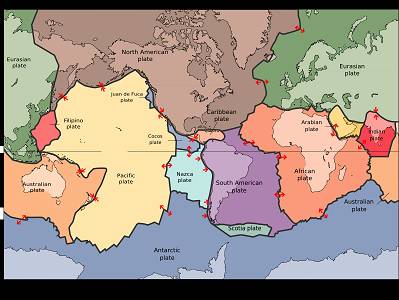
Which of these natural disasters happen on these plate boundaries?
earthquakes
volcanos
both of these
none of these
We cannot predict the exact moment a natural disaster will occur, but we do know...
what day they will happen on
how big the natural disaster will be
where the natural disaster is likely to occur
how many people will be killed in the natural disaster
Locations of natural disasters like volcanoes and earthquakes can be described as...
forming in a pattern
forming randomly on Earth
Only found in the ocean
Only found in South America
Kahuliu, Hawaii is 15 miles from the nearest volcano. If that volcano erupted, lava would not reach the town. However, the citizens should still protect themselves against _____ from the volcano.
magma
storms
falling ash
flooding

