wayground logo

Free Printable Worksheets

Font size

S
M
L
XL
Worksheets

Physical Science ch. 2 Review

Total questions: 70

Worksheet time: 2hrs 11mins

Name
Class
Date
1.
What kind of acceleration is shown here?
a)
positive
b)
negative
c)
none
d)
varies
2.
What kind of acceleration is shown here?
a)
positive
b)
negative
c)
none
d)
varies
3.
What kind of acceleration is shown here?
a)
none
b)
positive
c)
negative
d)
varies
4.

What is the velocity?

a)

not moving

b)

increasing

c)

constant

d)

negative

5.
What is the velocity?
a)
positive
b)
negative
c)
decreasing
d)
increasing
6.
What is the velocity?
a)
0 m/s
b)
positive m/s
c)
negative m/s
d)
decreasing
7.
Is the speed constant or non-constant?
a)
constant
b)
non-constant
8.
Is the speed constant or non-constant?
a)
constant
b)
non-constant
9.
Is the speed constant or non-constant?
a)
constant
b)
non-constant
10.
Is the speed constant or non-constant?
a)
constant
b)
non-constant
11.
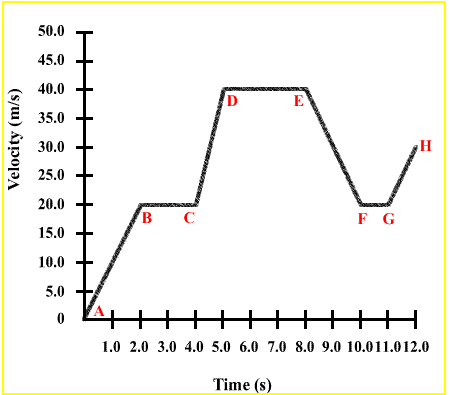
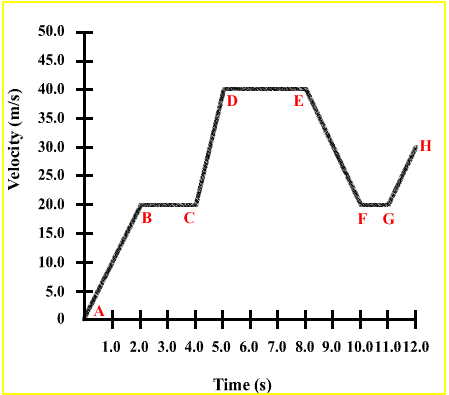
Which section of the graph shows decreasing velocity?
a)
CD
b)
DE
c)
EF
d)
GH
12.
Which section of the graph shows increasing velocity?
a)
AB
b)
BC
c)
DE
d)
EF
13.
Which section of the graph shows constant velocity?
a)
AB
b)
BC
c)
EF
d)
GH
14.
Which section of the graph shows acceleration?
a)
AB
b)
BC
c)
EF
d)
FG
15.
Which section of the graph shows deceleration?
a)
AB
b)
BC
c)
EF
d)
GH
16.

This position vs. time graph shows an object...

a)

not moving

b)

moving with constant velocity

c)

moving with changing velocity

17.

This position vs. time graph shows an object...

a)

not moving

b)

moving with constant velocity

c)

moving with changing velocity

18.

This position vs. time graph shows an object...

a)

not moving

b)

moving with constant velocity

c)

moving with + acceleration

d)

moving with - acceleration

19.

This velocity vs. time graph shows an object...


(Hint: For this graph, the velocity is 0 m/s!)

a)

not moving

b)

moving with constant velocity

c)

moving with changing velocity

20.

This velocity vs. time graph shows an object...

a)

not moving

b)

moving with constant velocity

c)

moving with changing velocity

21.

This velocity vs. time graph shows an object...

a)

not moving

b)

moving with constant velocity

c)

moving with changing velocity

22.

This position vs. time graph shows an object...

a)

not moving

b)

moving with constant velocity

c)

moving with changing velocity

23.

This position vs. time graph shows an object...

a)

not moving

b)

moving with constant velocity

c)

moving with changing velocity

24.

This velocity vs. time graph shows an object...

a)

not moving

b)

moving with constant velocity

c)

moving with changing velocity

25.

Which of these position vs. time graphs shows an object changing direction?

a)
b)
c)
d)
26.

On this position vs time graph, describe the motion of A.

a)

moving away from the origin with a constant velocity

b)

Returning to the origin with a constant velocity

c)

positive acceleration

d)

negative acceleration

e)

velocity is zero

27.

On this velocity vs time graph, describe the motion of A.

a)

positive velocity

b)

negative velocity

c)

positive acceleration

d)

negative acceleration

28.

On this velocity vs time graph, describe the motion of C.

a)

constant velocity

b)

no velocity

c)

positive acceleration

d)

negative acceleration

29.

On this velocity vs time graph, describe the motion of D.

a)

constant positive velocity

b)

constant negative velocity

c)

positive acceleration

d)

negative acceleration

30.

What is the velocity at 12.5 seconds?

a)

0 m/s

b)

2 m/s

c)

10 m/s

d)

20 m/s

31.

On this position vs time graph, describe the motion of B.

a)

moving away from the origin with a constant velocity

b)

Returning to the origin with a constant velocity

c)

positive acceleration

d)

negative acceleration

e)

velocity is zero

32.

Does line B or D have a greater velocity?.

a)

B

b)

D

33.

On this position vs time graph, describe the motion of C.

a)

moving away from the origin with a constant velocity

b)

Returning to the origin with a constant velocity

c)

positive acceleration

d)

negative acceleration

e)

velocity is zero

34.
Scott drives a Jeep 12 km east, then 4 km north, then finally 3 km west. He traveled a total distance of:
a)
5 km
b)
10 km
c)
13 km
d)
19 km
35.
A ping-pong ball rolls forward 6 meters, and bounces backward 3 meters. It traveled a total distance of:
a)
9 meters
b)
6 meters
c)
3 meters
d)
0 meters
36.
Liza is swimming laps from one end of a 50 meter pool to the other. Going from one end to the other is considered one lap. If she swims four complete laps, which statement is TRUE?
a)
Her distance and displacement are both zero.
b)
Her distance is zero, but her displacement is 200 meters.
c)
Her distance is 200 meters, but her displacement is zero.
d)
Her distance and displacement are both 200 meters.
37.
Ivan walks 10 meters west to the water fountain, then runs 2 meters east to his class to avoid a lockout. His displacement would be:
a)
8 meters
b)
8 meters, east
c)
8 meters, west
d)
12 meters
38.
During a game of dodgeball, Marina runs 2.45 meters forward to grab a dodgeball, then runs 1.25 meters backward to avoid a opponent's dodgeball. Her displacement would be:
a)
3.7 meters backwards
b)
1.2 meters backwards
c)
3.7 meters forwards
d)
1.2 meters forwards
39.
Ronaldo runs across a soccer field, moving 10 meters north, then 8 meters west. His displacement would be:
a)
10.2 m, NW
b)
12.8 m, NW
c)
15.4 m, NW
d)
18.0 m, NW
40.
Distance and direction of an object's change in position from a starting point
a)
displacement
b)
distance
c)
motion
d)
reference point
41.

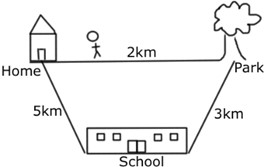
Jerry walked from home to school, then from the school to the park. What is his total distance?

a)

2 km

b)

5 km

c)

8 km

d)

10 km

42.

A cat walks 3 meters toward a laser, then jumps 5 meters due south of the laser when it sees a thing. What is the displacement of the cat (to the nearest tenth)?

a)

3.0m

b)

5.0m

c)

8.0m

d)

5.8m

43.
The speedometer on your car tells you
a)
average velocity
b)
instantaneous velocity
c)
average speed
d)
instantaneous speed
44.
What two measurements are necessary for calculating speed?
a)
Mass and time
b)
Temperature and mass
c)
Mass and distance
d)
Distance and time
45.
At 60 seconds, how far had this object traveled? 
a)
0 m
b)
10 m
c)
20 m
d)
40 m
46.
How long did it take this object to travel 10 m?
a)
0 s
b)
10 s
c)
15 s
d)
20 s
47.
What is the speed of an object that travels 60 meters in 4 seconds?
a)
240 m/s
b)
15 m/s
c)
0.067 m/s
d)
15 mph
48.
A measurement of how fast an object is moving
a)
Velocity
b)
Speed
c)
Vector
d)
Acceleration
49.
A description of the speed and direction of an object's motion
a)
Velocity
b)
Speed
c)
Acceleration
d)
Vector
50.
What is the speed of an object that travels 20 meters in 4 seconds?
a)
80 m/s
b)
0.2 m/s
c)
5 m/s
d)
24 m/s
51.

The rate at which something moves is what?

a)

time

b)

space

c)

sound

d)

speed

52.

Total distance divided by total time, for an object shows:

a)

acceleration

b)

the size of one's toupee

c)

absolute speed

d)

average speed

53.

The clown walked 27 feet in 9 seconds. what was his velocity?

a)

18 feet/sec

b)

243 feet/sec

c)

36 feet/sec

d)

3 feet/sec

54.

An old lady rolls down a hill at 3 meters/second. The hill is 36 meters long. How many seconds does it take the old lady to reach the bottom of the hill?

a)

39 seconds

b)

12 seconds

c)

15 seconds

d)

33 seconds

55.
A runner races in the 100 meter dash.  It takes her 10 seconds to finish.  What is her average speed?
a)
10 m/s
b)
1000 m/s
c)
100 seconds
d)
10 seconds
56.
Acceleration is....
a)
Speeding up only
b)
Speeding up and slowing down only?
c)
Slowing down only?
d)
Any change in speed (faster or slower) or a change in direction.
57.
A car accelerates from a standstill to 70 m/s in 10 seconds.  What is the acceleration?
a)
0.7m/s2
b)
7m/s2
c)
14m/s2
d)
none of the above
58.
A car accelerates from 15 m/s to 60 m/s in 30 seconds.  What is its acceleration?
a)
2 m/s2
b)
3 m/s2
c)
1.5 m/s2
d)
0.75 m/s2
59.
A drag racer accelerated from rest ( 0 m/s ) to 195 m/s in 6.5 s.  What was the acceleration?
a)
10 m/s
b)
30 m/s2
c)
-3 m/s2
d)
26 m/s
60.

Acceleration toward the center of a curved path is called __________________ acceleration.

a)

circular

b)

round

c)

angular

d)

centripetal

61.

Theory that describes the movement of land masses.

a)

centripetal motion

b)

plate tectonics

c)

Newton's laws

d)

Theory of gravity

62.

Name of the slant of a line on a graph.

a)

slope

b)

angle

c)

line slant

d)

constant

63.

product of an objects mass and velocity

a)

acceleration

b)

speed

c)

momentum

d)

displacement

64.

Any change over time

a)

distance

b)

mass

c)

constant speed

d)

rate

65.

An object that is neither speeding up nor slowing down travels at a _____.

a)

constant speed

b)

constant acceleration

c)

variable speed

d)

instantaneous speed

66.

a measurement of how far an object has moved

a)

distance

b)

displacement

c)

rate

d)

velocity

67.

The amount of matter in an object.

a)

speed

b)

velocity

c)

volume

d)

mass

68.

An object has a mass of 10 kg and a velocity of 25 m/s. What is it's momentum?

a)

2.5 kg m/s

b)

250 kg m/s

c)

0.4 kg m/s

d)

250 m/s

69.

If an object is traveling at a constant velocity but changes direction, is it accelerating?

a)

yes

b)

no

70.

Which of the following include direction?

a)

distance

b)

displacement

c)

speed

d)

velocity