wayground logo

Free Printable Worksheets

NEW

Font size

S
M
L
XL
Worksheets

Heredity Challenge - Week 2

Total questions: 60

Worksheet time: 35mins

Name
Class
Date
1.

Which of the following is an example of a phenotype?

a)

hh

b)

Red Hair

c)

Hh

d)

DNA

2.
What is a phenotype?
a)
An organism that has the same genes for a trait (ex. TT or tt)
b)
refers to the genetic makeup of an individual
c)
the passing of traits from parent to offspring
d)
The expression of a trait; physical appearance.
3.
An allele whose trait only shows up when no dominant allele is present.
a)
hidden allele
b)
dominant allele
c)
recessive allele
d)
present allele
4.
A human usually has _____ total chromosomes.
a)
23
b)
46
c)
22
d)
4
5.
_______ is the genetic material that carries all the information about how a living thing will look and function.  It has a double helix shape. 
a)
Traits
b)
Recessive Allele
c)
Dominant Allele
d)
DNA
6.
The passing of genetic traits from parent to offspring is called ______.
a)
Heredity
b)
Genes
c)
Phenotype
d)
Allele
7.
_______ carry the information that determines your traits such as eye color. 
a)
phenotype
b)
genotype
c)
genes
d)
dominant
8.
Cellular structures that occur in pairs that carry hereditary information are called ______.
a)
DNA
b)
dominant traits
c)
recessive traits
d)
chromosomes
9.

_____ is the two letter genetic code that determines an organism's traits.

a)

Phenotype

b)

Genotype

c)

Heredity

d)

A gene

10.

Binary fission is a type of _____ reproduction.

a)

sexual

b)

asexual

c)

budding

d)

regeneration

11.

If W = black fur and w = white fur. The white fur would be an example of a(n)

a)

dominant trait

b)

recessive trait

c)

asexual reproduction

d)

sexual reproduction

12.

______ provides the instructions for building and operating all living organisms and is divided into segments called genes.

a)

Dominant alleles

b)

Recessive alleles

c)

Binary fission

d)

Deoxyribonucleic Acid (DNA)

13.
Which of the following is heterozygous
a)
FF
b)
tt
c)
Gg
d)
RR
14.
Which of the following is homozygous recessive?
a)
rr
b)
AA
c)
TT
d)
Ff
15.
What does the prefix homo- in homozygous mean?
a)
same
b)
different
c)
dating
d)
humans
16.
What does the prefix hetero- in heterozygous mean?
a)
same
b)
different
c)
dating
d)
human
17.
Which of the following is homozygous dominant?
a)
Jj
b)
Rr
c)
MM
d)
ee
18.
Mark is heterozygous. If B is for brown hair, and b is for blonde hair, what is Mark's phenotype?
a)
Brown Hair
b)
Blonde Hair
c)
Brown and Blonde Hair
d)
Black Hair
19.
Mark is heterozygous. If B is for brown hair, and b is for blonde hair, what is Mark's genotype?
a)
BB
b)
bb
c)
Bb
d)
bB
20.
Mary is heterozygous. If F for freckles, and f is for no freckles, what is Mary's genotype?
a)
FF
b)
Ff
c)
ff
d)
fF
21.

A specific part of a chromosome that provides the code for a specific trait is known as...

a)

a trait

b)

a gene

c)

DNA

d)

a nucleus

22.

Genes often come in two forms know as...

a)

alleles

b)

phenotypes

c)

chromosomes

d)

genetic markers

23.

Whether or not you have a 'hitchhiker's thumb' is determined by a single gene. How many alleles for this single gene do you have?

a)

Zero

b)

One

c)

Two

d)

Four

24.

Saying that someone has cheek dimples would be referring to their...

a)

genotype

b)

phenotype

25.

What percent of the offspring will be homozygous?  

a)

0%

b)

25%

c)

50%

d)

75%

e)

100%

26.

Is the missing parent homozygous or heterozygous? 

a)

Homozygous

b)

Heterozygous

27.

Which of these describes the parents

a)

Both parents express the dominant trait

b)

Both parents express the recessive trait

c)

One parent expresses the dominant trait and one, one the recessive

28.

What percent of the offspring will express the dominant trait? 

a)

0%

b)

25%

c)

50%

d)

75%

e)

100%

29.

Tony has a scar on his arm from a dirtbike crash. What percent chance does Tony have of passing this trait on to his children

a)

0%

b)

25%

c)

50%

d)

75%

e)

100%

30.
this image is an example of
a)
codominance
b)
dominance
c)
incomplete dominance
31.

This type of inheritance pattern shows BOTH traits in possible offspring

a)

complete dominance

b)

incomplete dominance

c)

codominance

d)

dominant pattern

32.
How many daughter cells are produced at the end of meiosis?
a)
1
b)
2
c)
3
d)
4
33.
Before mitosis or meiosis can begin, DNA must go through Interphase. This is when...
a)
DNA replicates
b)
DNA splits
c)
DNA forms chromosomes
d)
Chromosomes cross over
34.
What causes genetic variation in meiosis?
a)
chromosomes lining up
b)
crossing over of chromosomes
c)
separation of chromosomes
d)
chromosomes pulling apart
35.
Which is the correct sequence? 
a)
mitosis - gametes - zygote - meiosis - fertilization - embryo
b)
Fertilization-mitosis-zygote-gametes-meiosis-embryo
c)
meiosis-zygote-gametes-mitosis-fertilization-embryo
d)
meiosis-gametes-fertilization-zygote-mitosis-embryo
36.
The two parts of a double-stranded chromosome are held together by a... 
a)
Nucleolus
b)
spindle fiber
c)
centromere
d)
centriole
37.
What chromosome is affected by Down's Syndrome?
a)
23
b)
18
c)
13
d)
21
38.
What type of mutation is this?
a)
Deletion
b)
Inversion
c)
Duplication
d)
Substitution
39.
Which would be considered a somatic cell?
a)
Sperm cell
b)
Egg Cell
c)
Skin Cell
d)
All of these
40.
Which reproductive process offers the greatest chance for variation within a species?
a)
Sexual Reproduction
b)
Budding
c)
Binary Fission
d)
Pollination
41.
The likely cause of genetic disorders is...
a)
Nondisjunction
b)
Overfertilization
c)
Uncontrolled Meiosis
d)
Translocation
42.
What is a picture used to examine chromosomes called?
a)
Sonogram
b)
Electrocardiogram
c)
X-Ray
d)
Karyotype
43.
 Turner's Syndrome is monosomy of which chromosome?
a)
18
b)
21
c)
sex chromosome
d)
13
44.
What type of RNA carries the DNA message out of the nucleus to the ribosomes?
a)
mRNA
b)
tRNA
c)
RNA
d)
DNA
45.
What do we call the process of turning DNA into mRNA?
a)
Translation
b)
Transcription 
c)
Replication
46.
When DNA is transcribed to RNA.... 
a)
A pairs with U
b)
C pairs with U
c)
A pairs with T
d)
C pairs with T
47.
Amino acids are the building blocks of... 
a)
DNA
b)
RNA
c)
Atoms
d)
Proteins
48.
What process is occurring in this photo?
a)
Transcription
b)
DNA unwinding
c)
Translation
d)
Transfer RNA is creating bases
49.
What process is occurring in this photo?
a)
Transcription
b)
Translation
c)
mRNA is matching with amino acids
d)
tRNA is transcribing the DNA
50.
Which of the following best describes a DNA molecule? 
a)
contains ribose 
b)
made of amino acids
c)
contains Uracil
d)
double helix
51.
Where does Translation occur?
a)
Proteins
b)
Mitochondria
c)
Ribosomes
d)
Cytoplasm
52.
What process does the energy come from to fuel protein synthesis?
a)
Cellular respiration
b)
ADP
c)
Carbohydrates
d)
Mitochondria
53.
Why are men 16 times more likely to be color-blind than women?
a)
to be color-blind, you must have a Y chromosome
b)
to be color-blind, all of your X chromosomes must have the gene
c)
color-blindness is caused by testosterone
d)
color-blindness is caused by the same gene as baldness
54.
If a gene is found only on the X chromosome and not the Y chromosome, it is said to be 
a)
sex-linked trait
b)
polygenic trait
c)
codominant trait
d)
incomplete dominance trait
55.

When the doctor operates on the patient's eye, he is using

a)

learned behavior.

b)

acquired physical trait.

c)

inherited physical trait.

d)

instinct.

56.

Where are chromosomes found?

a)

vacuole

b)

cell membrane

c)

nucleus

d)

mitochondria

57.

The scientific study of heredity.

a)

Genetics

b)

Heredity

c)

Probability

d)

Pedigree

58.

What type of inheritance is determined by multiple genes located at different loci on different chromosomes and there can be a range of traits?

a)

Codominance

b)

Incomplete dominance

c)

Polygenic traits

d)

Multiple alleles

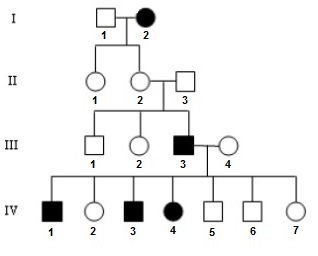
59.
This pedigree represents the inheritance of hemophilia in this family. How many of the females have the hemophilia trait?
a)
8
b)
5
c)
2
d)
3
60.
Which individual in the first generation is a carrier?
a)
The male
b)
The female
c)
individual 1
d)
None of the above