
 Worksheets
Unit 4: Weathering Erosion Review 2025
Total questions: 38
Worksheet time: 39mins

Animals can also break down rock with their biological activities of nesting, scratching, and trying to hide food. Is this a chemical or mechanical example of weathering?
Mechanical / Phsical
Chemical

Over time wind has carved out this rock feature. What type of weathering and specific example best describes this process?
Chemical, Dissolving
Mechanical, Pressure Release
Mechanical, Abrasion
Chemical, Abrasion

What type of weathering and specific example is shown in the picture?
Chemical, Hydrolosis
Mechanical, Exfoliation
Mechanical, Root Wedging
Chemical, Root Wedging

Water hitting the rocks, and tumbling them overtime has made them round and smooth, What type of weathering and specific example is most likely the cause?
Chemical, Abrasion
Mechanical, Abrasion
Mechanical, Exfoliation or Pressure Release
Chemical, Exfoliation or Pressure Release

Rainwater mixing with carbon dioxide in the atmosphere creates weak carbonic acid which sinks into the ground and dissolves limestone, creating sink holes and caves. What type of weathering and specific example is described?
Chemical Weathering, Dissolving
Mechanical Weathering, Dissolving
Chemical Weathering, Oxidation
Mechanical Weathering, Oxidation

Rusting happens to metal but can also occur on rocks and is caused by exposure to oxygen. Is this type of weathering mechanical or chemical, and what is the scientific name for this type of weathering?
Clay formation, which is mechanical
Hydrolosis, which is chemical
Oxidation, which is chemical
Oxidation, which is mechanical
A metal statue slowly turning green after years of being outside is an example of:
mechanical weathering
chemical weathering
Rocks along a riverbed that are smoothed from continuously moving water and sediment rubbing other rocks against them is an example of:
mechanical weathering
chemical weathering
Caves are most likely to form from the chemical weathering of which kind of rock?
Granite
Limestone
Basalt
Sandstone
In which climate would the chemical weathering of limestone occur most rapidly?
cold and dry
cold and humid
warm and dry
warm and humid
Oxidation forms ______________
Water
Plants
Rust
Ice

What type of weathering occurs when the average temperature is 0 degrees and an annual precipitation of 50?
Slight Mechanical
Strong Chemical
Moderate Chemical w/ Frost Action
Moderate Chemical
Water flows through permeable materials ____________________ than impermeable materials.
slower
faster
The ___________________ the grain size, the faster the water will move through the soil.
more mixed
smaller
larger
Sand sediments are usually more permeable than silt sediments because sand grains are...
larger
smoother
rounder
more soluble

What is the relationship between soil type/particle size and permiability (as shown by the bar graph below)?
The larger the particle size, the slower the permeability rate
The smaller the particle size, the faster the permeability rate
There is no relationship between particle size and permeability
The larger the particle size, the faster the permeability rate
Impermeable materials...
have an abundance of pores.
let water in.
have little to no pores.
The measure of how easily water can flow through an aquifer.
porosity
permeability
gradient
divide
As permeability increases
Infiltration decreases and runoff decreases
Infiltration increases and runoff decreases
Infiltration decreases and runoff increases
Infiltration increases and runoff increases
What type of sediment tends to be the most impermeable?
sand
clay
silt
rocks
If water can easily move between cracks of a rock, we can say that...
water is permeable
rock is permeable
rock is impermeable
water is impermeable
What is porosity
Rocks
The percent of the volume of open spaces in rock or sediment
Ability rock sediment fluids pass through open spaces/pores
Nothing
If particle size decreases permeability
decreases
increases
stays the same
It could increase or decrease
Why does water move slowly through clay or not at all?
clay has large pore spaces
clay has hard particles
clay has very small particles

Use the soil triangle to determine which type of soil is
25% clay, 55% sand, 20% silt
1 Silty clay loam
2 Clay loam
3 Loamy sand
4 Sandy clay loam

Use the soil triangle to determine which type of soil is 30% clay, 35% sand, 35%silt
1 Clay loam
2 Silty clay loam
3 Loamy sand
4 Cannot be determined

The image shows weathering in limestone. What type of landform is created?
1 Terrace
2 Moraines
3 Karst topography
4 Sea cliffs

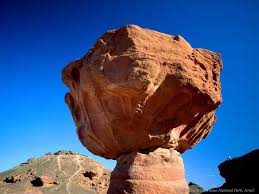
The correct term describing why part of this rock formation weathers at different rates is
a. Mechanical Weathering
b. Chemical Weathering
c. Physical Weathering
d. Differential Weathering

When the water vapor in the air changes back to liquid, what does it form?
rain,hail,sleet, or snow
water
condensation
snow and water
Where is most water found on Earth?
glaciers
oceans
rivers
lakes
What is an aquifer?
a body of permeable rock which can contain or transmit groundwater.
a well in which water is under pressure especially : one in which the water flows to the surface naturally.
confining layer
solid rock underlying loose deposits such as soil or alluvium.
A lake that stores water for human use.
pond
stream
reservoir
sea
In the water cycle, the sun provides
energy for water to evaporate from oceans, lakes and rivers.
water for evaporation to happen.
energy to produce electricity.
water for condensation to happen.
Processes by which water circulates between the earth's oceans, atmosphere and land.
Water Cycle
Rock Cycle
Nitrogen Cycle
Carbon Cycle

Rocks in river beds appear smooth…
because the minerals react with oxygen in the air.
because of the abrasion of smaller particles.
because rainwater contains a weak carbonic acid
because water expands when it freezes
Which of the following factors would increase both chemical and mechanical weathering rate?
a. Increasing temperature
b. Number of fossils in rocks
c. Parent rock composition
d. The amount of surface area

What creates the arch in the image to the right
a. Mechanical weathering
b. Outgassing
c. Plate Tectonics
d. Oxidation
Match the following processes with their definitions.

Breaking down rocks and land by gravity, wind, & plants.

Breaking down rocks and land by dissolving, oxidation, & carbonation

Moving rocks & sediment to a new location.

Dropping rocks & sediment in new locations

