
 Worksheets
Biochem
Total questions: 60
Worksheet time: 59mins
Name
Class
Date
1.
Protein molecules are composed of long chains of __________________
a)
DNA
b)
amino acids
c)
RNA
d)
ribosomes
2.
Which macromolecule doesn't dissolve in water?
a)
Carbs
b)
Lipids
c)
Nucleic Acids
d)
Proteins
3.
Which of the following are nucleic acids?
a)
Saturated and unsaturated fats
b)
DNA and RNA
c)
collagen and keratin
d)
glucose and starch
4.
Nucleic acids, proteins, and other large biological molecules are known as polymers because...
a)
they are the base units used in the formation of plastics
b)
they all function as enzymes
c)
they contain only ionic bonds
d)
they contain many small, repeating subunits bonded together
5.
A student is preparing to run in a school track competition. For the quickest source of energy, the student should eat a food that contains a high percentage of...
a)
carbohydrates
b)
fat
c)
proteins
d)
sodium
6.
What is one way that fatty acids (lipids) are used in the body?
a)
for storing energy
b)
for encoding genetic information
c)
as the building blocks of antibodies
d)
as the building blocks of hemoglobin
7.
Sugars such as ribose, fructose and glucose are examples of ______________?
a)
proteins
b)
lipids
c)
nucleic acids
d)
carbohydrates
8.
What is the monomer for nucleic acids?
a)
fatty acids
b)
nucleotides
c)
amino acids
d)
glucose
9.
Scientists have found geysers on one of Saturn’s moons. The geysers release
water vapor containing complex organic compounds, which may indicate the presence of life. Which of the following elements is most likely abundant in the organic compounds in the water vapor?
water vapor containing complex organic compounds, which may indicate the presence of life. Which of the following elements is most likely abundant in the organic compounds in the water vapor?
a)
carbon
b)
chlorine
c)
iron
d)
zince
10.
Carbon atoms have four electrons in their outer shell. This means that a single carbon atom can form up to _______ bonds with other atoms.
a)
4
b)
8
c)
6
d)
2
11.
Which macromolecule stores long-term energy?
a)
Proteins
b)
Lipids
c)
Nucleic Acids
d)
Carbohydrates
12.
Which macromolecule contains genetic information?
a)
Proteins
b)
Carbohydrates
c)
Nucleic Acids
d)
Lipids
13.
Which macromolecule is used for short term energy?
a)
Proteins
b)
Carbohydrates
c)
Nucleic Acids
d)
Lipids
14.
Which macromolecule includes structural molecules & enzymes?
a)
Proteins
b)
Carbohydrates
c)
Nucleic Acids
d)
Lipids
15.

Which organic molecule?
a)
Proteins
b)
Carbohydrates
c)
Nucleic Acids
d)
Lipids
16.

Which organic molecule?
a)
Proteins
b)
Carbohydrates
c)
Nucleic Acids
d)
Lipids
17.

Which organic molecule?
a)
Proteins
b)
Carbohydrates
c)
Nucleic Acids
d)
Lipids
18.

Which organic molecule?
a)
Proteins
b)
Carbohydrates
c)
Nucleic Acids
d)
Lipids
19.
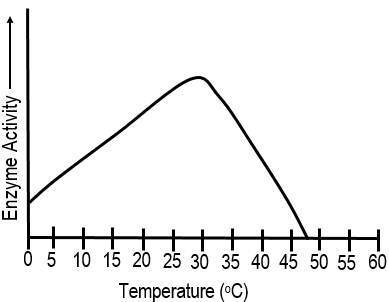
Based on the graph, what temperature does this enzyme work best?
a)
15 C
b)
40 C
c)
30 C
d)
47 C
20.

Letter C shows the ____________ in this reaction.
a)
active site
b)
enzymes
c)
substrate
d)
products
21.

The process/reaction used to link compounds/monomers together. Releases water.
a)
Dehydration
b)
Hydrolysis
c)
Enzomatic
d)
Tetratonic
22.
A monosaccharide is a:
a)
nucleic acid
b)
lipid
c)
carbohydrate
d)
protein
23.
Sugars usually end in....
a)
-ose
b)
-ace
c)
-ats
d)
-ids
24.
What is the purpose of an enzyme?
a)
give permission for the reaction
b)
raise activation energy
c)
speed up reactions
d)
control how many reactions occur
25.
A peptide is a compound consisting of 2 or more ________ .
a)
amino acids
b)
nucleic acids
c)
lipids
d)
carbohydrates
26.
When a carbohydrate polymer breaks apart using water it is called ______________
a)
hydrolysis
b)
carbolysis
c)
dehydration synthesis
d)
metabolism
27.
Which are the building blocks of most lipid molecules?
a)
glucose and protein
b)
glucose and fatty acids
c)
fatty acids and glycerol
d)
amino acids and glycerol
28.

What's a valence electron?
a)
electrons in the second energy level
b)
electrons in the outermost energy level
c)
the atomic number
d)
electrons in the first level
29.
Because it is already in the most stable form with a full valence shell, which element will not form bonds?
a)
Mercury
b)
Carbon
c)
Hydrogen
d)
Krypton
30.
How many valence electrons make the atom "happy"?
a)
2
b)
6
c)
8
d)
45
31.
The first electron shell is an exception because it is full when you have ____ electrons
a)
4
b)
1
c)
10
d)
2
32.
Type of bond in which electrons are shared
a)
Ionic
b)
Covalent
c)
Hydrogen
d)
Metallic
33.
Type of bond in which electrons are transferred/stolen
a)
Hydrogen
b)
Ionic
c)
Covalent
d)
Metallic
34.
Always equal to the atomic number
a)
protons
b)
electrons
c)
neutrons
35.

How many protons does an Aluminum atom have? (use the picture to help you)
a)
27
b)
13
c)
14
d)
40
36.

How many neutrons does the average sodium atom (Na-23) have?
a)
23
b)
11
c)
12
d)
34
37.
What type of molecule is water?
a)
Polar
b)
Non-polar
c)
Polar and non-polar
d)
compound
38.
What is refers to the binding together of 2 substances of the same type?
a)
Solvent
b)
Solute
c)
Cohesion
d)
Adhesion
39.
What do polar molecules attract to?
a)
Non-polar molecules
b)
Everything
c)
Other polar molecules
40.
Water's temperature usually remains, _____________?
a)
Stable
b)
Unstable
c)
cold
d)
hot
41.
What are hydrogen bonds made up of?
a)
Positive hydrogen atoms and negative oxygen atoms
b)
Negative hydrogen atoms and positive oxygen atoms
c)
H2
42.
Why can polar molecules attract each other?
a)
Because they are polar
b)
Because they are partly positive and partly negative
c)
Because of ionic bonds
d)
adhesion
43.
An attraction between molecules of different substances.
a)
Non-polar
b)
Polar
c)
Cohesion
d)
Adhesion
44.
Why can some lizards run on water
a)
Because of Adhesion
b)
Because of cohesion
c)
Because they're too cool for land
d)
Because they're really fast
45.

Attractions between water molecules are called
a)
Covalent bonds
b)
Ionic bonds
c)
Polar bonds
d)
Hydrogen bonds
46.
Why does ice float?
a)
As water freezes, it expands and its density decreases.
b)
As water freezes, it takes up more hydrogen from the atmosphere, causing it to have a greater buoyancy.
c)
As water freezes, air becomes trapped between the hydrogen bonds of water molecules.
d)
As water freezes, it takes up more oxygen from the atmosphere, causing it to have a greater buoyancy.
47.
Which types of compounds dissolve easily in water?
a)
Nonpolar
b)
Polar
c)
Ionic
d)
All covalent
48.

Water droplets take a spherical shape (as pictured) because of ____________
a)
adhesion
b)
cohesion
c)
capillary action
d)
solubility
49.
What is the reason why oil and water don't mix?
a)
Oil is too heavy to mix with water
b)
Water can only mix with polar molecules
c)
Water can only mix with non-polar molecules
d)
Oil is too light to mix with water
50.

The following graphs depict the effect of pH on the activity of enzymes. Enzymes with their highest activity at an alkaline (basic) pH are represented by which of the following graphs?
a)
I only
b)
II only
c)
III only
d)
I and III only
e)
I and IV only
51.
An organic compound that is composed of carbon, hydrogen, and oxygen in a 1:2:1 ratio is known as a
a)
lipid
b)
carbohydrate
c)
protein
d)
nucleic acid
52.
What 3 letters do enzymes typically end in?
a)
-ose
b)
-ase
c)
-ese
d)
-tic
53.
Any substance that is acted upon by an enzyme is called a(n)?
a)
Coenzyme
b)
Substrate
c)
Vitamin
d)
Polypeptide
54.
After the enzyme and substrate bind together and perform the reaction, what does the substrate become?
a)
a substrate
b)
an enzyme
c)
a product
d)
an active site
55.

The graph shows how enzymes affect reactions in cells. Which statement best summarizes the information shown in the graph?
a)
Enzymes increase the energy of the reactants.
b)
Enzymes decrease the energy level of the products.
c)
Enzyme decrease the activation energy of the reaction.
d)
Enzymes reverse the direction of the reaction.
56.
Enzymes need certain environmental conditions in order to function properly. What happens when enzymes are heated to a high temperature?
a)
they die
b)
they denature
c)
they change their amino acid sequence
d)
they work better
57.
What factors affect an enzyme's reaction rate?
a)
temperature
b)
pH
c)
substrate concentration
d)
all of these
58.
What does pH measure?
a)
Concentration of H+
b)
Concentration of OH-
c)
The amount of liquid in the test tube.
d)
The Concentration of H3O+
59.
An acid’s pH is between :
a)
0 to 6
b)
7
c)
8-14
d)
6-14
60.
A base is a substance
a)
That releases OH- ions when dissolved in water
b)
That releases H+ ions when dissolved in water
c)
Does not release any ions when dissolved in water
d)
None of the above
100 %

