Worksheets
Momentum/2D Dynamics
Total questions: 56
Worksheet time: 56mins


If there is no friction, then the acceleration would be equal to
mg
sin(θ)mg
g
sin(θ)g

As the angle of the incline increases, what happens to the normal force?
The normal force increases
The normal force decreases
The normal force is not affected by the incline
The normal force is only dependent on the force due to gravity


Which of the following statements is true about the image above?
The accelerations of the blocks will vary according to their mass
The net force acting on each block is the same
The blocks will experience the same acceleration
The 3m box will eat the 2m and the m boxes

A man standing on a scale in an elevator notices that the scale reads 40 newtons greater than his normal weight. Which type of movement of the elevator could cause this greater-than-normal reading?
accelerating upward
accelerating downward
moving upward at a constant speed
moving downward at a constant speed

Is it possible for the normal force to be zero?
Yes. If the surface is horizontal.
Yes. If the surface is vertical
No. FN will always be less than Fg
No. Fg will be less than FN.


The blocks shown in the figures have equal masses and are made of the same material. In Figure (C), the blocks are tied together with a light string. The velocity is the same in each figure. The total frictional force exerted by the surface on the blocks is
the same in Figure (C) and Figure (B).
the same in Figures (A), (B), and (C).
greater in Figure (C) than in Figure (A) or Figure (B).
the same in Figure (C) as in Figure (A).

A block of mass m is pulled by a force T at an angle 𝜽 above the horizontal in the direction shown across a rough surface at a constant velocity. The coefficient of kinetic friction between the block and the surface is mk. The magnitude of the frictional force is
µkmg
µkT cos 𝜽
µk(T – mg)
µk(mg – T sin 𝜽)

A mass m is placed on a rough incline at an angle 𝜽 to the horizontal. A force F is applied up the incline and it is just enough to prevent the mass from sliding down the incline. Using the compass lines, the direction of the frictional force is along
A
B
C
D

Which of the following is not true about the system?
T3 is equal to the scalar sum of the magnitudes of T2 and T1
T3 is equal in magnitude to Fg
The x- components of the T1 and T2 and equivalent but in opposite directions
The system is in equilibrium.

If μk = 0.65 and μs = 0.7, acceleration would be equal to
0 m/s/s
9.8 m/s/s
3.35 m/s/s
-2.63 m/s/s
A car travels up a hill at constant speed. Which of the following diagrams best represents the forces acting on the car at this instant?


Three forces of equal magnitude act on the box shown. One force is upward, one downward, and one rightward. Which of the following statements must be true based on this information? Select two answers.
The box must have a rightward component of velocity.
The box has no vertical component of velocity.
The acceleration of the box is directed to the right.
The velocity of the box is changing with time.


The graph above shows the force on an object of mass M as a function of time. For the time interval 0 to 4 s, the total change in the momentum of the object is
40 kgm/s
20 kgm/s
0 kgm/s
-20 kgm/s
indeterminable unless the mass M of the object is known

The graph above shows the force acting on an object as a function of time. The change in momentum of the object from time 0 to t is
2Ft
Ft
0.5 Ft
0.25 Ft
zero
An object moving on a horizontal, frictionless surface makes a glancing collision with another object initially at rest on the surface. In this case which of the following is true about momentum and kinetic energy?
Momentum is always conserved, and kinetic energy may be conserved
Kinetic energy is always conserved, and momentum may be conserved.
Momentum is always conserved, and kinetic energy is never conserved
Both momentum and kinetic energy are always conserved
Neither momentum nor kinetic energy is conserved
A projectile is launched from the ground at a 23 degree angle with a velocity of 67 m/s. Calculate the maximum height of the projectile.
35 m
40 m
23 m
96 m
474 m


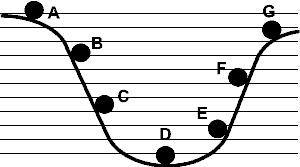
Between which adjacent pairs is the gain in kinetic energy the greatest?
i. The vector sum of the three forces must equal zero.
ii. The magnitude of the three forces must be equal.
iii. All three forces must be parallel.
The area under a force vs. displacement graph tells you the
mass of the object
momentum of the object
work done on the object
impulse of the object

A go-kart of mass M collides with an identical go-kart of mass M as shown. The trailing go-kart is going at 3 m/s before the collision and the leading go-kart is going at 2 m/s in the same direction. After the two go-karts collide and separate, the leading go-kart now is going at 3 m/s and the trailing go-kart goes at 2 m/s in the same direction. Which of the following is true of the collision?
It is elastic because momentum is conserved.
It is elastic because kinetic energy is conserved.
It is inelastic because momentum is not conserved.
It is inelastic because kinetic energy is not conserved.

A dart of mass 0.2 kg is launched from ground level at speed 10 m/s at an angle of 30 degrees above the horizontal as shown. At the apex of the dart’s trajectory, it strikes and sticks to a block of mass 2.0 kg, which is attached to a 1.2 m string. What maximum angle does the string make with the vertical after being the block is struck by the dart?
62 degrees
22 degrees
38 degrees
13 degrees

Waluigi drops a 0.2 kg bouncy ball from a height 20 m. It rebounds and reaches a maximum height of 5 m. What is the magnitude of the impulse that the ground exerts on the ball?
6.0 Ns
4.0 Ns
3.0 Ns
2.0 Ns

Rank the objects in terms of the speed of the blocks just before hitting the ground
vA>vC>vB
vA>(vB=vC)
vB>(vA=vC)
vA=vB=vC

A man is launched out of a cannon with a speed of 40 m/s at 45 degrees with respect with the ground. Which of the following is true about his acceleration at the highest point?
the acceleration is unknown
the acceleration is horizontal
the acceleration is straight down
the acceleration is straight up
When a cannon fires a cannonball, the cannon will recoils backwards because:
Energy if the cannonball and cannon is conserved
Momentum of the cannonball and cannon is conserved
Energy of the cannon is greater than the energy of the cannonball
Momentum of the cannon is greater than the energy of the cannonball
In an elastic collision, if the momentum is conserved, then which of the following statements is true about kinetic energy?
Kinetic energy is also conserved
Kinetic energy is gained
Kinetic energy is lost
None of the above
The area under the curve on a Force versus time ( F vs t) graph represents
Impulse
Momentum
Work
Kinetic energy
Two objects collide and bounce off each other. Linear momentum is:
Definitely conserved
Definitely not conserved
Conserved only if the collision is elastic
Conserved only if the environment is friction less
A freight car moves along a friction less level railroad track at constant speed. The car is open on top. A large load of coal is suddenly dumped into the car. What happens to the velocity of the car?
It increases
It remains the same
It decreases
Cannot be determined from the information given


An object is moving in the positive x-direction while a net force directed along the x-axis is exerted on the object. The figure above shows the force as a function of position. What is the net work done on the object over the distance shown?
F0d
23F0d
2F0d
4F0d


An object weighing 300 N is suspended by means of two cords, as shown above. The tension in the horizontal cord is
0 N
150 N
210 N
300 N
400 N

Three blocks of masses 3m, 2m, and m are connected to strings A, B, and C as shown above. The blocks are pulled along a rough surface by a force of magnitude F exerted by string C. The coefficient of friction between each block and the surface is the same. Which string must be the strongest in order not to break?
A
B
C
They must all be the same strength
It is impossible to determine without knowing the coefficient of friction

Two 0.60-kilogram objects are connected by a thread that passes over a light, frictionless pulley, as shown above. The objects are initially held at rest. If a third object with a mass of 0.30 kilogram is added on top of one of the 0.60-kilogram objects as shown and the objects are released, the magnitude of the acceleration of the 0.30-kilogram object is most nearly
10.0 m/s/s
6.0 m/s/s
3.0 m/s/s
2.0 m/s/s
1.0 m/s/s