wayground logo

Free Printable Worksheets

NEW

Font size

S
M
L
XL
Worksheets

Atomic Structure

Total questions: 60

Worksheet time: 55mins

Name
Class
Date
1.
The mass number of an element that has 18 protons, 18 electrons, and 19 neutrons is _____.
a)
12.5
b)
13
c)
25
d)
37
2.
The atomic number of an element that has 9 protons, 9 electrons, and 10 neutrons is _____.
a)
9
b)
10
c)
19
d)
28
3.
How many neutrons does uranium-239 have
a)
92
b)
147
c)
239
d)
331
4.
Which statement about subatomic particles is true?
a)
Protons, neutrons, and electrons all have about the same mass.
b)
Unlike protons or neutrons, electrons have no mass.
c)
Neutrons have no charge and no mass.
d)
An electron has far less mass than either a proton or neutron.
5.
Which of the following is unique for any given element?
a)
the number of neutrons
b)
the charge on the electrons
c)
the number of protons
d)
the mass of a neutron
6.
Which statement is true about oxygen-17 and oxygen-18?
a)
They do not have the same number of protons.
b)
Their atoms have an identical mass.
c)
They are isotopes of oxygen.
d)
The have the same mass number.
7.
The mass number of a single atom  is
a)
the sum of the protons and neutrons in the atom.
b)
twice the number of protons in one atom of the element.
c)
a ratio based on the mass of a carbon-12 atom.
d)
a weighted average of the masses of the element’s isotopes.
8.
The dense center region of an atom
a)
electron cloud
b)
core
c)
nucleus
d)
centrino
9.
An atom has 10 protons and a mass number of 18. It has __ neutrons
a)
10
b)
18
c)
28
d)
8
10.
How many protons are present in phosphorus-31?
a)
15
b)
16
c)
31
d)
46
11.
Two isotopes of carbon are carbon-12 and carbon-14.  These isotopes differ from one another by two protons.
a)
true
b)
false
12.
Changing the number of neutrons in an atom changes its...
a)
element type.
b)
mass.
c)
charge.
d)
atom type.
13.
When there are the same number of protons and electrons in an atom, that atom is a...
a)
positive ion.
b)
negative ion.
c)
unstable isotope.
d)
neutral atom.
14.

What is different about isotopes of the same element?

a)

# of protons

b)

# of electrons

c)

# of neutrons

15.
What subatomic particles are found in the nucleus of an atom?
a)
neutron and electron.
b)
neutron and proton.
c)
proton and electron. 
16.
Which subatomic particle is found outside of the nucleus?
a)
Electron
b)
Proton
c)
Neutron
d)
Quark
17.
Protons have a ______ charge.
a)
postive
b)
negative
c)
neutral
d)
postive and negative
18.
Which of the following is a negatively charged subatomic particle?
a)
Electron
b)
Proton
c)
Neutron
d)
Quark
19.
Particles in an atom that are neutral and have no charge are ______. 
a)
Negatrons 
b)
Electrons 
c)
Neutrons 
d)
Protons 
20.

Who believed that electrons were scattered amongst positively charged material. (plum pudding model)

a)

JJ Thomson

b)

Ernest Rutherford

c)

John Dalton

d)

Niels Bohr

21.
Discovered that the atom has a small, dense, positively charged nucleus.
a)
Ernest Rutherford
b)
Heisenberg
c)
Democritus
d)
JJ Thomson
22.

Believed that all atoms of the same element are identical.

a)

John Dalton

b)

JJ Thomson

c)

Niels Bohr

d)

Modern Atomic Theory

23.
Rutherford’s experiment determined that the nucleus of an atom is tiny, dense and  ______ charged. 
a)
neutrally
b)
negatively
c)
positively
24.

Place the following atomic models in order, from earliest to latest:


A) Rutherford B) Thomson C) Dalton

a)

B, C, A

b)

C, A, B

c)

A, C, B

d)

C, B, A

25.

In the atomic model nicknamed the "plum pudding" model, what do the plums represent?

a)

the nucleus

b)

the atom

c)

the electrons

d)

the positive material

26.
Whose experiment involved shooting small, positively charged alpha particles at a sheet of gold foil?
a)
J.J. Thompson
b)
Max Planck
c)
Ernest Rutherford
d)
Niels Bohr
27.
Who concluded that atoms consisted largely of empty space with most of the mass concentrated in the center?
a)
J. J. Thomson
b)
Max Planck
c)
Ernest Rutherford
d)
Niels Bohr
28.

Which of the following is/are conclusions based on Rutherford’s gold foil experiment?

a)

Atom is mostly empty space

b)

The nucleus is positively charged

c)

The atom has a small dense nucleus

d)

All answers are correct

29.
24.1% of all the isotopes of a an element have a mass of 75.23 amu, 48.7% have a mass of 74.61 amu, and 27.2% have a mass of 75.20 amu.
What is the average mass of this element?
a)
74.92 amu
b)
24.97 amu
c)
75.01 amu
d)
74.51 amu
30.

What does the 1.00794 stand for?

a)

Hydrogen

b)

atomic number

c)

average atomic mass

d)

atomic explosion

31.
What is the atomic number for an element with three protons?
a)
2
b)
1
c)
3
d)
6
32.

The average atomic mass of an element is the ___.

a)

average of the mass number and the atomic number for the element

b)

weighted average of the masses of the isotopes of the element

c)

total mass of the isotopes of the element

d)

total number of subatomic particles in the nucleus

33.

Calculate the average atomic mass of the element iron (Fe) using the following data:

[Isotope, % abundance]

[Iron-54, 6% ] [Iron-56, 92% ] [ Iron-57, 2% ]

a)

53.7 amu

b)

54.9 amu

c)

5592.0 amu

d)

55.9 amu

34.

An isotope has three forms.  70% have a mass of 4 amu, 20% have a mass of 5 amu and 10% have a mass of 3 amu.  Average atomic mass will be closest to

a)
2 amu
b)
3 amu
c)
4 amu
d)
5 amu
35.
How many neutrons does the isotope of lithium have?
a)
8
b)
3
c)
4
d)
5
36.
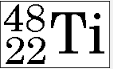
How many protons does this isotope of titanium have?
a)
48
b)
22
c)
26
d)
70
37.
In a correctly written symbol what would be located in the "A" position?
a)
number of neutrons
b)
atomic number
c)
number of electrons 
d)
mass number
38.
Four isotopes of lead include lead-204, lead-206, lead-207, and lead-208.  The average atomic mass of lead is 207.2.  Which isotope of lead is likely to be the most abundant.
a)
204
b)
206
c)
207
d)
208
39.

What isotope has 26 protons and 30 neutrons?

a)

Iron-56

b)

Zinc-56

c)

No way to tell

40.

How many protons are in Cs-133?

a)

6

b)

24

c)

55

d)

83

41.

An element has 29 protons, 35 neutrons, and 29 electrons. What is the mass number of this element?

a)

29

b)

35

c)

64

d)

93

42.

What is the difference between Sulfur-23 and Sulfur-25?

a)

Sulfur-25 has two more neutrons than Sulfur-23

b)

Sulfur-25 has two more protons than Sulfur-23

c)

Sulfur-25 has two more electrons than Sulfur-23

d)

There is no difference at all

43.

An isotope of Nitrogen has 13 neutrons. What is the identity of this isotope?

a)

Nitrogen-13

b)

Aluminum-13

c)

Nitrogen-20

d)

Aluminum-20

44.

Which isotope has 24 protons and 39 neutrons?

a)

Chromium-63

b)

Yttrium-63

45.
What did Thomson discover?
a)
electron
b)
proton
c)
neutron
d)
electron cloud
46.
The scientist responsible for "discovering" the nucleus is:
a)
Bohr
b)
Rutherford
c)
Schroedinger
d)
Einstein
47.

John Dalton stated:

a)

Atoms are tiny, invisible particles.

b)

Atoms of one element are all the same.

c)

Atoms of different elements are different.

d)

Compounds form by combining atoms.

e)

All of the statements listed.

48.

Rutherford's experiment that he used to discover protons and the nucleus.

a)

gold foil experiment

b)

cathode ray experiment

c)

neither of these is correct

49.

This is an example of which model of the atom?

a)

Rutherford's Model

b)

Plum Pudding Model

c)

Atomic Model

d)

Bohr's Model

50.

Which conclusion was drawn from the observation that most alpha particles passed straight through the gold foil in Rutherford's experiment?

a)

Atoms are indivisible.

b)

Electrons are located in the nucleus.

c)

Atoms have a uniform positive charge.

d)

Atoms are mostly empty space.

51.

What did the deflection of a small number of alpha particles in the gold foil experiment indicate about atomic structure?

a)

Atoms are made only of electrons.

b)

Electrons are heavier than protons.

c)

Atoms have no internal structure.

d)

Atoms contain a dense, positively charged nucleus.

52.

Which of the following was NOT a conclusion of the gold foil experiment?

a)

The nucleus is positively charged.

b)

Electrons are found inside the nucleus.

c)

The nucleus is small and dense.

d)

Atoms are mostly empty space.

53.

Which element has an average atomic mass of 40.1 amu?

a)

calcium

b)

zirconium

c)

potassium

d)

niobium

54.

An element consists of two isotopes:

106.9 amu, 51.84%

108.9 amu, 48.16%

Identify the element.

a)

silver

b)

rhodium

c)

hassium

d)

cadmium

55.

An element consists of two isotopes:

191.0 amu, 37.3%

193.0 amu, 62.7%

Identify the element.

a)

iridium

b)

osmium

c)

platinum

d)

gold

56.

What is the atomic number of bromine?

a)

35

b)

79

c)

80

d)

29

57.

How many neutrons are in an atom of argon-39?

a)

39

b)

22

c)

18

d)

21

58.

Which element has the higher average atomic mass?

a)

arsenic, As

b)

antimony, Sb

c)

phosphorus, P

d)

bismuth, Bi

59.

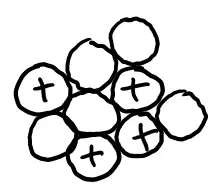
Identify the isotope of the given nucleus.

a)

fluorine-9

b)

beryllium-9

c)

boron-9

d)

lithium-9

60.

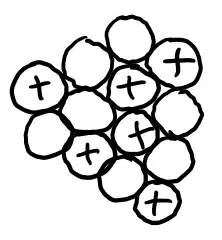
Identify the isotope of the given nucleus.

a)

boron-13

b)

carbon-13

c)

aluminum-13

d)

nitrogen-13