Wayground logo

Free Printable Worksheets

Font size

S
M
L
XL
Worksheets

Ch.27 The Importance of Plants and Plant Cells

Total questions: 50

Worksheet time: 29mins

Name
Class
Date
1.

Plants are really important for the planet and for all living things.

a)

True

b)

False

2.

Plants absorb _______ and release _______ from their leaves.

a)

carbon dioxide; oxygen

b)

oxygen; carbon dioxide

3.

We can also make clothes from plants like cotton.

a)

True

b)

False

4.

Garlic and ginger plants are used to make ___________.

a)

Medicines

b)

Oils

c)

Perfumes

d)

Spices

5.

Plants give us

a)

Food

b)

Wood

c)

Medicine

d)

All of the above

6.

The substance in plants that traps light to prepare food from water and carbon dioxide is called

a)

photosynthesis

b)

chlorophyll

c)

nutrition

d)

leaves

7.

Seed need the following factors to grow

a)

soil

b)

right temperature

c)

light

d)

air

8.

Plants are important to humans because....

a)

provides shade

b)

produces oxygen and takes in carbon dioxide

c)

has lovely flowers for beautification

d)

All of the above

9.

Some plants are medicinal

a)

true

b)

false

10.
Plants have ways of getting their seeds to travel away from them because ______.
a)
they want to help animals.
b)
seeds that travel away from the parent are more likely to get light.
c)
seeds need water to grow.
11.

Aloe Vera is an example of a medicinal plant.

a)

True

b)

False

12.

What can we make from plants?

a)

cars

b)

thread

c)

computers

d)

fridges

13.

What do we use as food?

a)

tyres

b)

fruit and vegetables

c)

cotton

d)

perfum and cosmetics

14.

what can we get from some trees?

a)

rubber

b)

cauliflower

c)

beans

d)

bush

15.

What can we make from wood?

a)

vegetables

b)

lorries

c)

paper and cards

d)

fruit

16.

we make.... from wheat.

a)

paper

b)

cosmetics

c)

flour

d)

rubber

17.

we use wood from tree trunks to make...

a)

furniture

b)

perfume

c)

fruit

d)

bread

18.

cereals

a)

rice,wheat 🌾

b)

gram

c)

curry leaves

19.

Name the medicine used to treat malaria:

a)

funnel

b)

Quinine

c)

cough syrup

d)

Cinchona

20.

Digitalis is used to treat cancer

a)

True

b)

False

21.

Plants are important in the cycling of both organic and inorganic nutrients

a)

True

b)

False

22.

What food flavorings are tropical and come from plant parts other than leaves

a)

Spices

b)

Herbs

c)

Nuts

d)

Cereals

23.

Undesirable plants that can crowd out crop plants or native plant species are called

a)

legumes

b)

weeds

c)

cultivars

d)

pesticides

24.

The part of the plant that usually contains seeds is a

a)

vegetable

b)

legume

c)

nut

d)

fruit

25.

The study of the interactions between plants and the environment is called

a)

agriculture

b)

botany

c)

plant ecology

d)

cultivar

26.

chemicals that kill undesirable organisms that may harm crops are

a)

pesticides

b)

aspirin

c)

fertilizers

d)

quinine

27.

Hay fever is an allergic reaction that causes sneezing, runny nose, and watering eyes

a)

True

b)

False

28.
The green pigment in plants is due to the presence of 
a)
chlorophyll
b)
Chlorine
c)
Chlorophyta
d)
chromatophores
29.
What two molecules are needed for photosynthesis to occur?
a)
oxygen and water
b)
CO2 and water
c)
glucose and water
d)
CO2 and glucose
30.

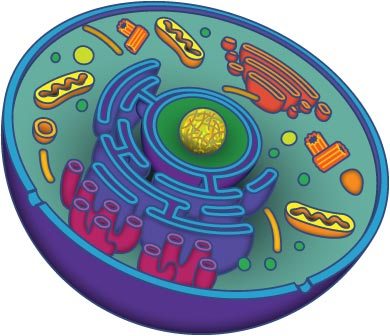
What kind of cell is this?

a)

animal cell

b)

bell bell

c)

plant cell

d)

vacuole

31.
What is the function of the Stomata?
a)
Gas exchange 
b)
Transpiration
c)
Water regulation
d)
all of these 
32.

What do you call the additional layer around the outside of plant cells that is made from cellulose that protect and give shape?

a)

Cell Wall

b)

Chloroplast

c)

Cell Membrane

d)

Golgi Complex

33.
Storage of food, water, wastes, and enzymes.
a)
Vacuole
b)
Mitochondria
c)
Cell Membrane
d)
Cytoplasm
34.
Converts stored food into energy.
a)
Mitochondria
b)
Cell Wall
c)
Chloroplast
d)
Ribosome
35.
Produces proteins
a)
Ribosome
b)
Nucleus
c)
Cytoplasm
d)
Endoplasmic Reticulum
36.
Package and transport proteins from the cell
a)
Golgi Complex (body)
b)
Endoplasmic Reticulum
c)
Ribosome
d)
Mitochondria
37.
Transport system within the cell
a)
Endoplasmic Reticulum
b)
Nucleolus
c)
Cytoplasm
d)
Vacuole
38.
Plant cell structures that turn energy from sunlight into food.
a)
Cell Wall
b)
Mitochondria
c)
Chloroplast
d)
Cytoplasm
39.
All living things are made up of...
a)
cells
b)
cell tissues
c)
organ
d)
organ systems
40.
All existing cells are produced by other
a)
living cells
b)
dead cells
c)
atom cells
d)
animal cells
41.
Which statement is NOT true?
a)
All plants are made of cells. 
b)
All animals are made of cells. 
c)
Cells can be seen with the naked eye.
d)
Animals and plants have different types of cells. 
42.
Control center of the cell (like a brain)
a)
Nucleus
b)
Nucleolus
c)
Cytoplasm
d)
Endoplasmic Reticulum
43.
Controls what enters and leaves the cell
a)
Cell Membrane
b)
Ribosome
c)
Chloroplast
d)
Vacuole
44.
Controls cell reproduction and makes ribosomes
a)
Nucleolus
b)
Nucleus
c)
Golgi Complex (body)
d)
Chloroplast
45.
What am I?
a)
cell wall
b)
mitochondria
c)
cytoplasm
d)
chloroplast
46.
What am I?
a)
vacuole
b)
ribosome
c)
endoplasmic reticulum
d)
golgi apparatus
47.
What cell part is NOT found in all cells?
a)
Cell Wall
b)
Cell Membrane
c)
Cytoplasm
d)
Genetic Material
48.
The picture illustrates a
a)
Prokaryotic Plant Cell
b)
Prokaryotic Animal Cell
c)
Eukaryotic Plant Cell
d)
Eukaryotic Animal Cell
49.

What are plant cells made of?

a)

Cell wall, cell membrane, cytoplasm, nucleus, and chloroplasts

b)

Stem, leaves, green, petals, flowers

c)

Photosynthesis, membranes, arms, and legs

d)

Jello, bodyguards, fences, and brains

50.

Houses gel-like fluids that support cell organelles and holds them in place.

a)

cytoplasm

b)

endoplasmic reticulum (e.r.)

c)

golgi bodies

d)

nucleus