wayground logo

Free Printable Worksheets

Font size

S
M
L
XL
Worksheets

3 Weeks Exam Photosynthesis/Cellular Respiration/DNA

Total questions: 48

Worksheet time: 53mins

Name
Class
Date
1.

Which is not a reactant (left side) needed for producing food in a green plant.

a)

Carbon Dioxide

b)

Water

c)

Oxygen

d)

Sunlight

2.

What part of the leaf is responsible for absorbing the sun’s energy?

a)

Cell Wall

b)

Veins

c)

Chlorophyll

d)

Nucleus

3.

The stoma on the underside of the leaf allows ___________ to move in and out of the leaf.

a)

Gases

b)

Water

c)

Nutrients

d)

Soil

4.

Sun’s radiant energy falls under which part of the electromagnetic spectrum?

a)

Ling-Waves

b)

Gamma Rays

c)

Visible Light

d)

X-Rays

5.

Photosynthesis happens both during the day and night in plants.

a)

True

b)

False

6.

What do plants need for the photosynthesis process?

a)

soil, air, and oxygen

b)

light, carbon dioxide, and water

c)

roots, flowers, and bees

d)

camera and a tripod

7.

What are the products of photosynthesis?

a)

carbon dioxide and glucose

b)

oxygen and glucose

c)

water and carbon dioxide

d)

oxygen and carbon dioxide

8.

__________ energy from the sun is changed into __________ energy during photosynthesis

a)

Electrical, Light

b)

Chemical, Light

c)

Physical, Chemical

d)

Light, Chemical

9.

Which of the following is the correct equation for PHOTOSYNTHESIS?

a)

CO2 + O2 + H2O --> Light+ Sugar

b)

O2 + light + H2O --> CO2 + Sugar

c)

CO2 + light + H2O --> O2 + Sugar

d)

CO2 + sugar + H2O --> O2 + light

10.

If all four plants were watered daily but placed in a closet, receiving no sunlight, what process would NOT occur?

a)

Photosynthesis

b)

Respiration

c)

Water absorption

d)

Ingestion of Carbon Dioxide

11.

Which gas is removed from the atmosphere during photosynthesis?

a)

Argon

b)

Oxygen

c)

Methane

d)

Carbon Dioxide

12.
What is the correct equation for cellular respiration?
a)
6O2 + C6H12O6 -> 6CO2 + 6H2O + Energy
b)
6O2 + C6H12O6 + Energy -> 6CO2 + 6H2O
c)
6CO2 + 6H2O -> 6O2 + C6H12O6 + Energy
d)
6CO2 + 6H2O + Energy -> 6O2 + C6H12O6
13.
What does metabolism mean?
a)
Converting energy into food
b)
Making light reactions happen
c)
Converting food into energy
14.
In which way are photosynthesis and cellular respiration different?
a)
Cellular respiration stores ATP, while photosynthesis releases ATP.
b)
Cellular respiration produces oxygen, while photosynthesis uses oxygen.
c)
Photosynthesis releases energy, while cellular respiration stores energy.
d)
Photosynthesis uses carbon dioxide, while cellular respiration produces carbon dioxide.
15.
After intense activity, your muscles feel sore because of 
a)
the accumulation of NAD+
b)
the accumulation of lactic acid 
c)
the accumulation of ATP
d)
the accumulation of carbon dioxide
16.
In cellular respiration, the electron transport chain takes place in
a)
the membrane of the mitochondrion
b)
the folds of the mitochondrion
c)
the cytoplasm
d)
the cell nucleus
17.
Fermentation enables glycolysis to continue under 
a)
anaerobic conditions
b)
aerobic conditions
c)
photosynthetic conditions
d)
hydrophobic conditions
18.

Which organism go through cellular respiration?

a)

animals

b)

plants

c)

both animals and plants

d)

none

19.

Cellular Respiration occurs in what cell organelle?

a)

chloroplast

b)

cytoplasm

c)

mitochondria

d)

animal

20.

What type of respiration requires oxygen?

a)

Aerobic

b)

Anaerobic

21.

Select ALL the products of Cellular Respiration? *clue: 3*

a)

oxygen

b)

glucose

c)

carbon dioxide

d)

water

e)

ATP (energy)

22.
Which organ excretes carbon dioxide?
a)
Lungs
b)
Liver
c)
Heart
d)
Kidney
23.
What is cellular respiration?
a)
the breakdown of glucose  to release ATP
b)
the breakdown of glucose to release NADH
c)
the breakdown of glucose to release FADH
d)
the breakdown of glucose to release carbon
24.
What is the purpose of cellular respiration?
a)
To turn energy from the sun into glucose
b)
To turn oxygen into glucose
c)
To turn ATP into glucose
d)
To turn glucose into energy in the form of ATP
25.

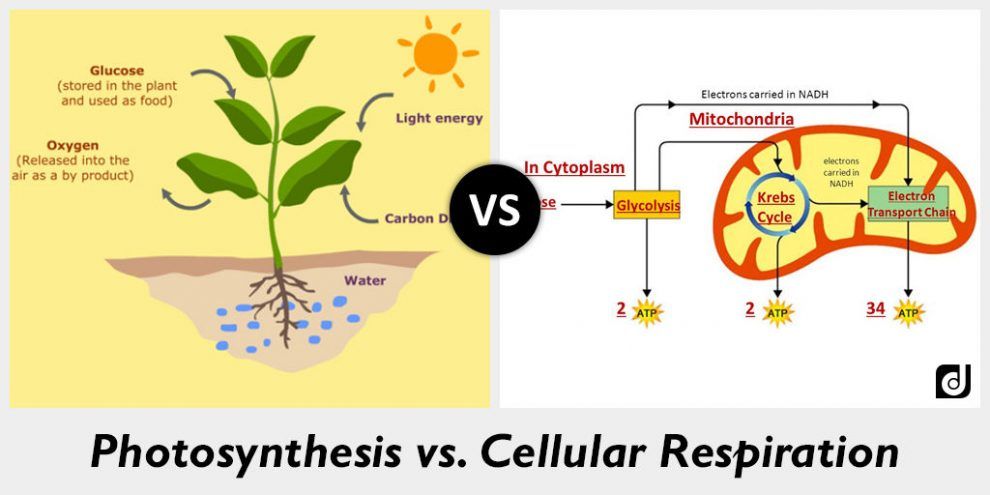
Which of these most accurately shows the relationship between photosynthesis and cellular respiration?

a)
b)
c)
d)
26.

Organisms that cannot make their own food and must obtain energy from external sources are called

a)

autotrophs

b)

heterotrophs

c)

plants

d)

producers

27.

Animals are very active and require large amounts of energy to move. The cells and tissues used for movement most likely have _______________ mitochondria when compared to other cells.

a)

less

b)

more

c)

the same

d)

missing

28.
Which of the following best describes a DNA molecule?
a)
double helix
b)
contains ribose
c)
made of amino acids
d)
contains Uracil
29.
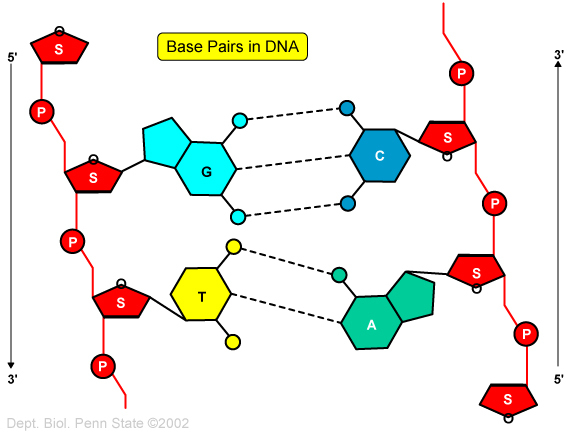
Which 2 molecules form the sides (backbone) of the DNA ladder?
a)
deoxyribose sugar and adenine
b)
deoxyribose sugar and a hydrogen bond
c)
deoxyribose sugar and the nucleus
d)
deoxyribose sugar and phosphate
30.
Nitrogenous bases are joined by which type of bond?
a)
polar bonds
b)
ionic bonds
c)
covalent bonds
d)
hydrogen bonds
31.
What does DNA stand for?
a)
Deoxyribonucleic acid
b)
Denitrogenous acid
c)
Deribonucleic acid
d)
Diribonucleic acid
32.
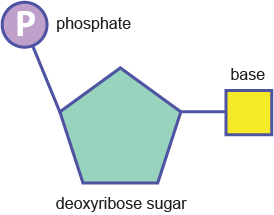
Nucleotides are made up of a sugar, phosphate, and..?
a)
nitrogenous base
b)
nucleic acid
c)
cholesterol
d)
fatty acid
33.
Guanine bonds with ______________.
a)
Adenine
b)
Guanine
c)
Cytosine
d)
Thymine
34.
Which of the following units are repeatedly joined together to form a strand of DNA? (This is the MONOMER of DNA.) 
a)
amino acids
b)
nucleotides
c)
fatty acids
d)
polysaccharides
35.
Which sequence of DNA bases would pair with this partial strand
ATG TGA CAG
a)
ATG TGA CAG
b)
TAC ACT GTC
c)
GTA AGT GAC
d)
CAT TCA CTG
36.
What are the 4 nitrogen bases?
a)
adenine, thymine, cytoplasm, and guanine
b)
adenine, thymine cytosine, and guanine
c)
adenine, thymine, cytosine, and gylcerol
d)
adenine, thymine, cytosine, and glucose
37.
order of replication
a)
3, 4, 2, 1
b)
3, 1, 4, 2
c)
2, 1, 4, 3
d)
3, 4, 1, 2
38.
DNA replication results in two DNA molecules,
a)
each one with two original strands
b)
each one with two new strands
c)
each one with one new strand and one original strand
d)
one with two new strands and the other with two original strands
39.
A process in which DNA has the unique ability to make an exact copy of itself.
a)
Replication
b)
Translation
c)
Transcription
40.
Which enzyme is responsible for adding nucleotides?
a)
Topoisomerase
b)
DNA Polymerase
c)
Ligase
d)
Primase
41.
A nucleotide includes...?
a)
pentose sugar
b)
nitrogenous base
c)
phosphate group
d)
all of the above
42.
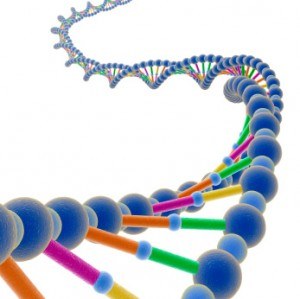
What is this image showing?
a)
DNA
b)
Chromosome
c)
Alleles
d)
Phenotype
43.

Which DNA enzyme seals small gaps to finish DNA replication?

a)

Helicase

b)

DNA polymerase

c)

Primase

d)

Ligase

44.

Which enzyme is responsible for adding bases?

a)

Topoisomerase

b)

DNA Polymerase

c)

Ligase

d)

Primase

45.
The enzyme that unzips the DNA to prepare for replication
a)
helicase
b)
replicase
c)
polymerase
d)
synthase
46.

DNA is called the "blueprint of life" because

a)

it is like a fingerprint

b)

it has a blue color

c)

it contains the plans for building an organism

d)

it can relay messages to other molecules

47.
For what reason does DNA copy itself?
a)
to replace worn out DNA
b)
so cells can divide
c)
to export DNA to other parts of the body
d)
more DNA is better
48.

I'm totally confident about the exam tommorow.

a)

Agree

b)

Sort of Agree

c)

Disagree

d)

Completely Disagree