wayground logo

Free Printable Worksheets

Font size

S
M
L
XL
Worksheets

Biology Review

Total questions: 45

Worksheet time: 1hrs 1mins

Name
Class
Date
1.
What is the function of a carbohydrate?
a)
Stores energy
b)
Movement
c)
Stores genetic information
d)
Speeds up reactions
2.
Which biomolecule is often stored in the body's tissues as energy?
a)
proteins
b)
carbohydrates
c)
lipids
d)
nucleic acids
3.
What is the monomer of proteins?
a)
amino acids
b)
polypeptides
c)
nucleotides
d)
monosaccharides
4.
DNA and RNA are examples of...
a)
proteins
b)
nucleic acids
c)
carbohydrates
d)
lipids
5.

Which of the following structures is ALWAYS found in both eukaryotic and prokaryotic cells?

a)

nucleus

b)

mitochondria

c)

ribosomes

d)

cell wall

6.

Bacteria is an example of a(n)

a)

prokaryotic cell.

b)

eukaryotic cell.

7.

Which does only eukaryotic cells contain?

a)

nucleus

b)

DNA

c)

cell membrane

d)

ribosomes

8.
 Breaks down excess or worn out cell parts and food particles. Often call the “recyclers of the cell  
a)
Vacuole 
b)
Lysosome
c)
Chloroplasts
d)
Nucleus
9.
Looks like a maze of passageways. This organelle produces many substances and is always found surrounding the nucleus. The rough parts of this organelle ribosomes stick to.
a)
Golgi Apparatus
b)
Mitochondria
c)
Endoplasmic reticulum
d)
Cell Wall
10.

The movement of particles from an area of high concentration to an area of low concentration

a)

active transport

b)

osmosis

c)

diffusion

d)

random movement

11.

The movement of materials that requires energy is called...

a)

active transport

b)

passive transport

c)

massive transport

d)

proactive transport

12.

If there is 5 percent water inside a cell and 5 percent water outside a cell

a)

more water will move inside the cell

b)

more water will move outside the cell

c)

There will be no net movement of water, it moves into and out of the cell at the same time.

13.

Where does photosynthesis take place?

a)

mitochondria

b)

nucleus

c)

chloroplast

d)

ribosome

14.

What are the outputs (products) of photosynthesis?

a)

carbon dioxide and water

b)

glucose and oxygen

c)

glucose and carbon dioxide

d)

water and oxygen

15.

Where does cellular respiration take place?

a)

chloroplast

b)

lungs

c)

mitochondria

d)

nucleus

16.

What are the outputs (products) of cellular respiration?

a)

glucose, oxygen, and energy

b)

carbon dioxide, water, and energy

c)

water, oxygen, and glucose

d)

water and energy

17.

Chemosynthesis is the

a)

conversion of carbon into sugars and nutrients by bacteria in dark places. They use hydrogen gas, hydrogen sulfide and methane gas as a source of energy, relies on sunlight.

b)

conversion of carbon into sugars and nutrients by bacteria in dark places. They use hydrogen gas, hydrogen sulfide and methane gas as a source of energy, rather than sunlight.

c)

conversion of carbon into sugars and nutrients by bacteria in dark places. They use hydrogen gas, hydrogen sulfide and methane gas as a source of energy, with little to no sunlight.

d)

conversion of carbon into sugars and nutrients by bacteria in dark places. They use hydrogen gas, hydrogen sulfide and methane gas as a source of energy, with some sunlight.

18.
What are the nucleotides made of?
a)
Sugar, Phosphate, nitrogen base
b)
Phosphate, Adenine, nitrogen base
c)
Thymine, Adenine, Cytomine
d)
Phosphate, Nitrogen, Adenine
19.
Which sequence of DNA bases would pair with this partial strand
ATG TGA CAG
a)
ATG TGA CAG
b)
TAC ACT GTC
c)
GTA AGT GAC
d)
CAT TCA CTG
20.
Which shows the correct complementary base pairing for DNA?
a)
C-A, T-G
b)
A-G, C-T
c)
C-G, U-A
d)
T-A, G-C
21.
What is the difference between DNA and RNA in terms of bases?
a)
RNA contains uracil in place of thymine
b)
RNA contains uracil in place of adenine
c)
RNA contains uracil in place of guanine
d)
RNA contains uracil in place of  cytosine
22.

Which of the following is the complementary mRNA sequence to this DNA strand: AACTGAA

a)

UUGACUU

b)

TTGACTT

c)

AACTGAA

d)

AACUGAA

23.
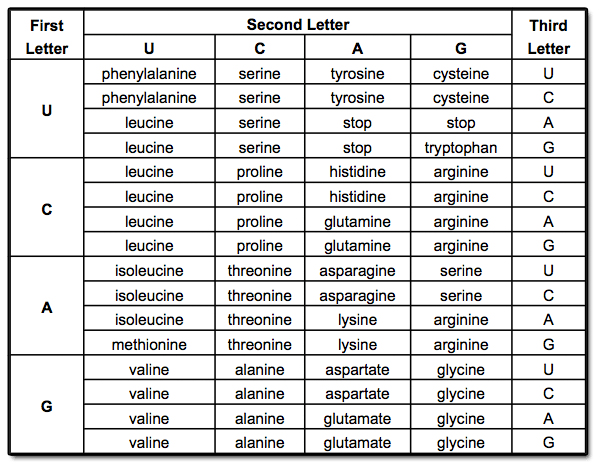
What amino acid is represented by the codon UUA?
a)
Phenylalanine
b)
Tyrosine
c)
Leucine
d)
Stop codon
24.
What mutation has occurred here? 
T-G-A-C-C-A
T-G-A-G-C-A
a)
Substitution
b)
Deletion
c)
Insertion
d)
Frameshift 
25.
Which of the following would result in a frameshift mutation?
a)
Insertions only
b)
Substitution only
c)
Deletion only
d)
Insertions and Deletions
26.
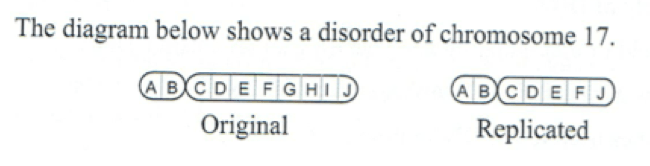
What type of chromosomal mutation has occurred?
a)
substitution
b)
insertion
c)
deletion
d)
nondisjunction
27.

Genetic mutations can be...

a)

beneficial, harmful, or neutral

b)

beneficial only

c)

harmful only

d)

neutral only

28.
Homozygous is when...
a)
the alleles are the same
b)
the alleles are different
c)
the alleles are absent
d)
the alleles are present
29.
Heterozygous is when...
a)
the alleles are the same
b)
the alleles are different
c)
the alleles are absent
d)
the alleles are present
30.
T - tall and t = short
In the punnett square below, what belongs in the missing square
a)
tt
b)
Tt
c)
Bb
d)
TT
31.
A calico cat shows both the traits for orange fur and black fur. What kind of allele expression is this?
a)
Incomplete Dominance
b)
Co dominance
c)
Independent assortment
d)
Recessive inheritance
32.
A red flowered plant (RR) breeds with a White flowered plant (WW). The gene for petal color in these plants expresses incomplete dominance.  What percentage of the offspring will have pink (RW) flowers?
a)
0%
b)
25%
c)
50%
d)
100%
33.

Labrador retriever's fur color is an example of epistasis. In this case the E gene controls the expression of the B gene. It a puppy was born with the genotype eeBB its fur color would be ________ and if it was born with the genotype EEbb it would be __________

a)

yellow, yellow

b)

yellow, black

c)

chocolate, black

d)

yellow, chocolate

34.

This is when multiple genes code for a single trait

a)

Polygenic

b)

Pleiotropy

c)

Linked genes

d)

Codominant genes

35.
The visual representation of an individual's chromosomes is a 
a)
phenotype
b)
genotype
c)
karyotype
d)
stereotype
36.
Hemophilia is a recessive x-linked disorder.
Which genotype represents a female who is a carrier for hemophilia?
a)
XHXh
b)
XhXh
c)
XHXH
d)
XhY
37.
What percentage of the female offspring will be a carrier for this recessive disease?
a)
0%
b)
50%
c)
100%
d)
25%
38.

A personal with type AB blood has which genotype?

a)

type A

b)

AA

c)

IAIA

d)

IAIB

39.
In a dihybrid cross
a)
one trait is crossed.
b)
two traits are crossed.
c)
four boxes are needed for the punnett square.
d)
mom's alleles are dominant.
40.
Using the dihybrid cross and key provided, what is the probability of the offspring being tall and white?
a)
9
b)
2
c)
3
d)
6
41.

This laboratory procedure is known as

a)

CLONING

b)

gel electrophoresis

c)

chromatography

d)

use of a dichotomous key

42.

The parents of a new baby believe they brought the wrong child home from the hospital. Gel electrophoresis was performed using DNA samples from the parents and the child. A section of the gel

electrophoresis results is shown below. Which conclusion is valid based on the gel electrophoresis results?

a)

They have the correct child, because her genetic information is identical to that of the father.


b)

They have the wrong child, because her genetic information does not match that of either parent.

c)

They have the correct child, because her genetic information came from both parents.


d)

They have the wrong child, because her genetic information matches only that of the mother.

43.
How does embryology support the Theory of Evolution?
a)
It shows that they have a common ancestor because of their similarities.
b)
         I'm not sure.
c)
Animals change over time. 
44.

What type of evidence is represented in the picture above:

a)

Fossils

b)

Vestigial Structures

c)

DNA

d)

Homologous Structures

45.

What type of evidence is shown in the image above?

a)

Fossils

b)

Vestigial structures

c)

Homologous Structures

d)

DNA