
 Worksheets
Chapter 10: Transport In Humans & Animals
Total questions: 60
Worksheet time: 50mins
Which type of cell is found in the greatest numbers in blood?
Red blood cell
White blood cell
Platelets
How do you calculate surface area to volume ratio?
Surface area / volume
Surface area - volume
Surface area + volume
What is the name of the liquid part of the blood?
Platelets
Plasma
Red blood cells
What do platelets do?
They stick together and make fibres that make scabs (blood clots) that stop pathogens entering the blood or stop you bleeding to death.
They form your immune system and destroy pathogens.
They carry oxygen around the body attached to haemoglobin.
What other names are given to red blood cells and also white blood cells?
Red blood cell = Lymphocytes
White blood cell = Erythrocytes
Red blood cell = Erythrocytes
White blood cell = Leucocytes
Red blood cell = Erythrocytes
White blood cell = Phagocytes
What do phagocytes do?
Engulf (surround) microbes and digest them.
Produce antibodies.
Release a toxin that kills pathogens.
Why do arteries have a thick muscle layer?
To provide energy for the blood vessel.
To prevent the blood flowing backwards.
To help withstand the high pressure blood, also to contract to control blood flow.
Why do veins and the heart have valves?
To stop the backflow of blood
To contract to push the blood under high pressure
To cause the pulse

The photograph shows two blood cells, X and Y.
What are the functions of cells X and Y?
cell X: carries out phagocytosis
cell Y: carries oxygen
cell X: carries oxygen
cell Y: produces antibodies
cell X: carries oxygen
cell Y: carries carbon dioxide
cell X: produces antibodies
cell Y: carries oxygen

The diagram shows human blood as seen through a light microscope.
A person’s blood is unable to clot.
Which component of the blood is not functioning properly?
A
B
C
D
Which chamber of the heart has the most muscular wall?
left atrium
left ventricle
right atrium
right ventricle
A deficiency in which of the following may result in a person’s blood failing to clot properly?
antibodies
fibrinogen
haemoglobin
protease

The diagram shows the vessels associated with the flow of fluids to and from body cells.
Which is the lymph vessel?
A
B
C
D
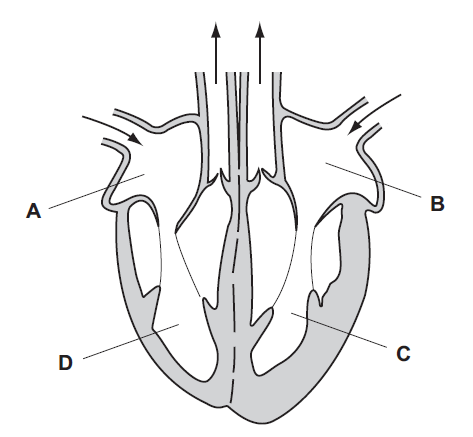
The diagram shows the directions of blood flow through a heart.
Which chamber of the heart receives blood directly from the lungs?
A
B
C
D
Fish have a ____ chambered heart?
4
3
2
1
An open circulatory system is one that has:
no difference between haemolymph and tissue fluid
no heart to pump the haemolymph
no vessels at all to carry haemolymph

this is an open circulatory system
this a closed circulatory system
this is a xylem
this is a phloem
this is a blood
Which one of them has an open circulatory system?
human
insect
earth worm
bird
mammal
Which one of them has a closed circulatory system?
insect
mollusk
spider
mammal
Which of the vertebrates have the blood flow through the heart twice?
reptiles
birds
amphibians
fish
How many chambers in the amphibians' heart?
one
two
three
four
Oxygenated blood and deoxygenated blood of amphibians are mixed together in the heart.
True
False
In fish, the blood that leaves the heart will travel to which part of the body?
brain
dorsal fin
stomach
gills

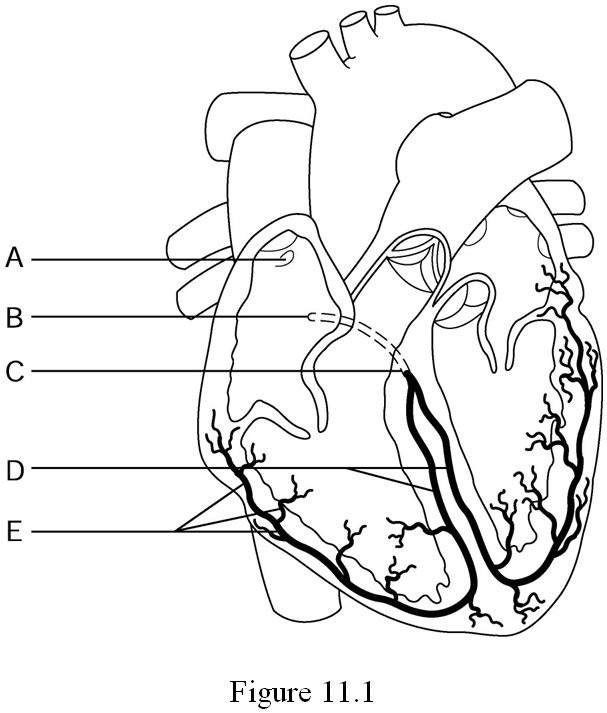
Last to receive electrical impulses resulting in the contraction of ventricles:
AV node
Purkinje fibers
SA node
AV bundle/bundle of His
Structure that creates the electrical signals for the conduction process:
SA node
AV node
Purkinje fibers
bundle of His/AV bundle
Place the following in the correct order:
1.atria contract
2.AV node
3.bundle of His/AV bundle
4.Purkinje fibers
5.SA node
6.ventricles contract
5, 1, 2, 3, 4, 6
2, 1, 5, 3, 4, 6
5, 6, 2, 3, 4, 1
2, 6, 5, 3, 4, 1
Which of the following is the importance of blood clotting? Choose your answers.
Prevent excessive blood lost
Prevent the entry of pathogen into the blood vessels
Prevent the dropping of blood pressure.
Prevent the entry of oxygen into the blood
Name the blood cell and plasma protein that is responsible in blood clotting mechanism.
Leucocytes
Platelets
Albumin
Fibrinogen
Erythrocytes
What are THREE substances required to convert prothrombin into thrombin.
Thrombokinase
Fibrinogen
Calcium ions
Vitamin K
Albumin
What substance is needed to convert fibrinogen to fibrin?
Thrombokinase
Thrombin
Prothrombin
Thrombus
Why fibrin mesh is important in blood clotting mechanism?
To attract more platelets.
To attract more erythrocytes.
To destroy pathogens.
To prevent erythrocytes from flowing out.
Ariana lack of clotting factors that cause her blood to unable to clot when she is having a cut.
Name this disease.
Haemophilia
Talasemia
Thrombosis
Embolism
Blood clot can be formed within the artery and prevents blood from flowing normally through the circulatory system.
What is this disease.
Heamophilia
Talasemia
Embolism
Thrombosis

Name this mesh that formed to trap erythrocytes as shown in diagram.
Thrombin mesh.
Fibrin mesh.
Scab
Andmesh Kamaleng
After being exposed to the air and hardened, fibrin mesh will form .................
cut
scabs
plaque
agglutination
Which one is correct about blood group AB?
Individuals with blood group AB and have only B antigen
Individuals with blood group AB have both A and B antigens
Individuals with blood group AB do not have both A and B antigens
The donor's blood must be compatible with the recipient's blood. This is important to prevent ___
Precipitation
Phagocytosis
Transfusion
Coagulation
Blood group B can donate blood to ...
A, AB
B, AB
AB only
A, B, AB and O
Which statement is correct
An individual who has type B blood can receive types A blood.
An individual who has type AB blood cannot receive types B blood
An individual who has type O blood cannot receive any other blood.
which blood group do not have antigen?
A
B
AB
O
Which blood group do not has antibody?
A
B
AB
O
A person can receive blood or not depends on the presence of ____________ in his blood plasma
antibody
antigen
Someone with Type A blood also has...
Type A antibodies
Type B antibodies
both Type A & B antibodies
neither Type A nor B antibodies
Someone with both Type A & B antibodies is which blood type?
A
B
AB
O
A substance on the surface of red blood cells that can trigger the production of antibodies
agglutinates
antigens
anemia
Rh Factor
Another term for the Rh factor...
Rhesus monkey
red blood cell
D antibody
D antigen
This determines whether a person's blood type is positive or negative...
Rh factor
platelets
D antibodies
plasma
Which could be in danger of a blood disorder if a mother and fetus had differing Rh factors?
the mother
the fetus during the first pregnancy
the fetus during the second pregnancy
the father
Which blood type is known as the universal donor? (can be used by all)
AB +
AB -
O+
O-
What is the term used for watery fluid inside the lymphatic vessels?
Plasma
Lymph
Blood
How is lymph moved through lymphatic vessels?
Contractions of skeletal muscle around the vessels
Blood cells carry lymph through the vessels
Contractions of the heart
If the valves in the lymphatic vessels stopped working, how would this affect the body?
Tissue fluid would flow backwards, potentially causing edema, or tissue fluid build-up
It would have no effect, because muscle action would still keep fluid flowing
There are no valves in the lymphatic vessels
Tissue fluid would flow too quickly, causing a heart attack due to the increased fluid flow to the heart
Where does lymph come from?
Leaked blood plasma
Special lymph-producing ducts
Glands in your elbow

