
 Worksheets
Gene to Protein
Total questions: 56
Worksheet time: 41mins
Name
Class
Date
1.
Where is the DNA found within a eukaryotic cell?
a)
nucleus
b)
nucleolus
c)
cytoskeleton
d)
golgi
2.

Which of the following best describes a DNA molecule?
a)
double helix
b)
contains ribose
c)
made of amino acids
d)
contains Uracil
3.
Which 2 molecules forms the sides (backbone) of the DNA ladder?
a)
deoxyribose and adenine
b)
deoxyribose and a hydrogen bond
c)
sugar and the nucleus
d)
deoxyribose (sugar) and phosphate
4.
DNA contains the following bases:
a)
adenine, thymine, glucose, and cytosine
b)
adenine, uracil, guanine, and cytosine
c)
adenine, thymine, guanine and cytosine
d)
adenine, uracil, glucose, and cytosine
5.
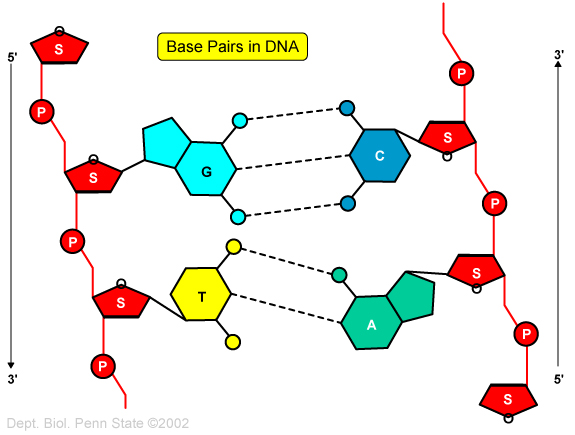
Nitrogen bases are joined together by which type of bond?
a)
slow-curing epoxy bonds
b)
unbreakable hydrogen bonds
c)
weak hydrogen bonds
d)
fast-curing epoxy bonds
6.
Adenine bonds with ______________ in DNA.
a)
Guanine
b)
Thymine
c)
Cytosine
d)
Adenine
7.
Guanine bonds with _______ in DNA.
a)
Adenine
b)
Guanine
c)
Cytosine
d)
Thymine
8.

Which process is shown?
a)
translation
b)
transcription
c)
mitosis
d)
replication
9.
This molecule may never leave the nucleus for fear of it being damaged.
a)
DNA
b)
RNA
c)
Both
10.
How did Rosalind Franklin's work contribute to Watson and Crick's discovery of DNA in 1953?
a)
It was used to determine the physical structure of DNA
b)
It was used to identify the four bases that make up DNA
c)
It was used to determine the theory of independent assortment
d)
It was used to show DNA was the molecule of inheritance
11.
Replication means to ___.
a)
understand
b)
divide in half
c)
copy
d)
none of the above
12.

Replicate the following strand of DNA:
AATCATGGA
AATCATGGA
a)
AATCATGGA
b)
TTAGTACCT
c)
UUAGUACCU
d)
GGATAUCUA
13.

Why is it be important to replicate DNA before a cell divides in mitosis or meiosis?
a)
In order for the DNA to be contained in the nucleus.
b)
In order for the cell to be able to increase in size.
c)
So each new cell receives the appropriate amount of genetic information.
d)
In order for the cell to re-order the DNA sequencing in the new cells.
14.

DNA is the template for making RNA during the process of ___.
a)
replication
b)
transcription
c)
translation
d)
trick question -- none of these apply
15.

During transcription, uracil forms base pairs with ___.
a)
thymine
b)
adenine
c)
cytosine
d)
guanine
16.
Guanine bonds with ____ in RNA.
a)
thymine
b)
uracil
c)
cytosine
d)
adenine
17.
The type of RNA that carries instructions from a gene for making a protein, to the cytoplasm, is
a)
mRNA
b)
rRNA
c)
tRNA
d)
snRNA
18.

The type of RNA that moves amino acids to the ribosome to make proteins is _.
a)
mRNA
b)
rRNA
c)
tRNA
d)
snRNA
19.
Fill in the complementary bases according to the base-pair rule in DNA: A T C C A G
a)
T U G G T C
b)
T A G G T C
c)
T A C G T G
d)
T A C C A C
20.
Fill in the complementary bases according to the base-pair rule in RNA: T A G C T A
a)
A U C G A U
b)
A T C G A T
c)
U T C G A U
d)
T U G C T A
21.
Transcription takes place in the
a)
cytoplasm
b)
chloroplast
c)
nucleus
d)
mitochondria
22.
Translation takes place in the
a)
ribosome
b)
chloroplast
c)
nucleus
d)
mitochondria
23.
This nucleic acid is single stranded.
a)
DNA
b)
RNA
c)
Both
24.

What amino acid is represented by the three-letter code UUA?
a)
Phenylalanine
b)
Tyrosine
c)
Leucine
d)
Stop codon
25.

What is the correct amino acid sequence for the RNA code AUGCCAGUAUGA
a)
Met-Pro-Val-Stop
b)
Met-Pro-Val-His
c)
Tyr-Gly-His-Stop
d)
Tyr-Gly-Arg-His
26.

How many amino acids exist in the human body?
a)
10
b)
20
c)
200
d)
50,000
27.

How many amino acids can your body make naturally?
a)
10
b)
12
c)
15
d)
20
28.
If the 10 nonessential amino acids are made naturally by the body, where do the other 10 essential amino acids come from?
a)
Amazon
b)
multi-vitamins only
c)
foods you eat
d)
none of the above
29.
Which of the following best describes how DNA and RNA are similar?
a)
they both contain A and T
b)
They both have a double helix
c)
They are both composed of 5 different nucleotides
d)
they both have C and G
30.
The DNA sequence ATCAGCGCTGGC is part of a gene. How many amino acids are coded for by this message?
a)
4
b)
8
c)
12
d)
20
31.
One human disease is caused by a change in one three-letter code in a gene from GAA to GUA. The disease is a result of ____.
a)
a mutation
b)
diffusion
c)
replication
d)
osmosis
32.

Which process is shown?
a)
mutation
b)
transcription
c)
mitosis
d)
translation
33.

Which process is shown?
a)
diffusion
b)
respiration
c)
recombination
d)
translation
34.
The building blocks of protein.
a)
genes
b)
amino acids
c)
mRNA
d)
chromosomes
35.
The process by which amino acids are assembled into proteins by ribosomes based on the instructions of RNA.
a)
mitosis
b)
meiosis
c)
replication
d)
protein synthesis
36.
What is the relationship between a protein, the cell, and DNA?
a)
DNA is produced by protein which is produced in the cell
b)
Protein is composed of DNA which is produced in the cell
c)
DNA controls the production of protein in the cell
d)
A cell is composed of DNA and protein
37.
An organic compound that is made up of amino acids and plays many important roles in living things.
a)
thymine
b)
guanine
c)
protein
d)
DNA
38.
Ribonucleic acid; a copy of DNA that is fed through a ribosome during protein synthesis.
a)
DNA
b)
RNA
c)
TNT
d)
DDT
39.

Which process is shown?
a)
mitosis
b)
protein synthesis
c)
fertilization
d)
meiosis
40.
Cell division that produces sex cells.
a)
protein synthesis
b)
mitosis
c)
meiosis
d)
transcription
41.
The sex cell that is produced during meiosis that has half the number of chromosomes as other body cells.
a)
zygote
b)
DNA
c)
RNA
d)
gamete
42.

Which process is shown?
a)
mitosis
b)
meiosis
c)
protein synthesis
d)
fertilization
43.
The joining of two gametes that produce a zygote.
a)
meiosis
b)
fertilization
c)
protein synthesis
d)
mitosis
44.

An egg cell that has been fertilized by a sperm cell.
a)
gamete
b)
zygote
c)
mRNA
d)
ribosome
45.
Meiosis in males results in gametes called _________.
a)
eggs
b)
testes
c)
ovary
d)
sperm
46.
Mitosis has ___ division(s). Meiosis has ___ division(s).
a)
1 ; 2
b)
2 ; 1
c)
1 ; 1
d)
2 ; 2
47.
What does meiosis in females results in?
a)
4 eggs
b)
3 eggs, 1 polar body
c)
2 eggs, 2 polar bodies
d)
1 egg, 3 polar bodies
48.
The end of meiosis results in ________ to each other.
a)
2 cells that are identical
b)
4 cells that are identical
c)
2 cells that are not identical
d)
4 cells that are not identical
49.
A human zygote should have _____ chromosomes.
a)
46
b)
23
c)
92
d)
64
50.
At the end of mitosis you have _____ cells
a)
identical
b)
different
c)
identical twins
d)
variety
51.
In males, meiosis occurs in the ___.
a)
mitochondria
b)
testes
c)
ovaries
d)
ribosomes
52.
In females, meiosis occurs in the ___.
a)
mitochondria
b)
testes
c)
ovaries
d)
ribosomes
53.

Which process is shown?
a)
mitosis
b)
protein synthesis
c)
fertilization
d)
meiosis
54.

Based on the following karyotype (a picture of chromosomes), the individual would be a ___.
a)
male (XY)
b)
female (XX)
55.
The 23rd pair of chromosomes are known as the ____ chromosomes.
a)
body
b)
duplicate
c)
sex
d)
evolutionary
56.
Using organisms to improve or develop other organisms for specific uses.
a)
biology
b)
cytology
c)
biotechnology
d)
paleontology
100 %

