
 Worksheets
Cell Transport
Total questions: 50
Worksheet time: 29mins
Diffusion & Facilitated Diffusion are both __________ transport.
Passive
Active
Easy
Free
Passive Transport is the movement of particles across the membrane from an area of [ ___ ] to an area of [ ___ ]
high to low
low to high
low to low
high to high
Passive Transport uses ____ energy
no
a lot of
a little bit of
some
_____________ is the free movement of particles across the membrane with the concentration gradient
diffusion
facilitated diffusion
active transport
fusion
Diffusion is the natural movement of molecules from:
Areas of low concentration to areas of high concentration
Areas of high concentration to areas of low concentration
Cold to hot environments
Gaseous to liquid environments
What causes diffusion?
The constant, random motion of molecules
Magnetic attraction between atoms
The nuclear forces that hold atoms together
The tendency of atoms to form chemical bonds with one another
From fastest to slowest rate of diffusion, which of the following is in the correct sequence?
Solids, liquids, gases
Liquids, gases, solids
Gases, liquids, solids
Gases, solids, liquids
Why is diffusion so important in biology?
It's the basic power source for most types of cells
It allows substances to move across cell membranes
It prevents toxins from entering our bodies
Without diffusion, cell division could not take place
What does a 'region with high concentration' mean?
An area with a SMALL number of particles
An area with a LARGE number of particles
An area with an UNEVEN number of particles
An area with no particles
An increase in temperature does what to diffusion?
Speeds it up
Slows it down
Nothing
Stops it all together
What is a solute?
A substance dissolved in another substance
the substance doing the dissolving
What is a solvent
The one doing the dissolving
The substance dissoved in another substance

Which diagram best shows the end result of diffusion?
F
G
H
J
Diffusion moves along the __________
concentration gradient
Avogadro's constant
conservation of energy
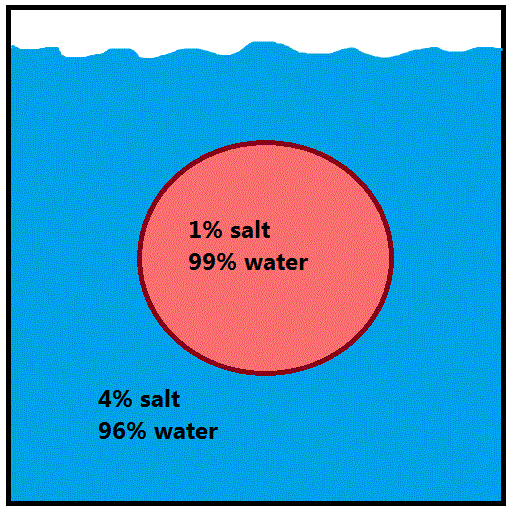

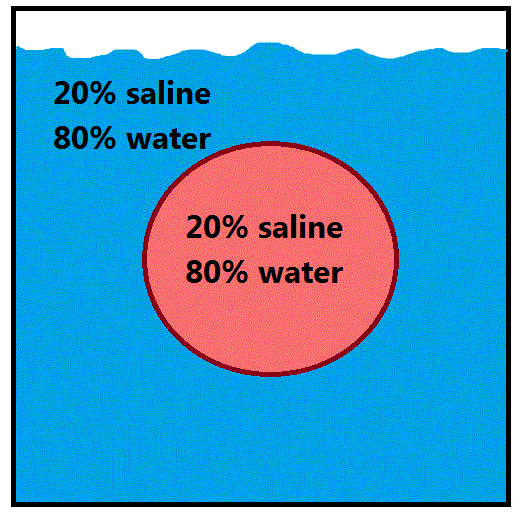
Active transport is the movement of large materials across a cell membrane from ______ to ______ concentration
high to low
low to high
high to high
low to low
Active transport across a cell membrane from low to high concentration, requires
energy (ATP)
no energy
water
oxygen
The girl sitting two rows ahead of you put on too much perfume this morning. Is this diffusion, osmosis or active transport?
diffusion
osmosis
active transport
You put raisins in a glass of water and they plump up. Is this diffusion, osmosis or active transport?
diffusion
osmosis
active transport

I. High surface area
II. Thin walls
III. Dry surfaces

Numerous fingerlike projections in the folds of the wall of the ileum is classified as
Bolus
Chyme
Bile
Villi
The majority of the absorption of nutrients into the bloodstream occurs in the _______.
Stomach
Small intestine
Large intestine
Liver

Identify the respiratory structures of the specimen shown
Operculum
Gills
Scales
Skin
Diffusion is faster across an exchange surface if the concentration gradient is…
less
increased
the same
moved
Gas exchange surfaces are usually very
thin
thick
wide
tall
All exchange surfaces are involved in the…
removal of wastes
uptake of nutrients
gas exchange
The transfer of materials across a membrane
The location for gas and nutrient exchange respectively is…
Alveoli & capillaries
Capillaries & alveoli
Villi & alveoli
Alveoli & villi
Exchange surfaces are moist because
substances travel better as a gas
substances can only travel as a solute
moist surfaces decreases the distance to travel
moist surfaces have a larger surface area
Alveoli and villi have a large surface area as
there is more time to diffuse more substances
there is more area for gas to move vis active transport
there is more area for exchange to occur
less area for exchange to occur

