wayground logo

Free Printable Worksheets

Font size

S
M
L
XL
Worksheets

DOK 1 EOC Review

Total questions: 79

Worksheet time: 2hrs 48mins

Name
Class
Date
1.
Is a virus considered living or non-living?
a)
Living
b)
Non-Living
c)
Neither
2.
Reasons that viruses are considered to be nonliving is because
a)
They are not cellular
b)
They cannot reproduce on their own
c)
They cannot make proteins
d)
all of the above
3.
cells with no nucleus are called
a)
prokaryotic
b)
eukaryotic
c)
dead
d)
alive
4.
All of the following are characteristics of all living things EXCEPT
a)
Respond to stimulus
b)
Grow and develop
c)
maintain homeostasis
d)
Movement
5.
Living things need energy to survive?
a)
True
b)
False
6.

Which type of specialized cell carries oxygen from the lungs all over the body?

a)

red blood cells

b)

squamous (skin) cells

c)

muscle cells

d)

white blood cells (macrophages)

e)

nerve cells (neurons)

7.

Which type of specialized cell has many mitochondria and changes size (contracts)?

a)

red blood cells

b)

squamous (skin) cells

c)

muscle cells

d)

white blood cells (macrophages)

e)

nerve cells (neurons)

8.
This cell is simple. Only genetic material, cytoplasm and ribosomes inside.
a)
Eukaryotic
b)
Prokaryotic
c)
Plant
d)
Animal
9.
This organelle's function is to make protein.
a)
Rough E.R.
b)
Smooth E.R.
c)
Ribosome
d)
Nucleus
10.
The function of this organelle is to break down food, worn out cell/cell organelles.
a)
Nucleus
b)
Vacuole
c)
Ribosome
d)
Lysosome
11.
The function of this organelle is to store water. Large ones are found in plants. 
a)
Lysosome
b)
Golgi Body
c)
Cytoplasm
d)
Vacuole
12.
This specialized cell does not contain a nucleus to allow for transport of oxygen
a)
Nerve Cell
b)
Red Blood Cell
c)
White Blood Cell
d)
Palisade cell
13.

A carbohydrate is a macromolecule that is used to...

a)

give cells/systems energy.

b)

build cell parts.

c)

give cells/systems long term energy storage.

d)

help cells with chemical processes.

14.
DNA and RNA are examples of 
a)
Carbohydrates
b)
Lipids
c)
Proteins
d)
Nucleic Acids
15.
Nucleotides are monomers of
a)
Carbohydrates
b)
Lipids
c)
Proteins
d)
Nucleic Acids
16.
Monosaccharides are monomers of
a)
Carbohydrates
b)
Lipids
c)
Proteins
d)
Nucleic Acids
17.
Which macromolecule is shown?
 View Figure 1 (if not visible)
a)
lipid
b)
protein
c)
nucleic acid
d)
carbohydrate
18.
What are the monomers of DNA?
a)
glycerols
b)
amino acids
c)
fatty acids
d)
nucleotides
19.
Lipids can be digested into what smaller subunits?
a)
nucleic acids
b)
amino acids
c)
fatty acids
d)
glucose
20.
How many sugar units make up polysaccharides?
a)
one
b)
two
c)
more than two
d)
zero
21.
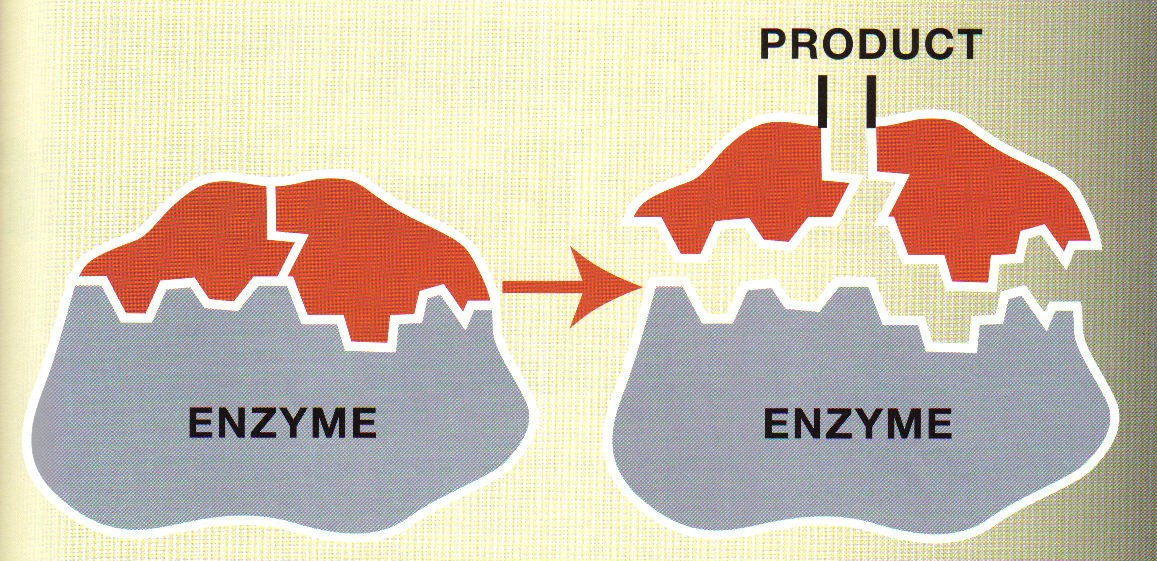
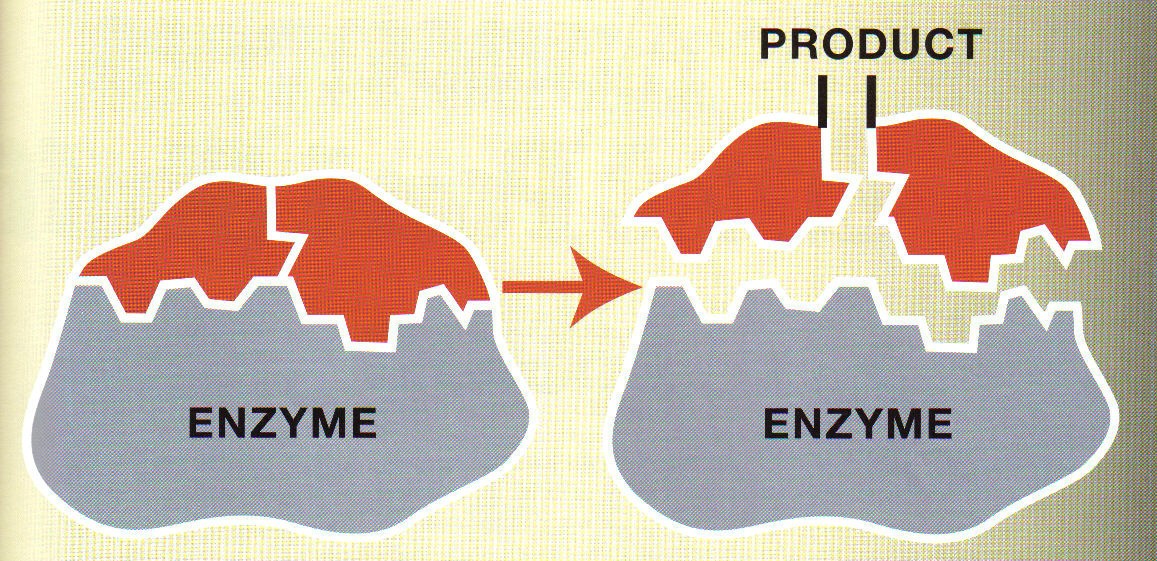
The area that the substrate fits into on the enzyme is called the:
a)
Active Site
b)
Allosteric Site
c)
DiSulphide Bridge
d)
β-Pleated Sheet
22.
Enzymes speed up reaction rates by changing:
a)
Activation Energy
b)
pH
c)
Hydrogen Bonds
d)
Kinetic Energy
23.
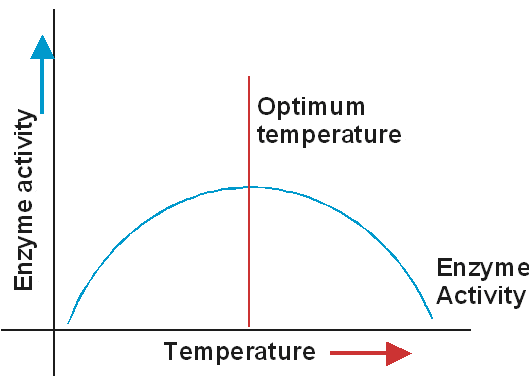
At high temperatures enzyme activity declines because of:
a)
Denaturation
b)
Decreased Kinetic Motion
c)
Increased H-Bonding
d)
Dissociation of Ionic Compounds
24.
 Look at the diagram of a cross-section of a cell membrane below. The cell membrane controls movement of materials into and out of the cell. The following particles are moving from high concentration to low concentration and are using a carrier protein. How would you describe this type of movement across the membrane? 
a)
simple osmosis
b)
active transport
c)
simple diffusion
d)
facilitated diffusion
25.
Look at the cross section of a cell membrane of a eukaryotic cell. H+ ions are being pumped from a low concentration to a high concentration. How do you describe this type of transport across the cell membrane?
a)
active transport
b)
passive transport
c)
facilitated diffusion
d)
co-transport
26.
During diffusion molecules tend to move 
a)
   up the concentration gradient
b)
 from an area of lower concentration to an area of higher concentration
c)
 in a direction that doesn’t depend on concentration
d)
 down the concentration gradient
27.
When particles move from areas of high concentration to areas less concentrated, this has taken place.
a)
diffusion
b)
mitosis
c)
endocytosis
d)
photosynthesis
28.

What does selectively-permeable mean?

a)

Allow certain things to enter and leave the cell

b)

Nothing gets through

c)

The cell lets only large substances through

29.
Which way will the water molecules move during osmosis?
a)
Out of the cell, so the cell shrinks.
b)
Out of the cell, so the cell swells.
c)
Into the cell, so the cell shrinks.
d)
Into the cell, so the cell swells.
30.

Passive transport requires ________________

a)

concentration gradients

b)

no energy

c)

motion

d)

energy

31.

What pigment captures/absorbs sunlight?

a)

stomata

b)

chlorophyll

c)

chloroplast

d)

phloem

32.
Plants need carbon dioxide from their environment to produce glucose during which stage of photosynthesis? 
a)
The light-dependent stage
b)
The light-independent stage (The Calvin Cycle)
c)
The electron transport chain
d)
ATP formation
33.
Where do the light-dependent reactions occur? 
a)
thylakoid membrane
b)
stroma
c)
mesophyll
d)
mitochondria
34.
After intense activity, your muscles feel sore because of 
a)
the accumulation of NAD+
b)
the accumulation of lactic acid 
c)
the accumulation of ATP
d)
the accumulation of carbon dioxide
35.
Fermentation enables glycolysis to continue under 
a)
anaerobic conditions
b)
aerobic conditions
c)
photosynthetic conditions
d)
hydrophobic conditions
36.

Cellular Respiration occurs in what cell organelle?

a)

chloroplast

b)

cytoplasm

c)

mitochondria

d)

animal

37.
Which type of respiration is most efficient?
a)
Aerobic
b)
Anaerobic
38.
Where does glycolysis take place?
a)
Cytoplasm
b)
Stroma
c)
Thylakoid
d)
Mitochondria
39.

A decrease in the amount of oxygen available will....

a)

not have an effect on the amount of energy produced during cellular respiration

b)

decrease the amount of glucose produced during cellular respiration

c)

cause the amount of water produced during cellular respiration to increase

d)

decrease the amount of energy produced during cellular respiration

40.
DNA is replicated during the ______ phase of the cell cycle.
a)
G1
b)
Synthesis
c)
G2
d)
G0
41.
What is the name of the structure labeled X?
a)
Centriole
b)
Centrosome
c)
Chromatid
d)
Chromosome 
42.
a)
Anaphase
b)
Cytokinesis
c)
Telophase
d)
Metaphase
43.

In which cell below would a student likely observe a cell plate during mitosis?

a)

rat muscle cell

b)

alligator stomach cell

c)

onion root cell

d)

human lung cell

44.

Centrioles would most likely be found in ______.

a)

geranium leaf cells

b)

mushroom spore cells

c)

E. coli bacterial cells

d)

human muscle cells

45.
What is it called when a sperm and egg meet?
a)
meiosis
b)
fertilization
c)
cell division
d)
mitosis
46.
What causes genetic variation in meiosis?
a)
chromosomes lining up
b)
crossing over of chromosomes
c)
separation of chromosomes
d)
chromosomes pulling apart
47.
Diploid Cells are represented by
a)
2n
b)
n
c)
4n
d)
1/2 n
48.
The process of crossing over occurs in what phase of meiosis?
a)
anaphase 1
b)
prophase 1
c)
prophase 2
d)
telophase 1
49.

A cat has a total of 40 chromosomes in its body cells. How many in its sex cells?

a)

38

b)

20

c)

76

d)

10

50.

In humans, sperm cell have ___________ chromosomes and are ___________________, while skin cells have _____________ chromosomes are are diploid.

a)

23. haploid. 46 diploid

b)

46. haploid. 23. diploid

c)

23 diploid. 46 haploid

d)

46. diploid. 23. haploid.

51.
Crossing over helps promote ?
a)
male genotype
b)
genetic variation
c)
DNA replication
d)
mitosis
52.
What are the nucleotides made of?
a)
Sugar, Phosphate, nitrogen base
b)
Phosphate, Adenine, nitrogen base
c)
Thymine, Adenine, Cytomine
d)
Phosphate, Nitrogen, Adenine
53.
Adenine bonds with ______________.
a)
Guanine
b)
Thymine
c)
Cytosine
d)
Adenine
54.

In eukaryotes, which organelle is DNA usually found in?

a)

cell membrane

b)

vacuole

c)

chloroplast

d)

nucleus

55.
The two strands of nitrogenous bases in DNA are joined by which type of bond?
a)
polar bonds
b)
ionic bonds
c)
covalent bonds
d)
hydrogen bonds
56.
A long chain of amino acids is a/an
a)
protein
b)
nucleic acid
c)
tRNA
d)
mRNA
57.
If a DNA molecule consists of 29% Guanine, how much cytosine will it contain?
a)
29%
b)
58%
c)
21%
d)
I have no idea.
58.
How does RNA differ from DNA?
a)
RNA contains uracil and deoxyribose
b)
RNA contains ribose and thymine
c)
RNA contains uracil and ribose
d)
RNA contains adenine and ribose
59.
The process by which the genetic code of DNA is copied into a strand of RNA is called
a)
translation
b)
transcription
c)
transformation
d)
replication
60.
In messenger RNA, each codon specifies a particular
a)
nucleotide
b)
enzyme
c)
amino acid
d)
promoter
61.
Which of the following statements is true?
a)
DNA is single-stranded
b)
RNA is single-stranded
c)
DNA contains uracil
d)
RNA contains deoxyribose
62.
What is the template for mRNA?
a)
DNA
b)
tRNA
c)
rRNA
d)
proteins
63.
What is the central dogma of molecular biology?
a)
RNA-protein-DNA
b)
RNA-DNA-protein
c)
DNA-protein-RNA
d)
DNA-RNA-prtein
64.
What mutation has occurred here? 
T-G-A-C-C-A
T-G-A-G-C-A
a)
Substitution
b)
Deletion
c)
Insertion
d)
Frameshift 
65.
Which of the following would result in a frameshift mutation?
a)
Insertions only
b)
Substitution only
c)
Deletion only
d)
Insertions and Deletions
66.

Which Karyotype displays a female with Down syndrome?

a)
b)
c)
d)
67.
This is an example of ___________?
a)
Incomplete dominance
b)
Co-Dominance
68.
This is an example of ___________.
a)
Incomplete Dominance
b)
Codominance
69.

Which chromosome contains more genes?

a)

The X chromosome

b)

The Y chromosome

c)

They are homologous, so they contain the same amount of genes.

70.

Males can be heterozygous for sex-linked traits.

a)

True

b)

False

71.

What would the genotype be of a colorblind male?

a)

XNY

b)

XNYn

c)

XnY

d)

XnYn

72.

Which allele codes for an X-Linked recessive trait?

a)

XT

b)

Xt

c)

YT

d)

Yt

73.

What are the blood types of the possible children that a woman (type O) and man (type AB) can have?

a)

O and AB

b)

O and A

c)

O and B

d)

A and B

74.

What are the 4 possible phenotypes for human blood type?

a)

Type A

b)

Type B

c)

Type BB

d)

Type AB

e)

Type O

75.
Is this trait (the shaded individuals) dominant or recessive?
a)
dominant
b)
recessive
76.
What would the genotype be for the blonde son in generation 2?
a)
BB
b)
Bb
c)
bb
d)
Not enough information 
77.
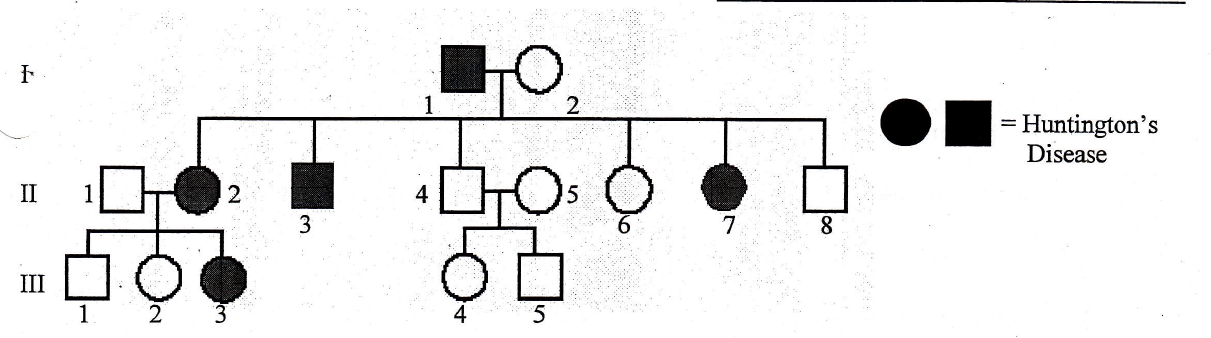
There are no carriers for Huntington's Disease- you either have it or you don't. Is Huntington's disease caused by a dominant or recessive trait?
a)
Dominant
b)
Recessive
78.
Give the genotype for person III-3.
a)
GG
b)
Gg
c)
gg
d)
we cannot be 100% sure of the genotype
79.
What kind of trait is colorblindness if females can be carriers without having the disease?
a)
Regular trait
b)
Sex-linked trait
c)
Co-dominant trait
d)
Incomplete dominant trait